Nov 01


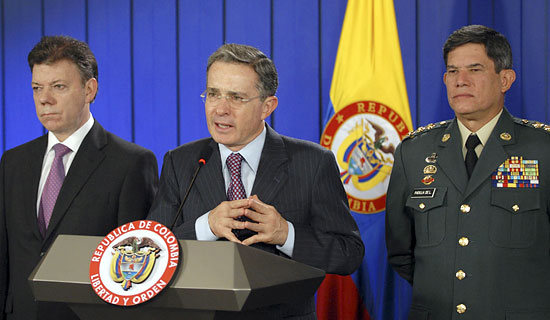
President Alvaro Uribe of Colombia, center, accompanied by Defense Minister Juan Manuel Santos, left, and Chief Army Commander Freddy Padilla, in Bogota on Wednesday. (Miguel Angel Solano/Reuters)

SOACHA, Colombia: Julian Oviedo, a 19-year-old construction worker in this gritty patchwork of slums, told his mother on March 2 that he was going to talk to a man about a job offer. A day later, Oviedo was shot and killed by army troops about 560 kilometers to the north. He was classified as a subversive and registered as a combat kill.

Colombia’s government, the Bush administration’s top ally in Latin America, has been buffeted by the disappearance of Oviedo and dozens of other young, impoverished men and women whose cases have come to light. Some were vagrants, some were street vendors or manual laborers. But their fates were often the same: They were catalogued as insurgents or criminal gang members and killed by the armed forces.

Prosecutors and human rights researchers are investigating hundreds of such deaths and disappearances, contending that the Colombian security forces are murdering civilians and making it look as if they were killed in combat, often by planting weapons on or near their bodies or dressing the corpses in guerrilla fatigues.

With soldiers under intense pressure in recent years to register combat kills to earn promotions and benefits like time off and extra pay, reports of civilian killings are climbing, prosecutors and researchers said, pointing to a grisly facet of this country’s long internal war against leftist insurgencies.

Continue reading »

Tags: , , , , , , ,

Jun 10

(NaturalNews) Prepare to say goodbye to bananas. Do you remember back in the sixties when there was a change in bananas? It wasn’t announced, but those of us who love the fruit did. They became less sweet and creamy — just not as good. There was no information about it. The change seemed to slip under the radar and most of us forgot about it.

That change foretold what’s now coming — the complete death of bananas. No, this is not hyperbole. Bananas are dying, and their death is a precursor of what’s to come if we continue to accept corporate farming. But first, back to the impending loss of bananas.

We tend to think of bananas as a single species with no more than one or two variations on the theme –something like oranges, lemons, limes, and grapefruits that are all variations of a single species. That, though, is far from the truth. Until the mid-eighteen hundreds, most bananas grew wild and local people ate them, though some local cultivation existed. There was a huge variety. Some were sweet and some sour. Some were creamy, while others had a bit of crunch. Some were yellow, but others were red or purple. Today, most of that variety is lost.

Chiquita’s History

During the 1870’s, Minor Keith was a young man from a wealthy railroad company who went to Costa Rica to help build a national railroad. He and other relatives accomplished the task at the cost of 5,000 workers’ lives. He also started planting bananas, a crop that was gaining popularity in the U.S., on the easements along the railway. The Costa Rican government could not make payments on its railroad loans from British banks. Because of his wealth and connections, Keith was able to raise the money to finish the job, largely by negotiating a significant decrease in the interest rate, from 7% down to 2.5%. This put him in the debt of the dictator, whose daughter he had married, so he was granted 800,000 acres of tax-free land along the railroad, where he’d been planting bananas, along with a 99-year lease on the railroad’s operation along that route. Continue reading »

Tags: , , , , , , , , , ,

May 29

BRASILIA: South America is thinking of creating a common currency and a central bank along the lines of those in the European Union’s eurozone, Brazilian President Luiz Inacio Lula da Silva said yesterday.

The idea is a logical next step following the signing last Friday of a treaty creating a Union of South American States that aims to promote joint regional customs and defense policies, Lula said during his weekly radio broadcast.

“Many things still haven’t been realised. We are now going to create a Bank of South America. We are going to move forward so in the future we’ll have a single central bank, a common currency,” he said.

But, he added: “This is a process. It won’t be something that happens quickly.”
Argentina, Bolivia, Brazil, Chile, Colombia, Ecuador, Guyana, Paraguay, Peru, Suriname, Uruguay and Venezuela all signed up to the Unasur treaty creating the regional union during a ceremony in Brasilia last Friday. Continue reading »

Tags: , , , , , , , , , , , ,

Mar 07

March 5, 2008 — CUCUTA, Colombia - Venezuela and Ecuador reinforced their borders with Colombia yesterday as the three nations traded increasingly bitter accusations over Colombia’s cross-border strike on a leftist guerrilla base in Ecuador.Rejecting a Colombian apology as insufficient, Ecuador sought international condemnation of the attack during an emergency meeting of the Organization of American States, convened in Washington to help defuse one of South America’s most volatile crises in years. Continue reading »

Tags: , , , , , , ,

Mar 06

(Reuters) - President Hugo Chavez warned Colombia on Saturday it would be a “cause for war” if its forces struck inside Venezuelan territory as they did in Ecuador killing a top Colombian rebel commander there.“Don’t be thinking that you can do that here … because it would be extremely serious and would be a causa belli, a cause for war, (if there is) a military incursion in Venezuelan territory. There’s no excuse,” Chavez said in his most belligerent comments to date in a diplomatic dispute with Bogota.

Colombia’s military said troops killed Raul Reyes, a leader of Marxist FARC rebels, during an attack on a jungle camp in Ecuador in a severe blow to Latin America’s oldest guerrilla insurgency. The operation included air strikes and fighting with rebels across the border.

Chavez has been at odds with U.S.-backed Colombian President Alvaro Uribe over the Venezuelan’s mediation with the FARC, or the Revolutionary Armed Forces of Colombia, over the release of hostages held by the rebels.

The outspoken, anti-U.S. Chavez has called Uribe a pawn of the United States in the superpower’s plans to attack Venezuela. Colombia and the United States deny the accusation from Chavez who regularly says without providing evidence that Washington is plotting his ouster.

Chavez has withdrawn his ambassador from Bogota and in recent weeks insulted Uribe during his speeches.

(Reporting by Patricia Rondon; Writing by Saul Hudson; Editing by Peter Cooney)

Source: Reuters

Tags: , , , ,