On 1/23/2013, Fukushima Diary reported “Radiation level of Japanese cedar is 20 times much as back ground, Tokyo to have 5~6 times much as pollen this year” [URL 1].
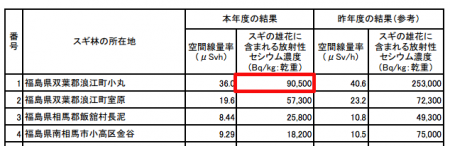
According to the Forestry Agency, 90,500 Bq/Kg of cesium-134/137 was measured from the pollen of Japanese cedar. The sample was taken in Namie machi Fukushima.
They surveyed from 11/6/2012 to 12/26/2012.
The Forestry Agency comments the radiation level decreased to be about half of 2012, but they are still in high level to reach metropolitan area.
Baobab trees, like this giant in Tanzania, are under threat from land clearing, droughts, fungal pathogens, and overharvesting of their bark for matweaving by local villagers. (Credit: Photo by Bill Laurance)
The largest living organisms on the planet, the big, old trees that harbour and sustain countless birds and other wildlife, are dying.
A report by three of the world’s leading ecologists in today’s issue of the journal Science warns of an alarming increase in deathrates among trees 100-300 years old in many of the world’s forests, woodlands, savannahs, farming areas and even in cities.
“It’s a worldwide problem and appears to be happening in most types of forest,” says lead author Professor David Lindenmayer of the ARC Centre of Excellence for Environmental Decisions (CEED) and Australian National University.
“Large old trees are critical in many natural and human-dominated environments. Studies of ecosystems around the world suggest populations of these trees are declining rapidly,” he and colleagues Professor Bill Laurance of James Cook University, Australia, and Professor Jerry Franklin of Washington University, USA, say in their Science report. Continue reading »
Researchers have discovered that there’s enough power in living trees to run an electric circuit.
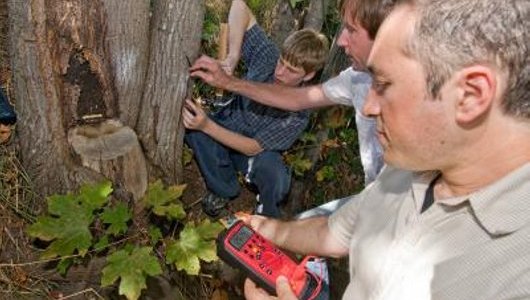
TREE POWER: Engineers Babak Parviz and Brian Otis demonstrate with students how a device can be plugged into a tree for power. (Photo: University of Washington)
In today’s world of high-tech portable gadgets, iPods and cell phones, we’ve become dependent upon readily accessible electric outlets to power our devices and charge our batteries. But now researchers at the University of Washington have discovered nature’s alternative to the power outlet: living trees.
That’s right, living trees. UW engineers Babak Parviz and Brian Otis have invented an electrical device that can be plugged directly into any tree for power. “As far as we know this is the first peer-reviewed paper of someone powering something entirely by sticking electrodes into a tree,” said Parviz.
The research was based upon a breakthrough study last year out of MIT, when scientists found that plants generate a voltage of up to 200 millivolts when one electrode is placed in a plant and the other in the surrounding soil. Those researchers are already designing devices which act as forest sensors powered entirely by this new method. But until now, no one has applied these findings to the development of tree power.
Genetically modified food is certainly a well known issue, but genetically modified trees? Not so much. But nevertheless they are being developed, and at the UN Convention of Biodiversity, in Hyderabad, India, a coalition of green groups is urging a global ban on them.
The forestry industry is developing GM trees for use in its industrial plantations, in order to achieve trees that can grow faster, have reduced lignin content for production of paper or agrofuels, are insect or fertilizer resistant, or can grow in colder temperatures. This research is aimed at increasing their own profits while exacerbating the already known and very serious impacts of large scale tree plantations on local communities and biodiversity.
Title: Planting The Seeds Of Comeback
Source: NHK
Upoaded by: MissingSky101
Upload Date: Oct 16, 2012
Fukushima, 60 km from Fukushima Daiichi
How does radiation affect fruit trees?
Here’s a sample of peach branches and fruit. Black areas indicate the high level of radiation. A large amount of radiation was found on the surface of the branches and fruit in particular.
The Ghirardi Compton Oak has been a piece of League City’s history for over 100 years. The tree stands 56 feet tall, has a canopy that is over 100 feet wide, and is 135 inches around. It also weighs an incredible 518,000 pounds. A county road widening project put the future of the Ghirardi Oak in jeopardy. Council voted to use park dedication funds to hire Hess Landscaping Construction to move the majestic oak. A project that took them just under a month to complete. Watch the incredible process from start to finish in this video.
“One of the big things in my life was to try to make a living at something that I liked…on that I didn’t sell out on.” …Mike Garnier
I have a gem for you today folks. Mike Garnier moved to Oregon to put down roots after Vietnam but his desire to make a living working with wood initially ran into one disappointment after another.
Eventually, he raised his sights, literally, to the trees on his property. The rest is now history. He’s the king of Tree House mountain.
Mike owns more tree houses than anyone on the planet. And if you don’t think that’s a big deal, watch the video.
As I began watching the video for the first time myself, I knew right away I was going to feature it on VT just for the great treehouse story alone.
The first bullet quote that had me diving for a notebook was,
“I had to figure out how to make a living off the trees without cutting them down.”
I said to myself maybe we have the spirit of Will Rogerslurking is this old vet. But as I got further into it I saw a gleaming example of what a man looks like who is doing exactly what he wants to do.
The video was a gift from heaven because to use the term ‘looks like’ you have to be able see him and hear the story from the horse’s mouth. We should all be so lucky, and fortunately some of us are.
So tonight we have an adjusted version of VT Weekend Movies in the genre I have used already a few times, climbing into someone else’s shoes and life for a few minutes.
We had a lot of fun doing the one with the UFO Welcome Center in South Carolina. Jody Pendarvis and Mike are both characters, in different ways…but they share a sparkle in their eyes as they take you on their respective magical mystery tours, and never seem bored by it. Mike still serves Fantasy Flakes for breakfast and entertains his guests with his early mechanical psychedelic trip contraption.
But building his own world in the trees involved more than the money, labor and the heart to do it. Mike had to fight the local government for almost ten years before gaining the right to house guests in his nine treehouses. Josephine County building inspectors didn’t believe that it was structurally sound, so he gathered 66 people, two dogs and a cat (collectively weighing 10,847 pounds) in a single treehouse.
Despite this convincing neighborhood test the county demanded that he tear the treehouses down. Mike ignored them, and when they objected to him charging money to stay in the treehouses, Garnier then allowed visitors to stay for free, with the requirement that they buy a $75 t-shirt first.
The resulting legal battle lasted ten years, with Garnier attaching a steel cable zip line to his bedroom window in case of the need for a midnight escape. In 2001, the county relented and granted Garnier his building permits.
The old saying goes, “You can’t keep a good man down”, and that was literally the case for brother Mike. Our thanks go out to the people that made the video. Print does not do this story justice. Multimedia was invented to serve the internet audience. I hope to be talking to Mike about doing some radio on our VT affiliates.
If you want to be successful, it’s just this simple. Know what you are doing. Love what you are doing. And believe in what you are doing…Will Rogers
In 1974, fresh out of the army (as a Green Beret medic), Michael Garnier went to rural Oregon to try to make a living off the woods. He tried making furniture, fences, pole barns and selling organic, psychedelic picture propellers (to see Fantasy Flakes), but finally it was a treehouse that got him all the attention.
A chance for grownups to be kids again
Modeled after the treehouse he had once built for his kids, his first treehouse B&B was completed in 1990 and people began paying to stay…
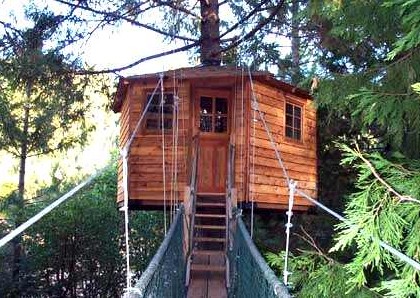
…Today he has 9 treehouses for rent, 20 staircases, 5 or 6 bridges, several platforms and zip lines for rapid descent and at least one fireman’s pole. Some of his treehouses even have toilets, running water and showers, though he warns guests to “stand when they flush”.
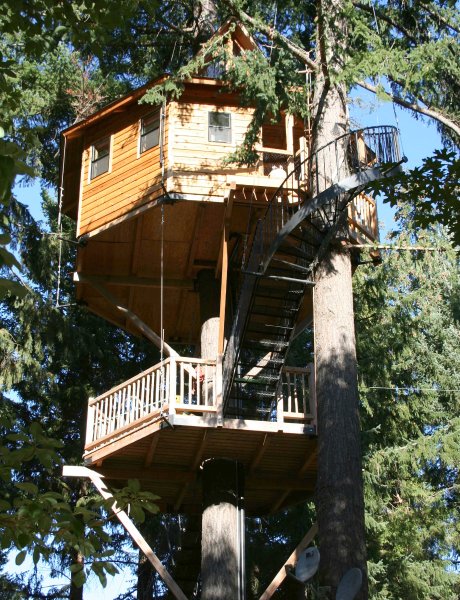
Garnier claims to have the tallest treehouse in the world. His Treezebo stands 37 feet, or 6 stories, above the ground (He also claims that his personal home is the largest treehouse in the world).
STOCKHOLM, May 29, 2012 (IPS) – The home furnishing giant Ikea, founded in Sweden in 1943, is facing heavy criticism for the logging and clear-cutting of old-growth forests in the north of Russian Karelia by its wholly owned subsidiary Swedwood.
According to leading environmental organisations, such logging is destroying ancient and unique forests that have a high conservation value.
Dr. Satoshi Mori of Tokyo University has a radioautograph of Japanese cypress leaves that he took from Iitate-mura in Fukushima Prefecture last year in his blog. He says he cannot help feeling pity for the tree:
This picture of Japanese cypress cultivated in Komiya District of Iitate-murawas was taken in the fall of last year. I also took the leaves and female cones at the height I was able to reach. Continue reading »