MUST-SEE!
Watch the video here:
– Dr. Helen Caldicott (Co-Founder Of Physicians For Social Responsibility): What We Learned From Fukushima (Video – April 2, 2012)
The man who trades freedom for security does not deserve nor will he ever receive either. – Benjamin Franklin
MUST-SEE!
Watch the video here:
– Dr. Helen Caldicott (Co-Founder Of Physicians For Social Responsibility): What We Learned From Fukushima (Video – April 2, 2012)
MUST-SEE!
Watch the video here:
– Dr. Helen Caldicott (Co-Founder Of Physicians For Social Responsibility): What We Learned From Fukushima (Video – April 2, 2012)
Helen should really educate herself about global warming and about the elitists who really run our governments, MSM and the corporations.
Other than that THANK YOU so much Dr. Helen Caldicott!!!
MUST-SEE!
YouTube Added: 04.04.2012
Description:
Dr. Helen Caldicott: If Spent Fuel Pool No. 4 collapses I am evacuating my family from Boston.
Few people know that the Pacific Northwest got whacked hard by fallout from the Fukushima disaster with radiation rates hundreds of thousands of times higher than normal background radiation.
The damage from this is not something that the corporate media or the government is talking about. It mysteriously disappeared from the radar almost immediately.
Dr. Caldicott referred to this as a process of “cover-up and psychic numbing.” Looks like it may be working.
The Nuclear Regulatory Commission just approved two new nuclear power plants this week (4/2/12) in South Carolina in addition to the two approved earlier this year in Georgia.
Dr. Caldicott talks about the dangers and hidden costs of nuclear power then tells the awful truth in minute detail about the actual scale of the Fukushima disaster and compares it to the nuclear disasters of Chernobyl and Three Mile Island.
Recent studies estimated that a million people have died so far from Chernobyl.
Dr. Helen Caldicott is a physician, Nobel Peace Prize winner, noted author, anti-nuclear power advocate and has founded numerous national and international groups which oppose nuclear power & weapons, including Physicians for Social Responsibility.
More info:
– The Radiation Warnings You Won’t Get From MSM And Your Traitor Government
YouTube Added: 27.12.2011
Description:
Dr. Chris Busby interviewed 20th December 2011 by Theo Chalmers on Sky TV’s “One Step Beyond” about Fallujah, Fukushima and the cover-ups over the health effects of exposure to radioactivity.
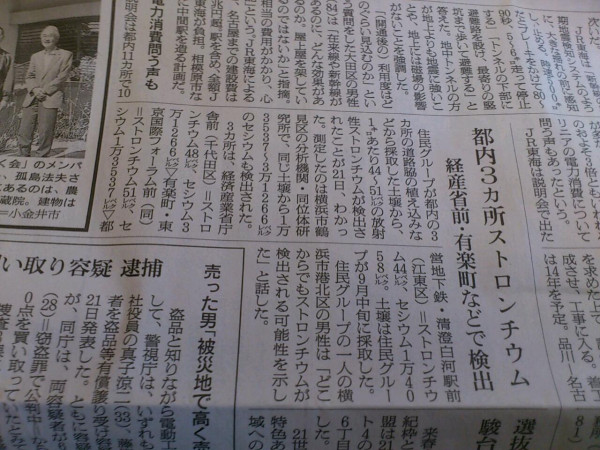
– Just In: 348 Bq/Kg of Strontium Discovery in Tokorozawa City in Saitama? (EX-SKF, Dec. 16, 2011):
For now, the information is via the tweets of people who watched the press conference online.
It was during the question by Yasumi Iwakami, independent journalist, during the press conference at the Nuclear and Industrial Safety Agency, who has declared there was/is/will be no water leak from Fukushima I Nuke Plant.
348 becquerels/kg of radioactive strontium was discovered in Tokorozawa City in Saitama Prefecture, according to Iwakami.
See also:
– Fukushima Water Purifying System HAS NEVER WORKED!:
Now the gutter is directly connected to the sea.
– Fukushima radioactive water ‘leaked into Pacific’ (AFP, Dec. 6, 2011):
TOKYO — Highly radioactive waste water from a crippled Fukushima nuclear plant has leaked to the Pacific, its operator said Tuesday, promising to prevent similar incidents.
Tokyo Electric Power Co. (TEPCO) said it believes 150 litres (40 US gallons) of waste water including highly harmful strontium, linked with bone cancers, has spread to the open ocean.
The announcement came a day after TEPCO said it found 45 tonnes of waste water pooled around the leaky water-treatment system at the Fukushima Daiichi nuclear plant.
TEPCO said Monday it believed about 300 litres of waste water have escaped and run into a nearby gutter that leads to the ocean before crews could contain the leaks.
The water leaked to the sea is believed to contain 26 billion becquerels of radioactive materials, TEPCO said.
The company said, however, human health should not be affected even after eating sea food caught in the area for every day for one year.
“We again sincerely apologise for causing worries and troubles to the area residents as well as the society at large for releasing water containing radioactive materials,” TEPCO said in a statement.
In the weeks after the March 11 earthquake and tsunami hit the plant, TEPCO dumped 10,000 tonnes of lower-level radioactive water into the Pacific Ocean.
Read moreFukushima: TEPCO Admits Radioactive Strontium-90 ‘Leaked Into Pacific’
See also:
– Japanese Scientists Call For Dumping Radioactive Soil Into Sea
Imagine my total absence of shock.
– Fukushima plant leaks radioactive water (Guardian, Dec. 5, 2011):
Radioactive water might have found its way into the Pacific ocean and experts believe it could contain strontium
Large quantities of highly radioactive water have leaked through a crack in the wall of a treatment facility at the Fukushima power plant, and some may have founds its way into the sea, the plant’s operator, Tokyo Electric Power [Tepco], said.
The firm said as much as 45 tonnes of water had leaked through the concrete wall of a building being used to purify contaminated water that is then used to cool molten fuel in the plant’s three damaged reactors.
The firm has piled up sandbags to prevent further leaks but fears some water may have already found its way into a gutter that connects to the Pacific ocean about 600 metres away.
Experts believe the water could contain high levels of strontium-90, a beta-emitting radioactive substance that, if ingested, can cause bone cancer.
Read moreFukushima Nuclear Plant Leaks Large Quantities Of Highly Radioactive Water
– Radioactive Strontium Found in Central Tokyo (EX-SKF, Nov. 21, 2011):
(UPDATE-2) Asahi Shinbun carried the news:
(UPDATE) So far, it is dead silence from the Japanese MSMs; even the critical papers like Tokyo Shinbun is mum on strontium in Tokyo.
—————————————————-
A citizen group did the soil survey of three locations in central Tokyo, and had the soil samples tested for radioactive cesium and strontium. All three had both.
Summary of reporting by Yasumi Iwakami, independent journalist:
Locations and amounts of radioactive materials:
Kiyosumi Shirakawa Station, Koto-ku:
Radioactive cesium (134 and 137 combined): 19,126 Bq/kg
Radioactive strontium (89 and 90 combined): 44 Bq/kgYurakucho Station, Chiyoda-ku:
Radioactive cesium (134 and 137 combined): 20,955 Bq/kg
Radioactive strontium (89 and 90 combined): 51 Bq/kgFront of the Ministry of Economy, Trade and Industry, Chiyoda-ku:
Radioactive cesium (134 and 137 combined): 48,176 Bq/kg
Radioactive strontium (89 and 90 combined): 48 Bq/kgIt’s a poetic justice that the amount of radioactive cesium is the highest at METI. I hear TEPCO’s headquarter building in Tokyo also enjoys rather high radiation.
From the article:
Does that mean that NOW 25 years after Chernobyl those people are getting seriously ill who were back then exposed to low-level radiation?
Yes, indeed. Those who have been adults back then survived 25 years and are NOW getting sick. We call it the silent death. Those who have been children back then got sick a lot earlier – often times with fatal consequences.
…
How do I have to imagine life in those contaminated areas?
Life? Above all there is death, silent death, mainly cancer. People die of all sorts of diseases related to Strontium, affecting for example the heart muscle, whose energy becomes dysfunctional. We have studies from Belarus documenting that already 2-year-old to 4-year-old children die of acute heart failure. It does not have to be cancer. The people die of kidney and liver failure and all kinds of blood diseases, also known as ‘Chernobyl AIDS’.
Now compare that to what the Japanese people are being told by their elite puppet government:
– NHK Calls 20 Millisieverts/Year ‘Low-Level Radiation’ & The Lies Of Minister Goshi Hosono
Dörte Siedentopf is a member of International Physicians for the Prevention of Nuclear War (IPPNW), which is a non-partisan federation of national medical groups in 63 countries, representing tens of thousands of doctors, medical students, other health workers, and concerned citizens who share the common goal of creating a more peaceful and secure world freed from the threat of nuclear annihilation. The organization’s headquarters is in Somerville, Massachusetts.
English summary by Fukushima Diary’s Mochizuki at the end of this article.
– Das leise Sterben – Horrorszenario wartet auf Japan (NTV, March 19, 2011):
Dörte Siedentopf bereist seit 20 Jahren verstrahlte Regionen rund um Tschernobyl. Dort und auch hier in Deutschland hilft sie Betroffenen der Katastrophe. Siedentopf ist Mitglied des IPPNW, der internationalen Ärztevereinigung für die Verhütung des Atomkrieges. Mit n-tv.de spricht sie über das traurige Leben und leise Sterben in den Dörfern Weißrusslands und über das, was auf die Japaner nach dem Reaktorunfall von Fukushima zukommen könnte.
n-tv.de: Aus Ihren Erfahrungen, die Sie seit 20 Jahren mit den Strahlenopfern von Tschernobyl machen, wüsste ich gerne von Ihnen, was auf die Menschen in Japan zukommt.
Dörte Siedentopf: Neben den ganz akuten Verstrahlungen, denen die Liquidatoren, also die Arbeiter im Atomkraftwerk, ausgesetzt sind und deren Schicksal sich jeder ausmalen kann, gilt unser Augenmerk insbesondere jenen Tausenden oder Hunderttausenden von Menschen, die der Niedrigstrahlung ausgesetzt sind. Bei all den schlimmen Bildern dieser Katastrophe und den Geschichten über jene Männer, auf die ein mehr oder weniger schneller Tod oder ein langes Siechtum wartet, vergessen wir viel zu schnell die Erkrankungen, die sich über Jahre in den Körpern der Niedrigverstrahlten ausbreiten.
Gibt es schon konkrete Angaben über eine atomare Verseuchung im Umfeld der Kraftwerke von Fukushima?
Verlässliche Informationen dazu gibt es leider kaum. Jüngst erreichten uns Nachrichten, wonach Cäsium an die Umwelt abgegeben worden sein. Dies möchte mal als ein Beispiel heranziehen: Das Cäsium ist dem Kalium biologische ähnlich und der menschliche Körper kann nicht zwischen dem guten Kalium und dem Cäsium unterscheiden. Der Körper nimmt es über die Atmung und die Nahrung auf. Man kann sich nicht davor schützen. Nach der Aufnahme baut sich das Cäsium selbstständig in die Körperzellen ein und zerstört dort den Energiehaushalt der Zellen. Dabei ist es völlig unerheblich, ob es sich um Leber-, Nieren- oder Hirnzellen handelt. Diese befallene Zelle stirbt ab, nachdem sie vorher noch ihre Nachbarzellen in Mitleidenschaft zieht. Damit beginnt ein unheimlicher Kreislauf. Wie das Leben mit einer Zelle beginnt, beginnt in diesem Fall auch das Sterben.
Wie hoch ist denn die Latenzzeit des eingebauten Cäsiums?
Das hängt davon ab, wer das Cäsium aufnimmt. Kinder sind mehr gefährdet, weil sich ihre Zellen pausenlos teilen. Weil sie wachsen, benötigen sie dauernd Energie und müssen dauernd mit der Schädigung ihrer Zellen zurechtkommen. Erwachsene, die weniger Zellenteilungen insgesamt haben, weil ihre Organe schon ausgewachsen sind, sind zunächst nicht so schlimm gefährdet. Bei Kindern treten die bösartigen Erkrankungen demnach schneller auf – bereits nach einem bis vier Jahren, wie wir von Tschernobyl wissen. Bei Erwachsenen beträgt die Latenzzeit 20 bis 25 Jahre.
Das heißt, dass jetzt, 25 Jahre nach Tschernobyl jene Menschen schwer erkranken, die damals der so genannten Niedrigverstrahlung ausgesetzt waren?
Ja, so ist es. Die damaligen Erwachsenen haben 25 Jahre überlebt und werden jetzt krank. Wir sprechen vom leisen Sterben. Die damaligen Kinder sind schon viel früher erkrankt – oft mit tödlichem Ausgang.
Was bedeutet das für die Fortpflanzung der Menschen?
Read moreSilent Death – Horror Scenario Awaits Japan (The Low-Level Radiation Myth Exposed)
Find supplements that do not contain artificial sweeteners like Aspartame.
Chris Busby updates Japan on what to do to reduce the risk of radiation damage from the contamination from the Strontium-90, Uranium and Plutonium dispersed widely over northern Japan.
First of all, evacuate the children and evacuate yourselves. The contamination of the ground and the food is a serious health hazard. Car air filter analysis shows the material on the ground becomes airborne and can be inhaled.
Get away If you can; but if not not then you can reduce the access of these radionuclides to the DNA. It is basic Physical Chemistry that increasing the Calcium concentration, (Calcium which stabilises the DNA phosphate backbone), will inhibit the equilibrium binding of radionuclides like Strontium, Uranium, Plutonium and other high DNAP affinity elements and complex ions.
Read moreProf. Chris Busby Update On Supplements To Block Fukushima Radiation (Video)
Oh, sure!
And I bet they will have to find a lot of ‘unidentified substances in bottles’ all over Japan soon.
More on Tokyo here.
And these ‘radiation terrorists’ sprinkle everything with Strontium-90:
– News: This is where strontium is … It actually looks like everywhere (Fukushima Diary, Oct. 12, 2011)
– Tokyo’s Setagaya Says Radiation Spike Unlikely From Fukushima (Bloomberg, Oct. 13, 2011):
Tokyo’s Setagaya district officials said an investigation today of a “high” radiation reading in the area indicates it may not have come from the crippled Fukushima reactors.
The district in the western part of the capital said earlier today it will expand tests in 258 locations after a local resident alerted authorities to a radiation spike that required partially blocking off a sidewalk to the public.
Investigators entered an unoccupied house alongside the sidewalk and radiation readings led them to remove floorboards where they found a case of unidentified substances in bottles, public broadcaster NHK reported.
“When a dosimeter was brought close to the bottles the radiation readings exceeded the limit of the device,” Setagaya Mayor Nobuto Hosaka said in a press conference carried by NHK. No further details were given on the possible contents of the bottles.
The reading was more than 30 microsieverts per hour, NHK reported, which equates to a dose of 157.7 millisieverts per year, or more than 150 times the internationally recommended safety level for the general public, according to a Science Ministry formula.
The discovery follows a flurry of reports this week on a rise in radiation readings in Tokyo and Yokohama, indicating fallout from the Fukushima nuclear disaster has formed “hot spots” in the cities.
Read moreTokyo’s Setagaya Officials: Radiation Spike Unlikely From Fukushima
– (UPDATED) Strontium-90 Discovered in Yokohama City, 245 km from Fukushima I Nuke Plant (EX-SKF, Oct. 9, 2011):
Details in the mail magazine by the independent journalist Yasumi Iwakami (paid subscription). I’m asking if I could translate and post it here.
The number is 195 becquerels/kg, more than 150 times more than the background (1.2 becquerels/kg).
This is probably the lower of the two samples; the other sample is currently being analyzed.
As far as the Ministry of Education is concerned, the southern most detection of strontium-90 was in Shirakawa City, 79 kilometers from the plant. The Ministry doesn’t have a plan to test for strontium or plutonium outside the 80 kilometer radius.
Read moreStrontium-90 Discovered in Yokohama City, 245 Km From Fukushima Nuclear Plant
See also:
– 300,000 Bq/m² of Radioactive Cesium at Okutama Region Where Tokyo’s Drinking Water Comes From
– Japan: New Government Maps Show Wide Dispersion of Plutonium and Strontium
“Professor Nojiri Mihoko stated, plutonium, uranium, they never fly further than 20km by such a little explosion.”
Flashback:
These heavy particles were also detected in Hawaii and the Pacific Northwest …
– Tokyo on the edge (Fukushima Diary, October 10th, 2011):
From 36:00~
Strontium 90 was measured in Yokohama, Kouhokuku. (5 mins by car from my apartment.)
In the simplest put, it’s over.
The amount was 195 Bq/kg.
Detected by a university staff teaching engineering, so the measurement is trustworthy.
It has nothing to do with the historical world-wide nuclear test, because it was measured on the roof of and apartment, which was built only 5 years ago.
Now the test result was sent to Yokohama city government.
Read moreTokyo On The Edge: 195 Bq/Kg Strontium-90 Detected – Simply Put: ‘It’s Over’
– Ministry of Education Maps of Plutonium and Strontium Show Wide Dispersion of Supposedly Heavy Nuclides (EX-SKF, Sep. 30, 2011):
On September 30 the Ministry of Education and Science posted the blurry maps plotting the locations where plutonium and strontium have been detected.
(On the same day, September 30, the national government abolished the evacuation-ready zone between the 20 and 30 kilometer radius from the plant, “allowing” the residents to return.)
Read moreJapan: New Government Maps Show Wide Dispersion of Plutonium and Strontium
Here are two excellent lists on what you can do to protect yourself from radiation:
– How To Decrease Radiation Illness And Protect Yourself From Radiation
– Dr. Rima Laibow Recommends What to Do About Radiation
Related info:
– Vermont finds contaminated fish as nuclear debate rages (Reuters, Aug 2, 2011):
* Vermont Yankee could close by March 2012
* Entergy fighting for reactor survival
NEW YORK, Aug 2 (Reuters) – Vermont health regulators said
on Tuesday they found a fish containing radioactive material in
the Connecticut River near Entergy’s (ETR.N) Vermont Yankee
nuclear power plant which could be another setback for Entergy
to keep it running.The state said it needs to do more testing to determine the
source of the Strontium-90, which can cause bone cancer and
leukemia.
Fukushima Warning (Translated) w/ Chris Busby HOT PARTICLES
YouTube Added: 14.07.2011
– #Fukushima I Nuke Plant: Radioactive Strontium from Ocean Soil Off the Plant (EX_SKF, June 25, 2011):
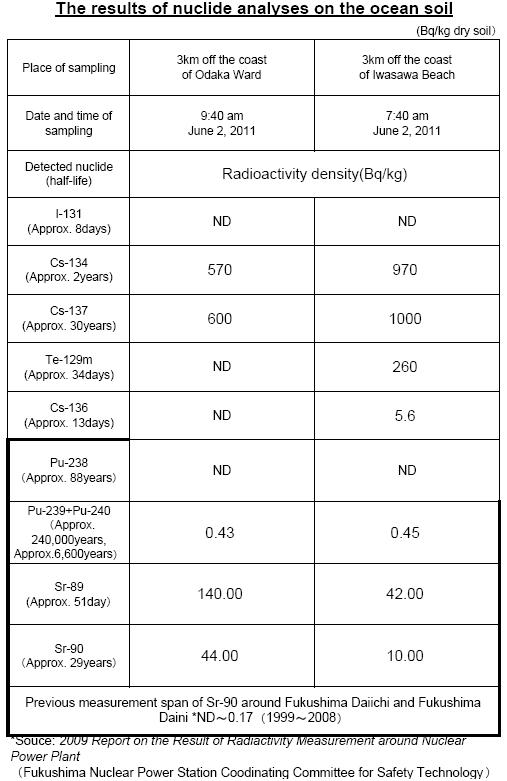
Strontium-89 and strontium-90 have been detected in soil and ocean water, but for the first time they have been detected in ocean soil 3 kilometers off the coast where Fukushima I Nuclear Power Plant is located. The samples from 2 locations were taken on June 2.
The Ministry of Education and Science have announced the detection of radioactive cesium from the ocean soil, but has been silent about strontium.
Strontium-89 (half-life 51 days) was detected at 140 becquerels/kg at one location (off Minami-Soma City), 42 becquerels/kg at the other (off Naraha-machi). Strontium-90 (half-life 29 year) was detected at 44 becquerels/kg at one location, 10 becquerels/kg at the other.
There is no safety standard set for radioactive strontium. The amount detected in regular sampling surveys from 1999 to 2008 at Fukushima II (not I) was ND (not detected) to 0.17 becquerel/kg.
The survey also detected a minute amount of plutonium-239+plutonium-240.
Clearly, no one cares any more in Japan. No major news outlet carried the news, not at least on line. The only paper that carried this news was the Japan Communist Party’s newspaper, Akahata (red flag).
Here’s TEPCO’s press release on June 25, 2011:
– High level of strontium found at Fukushima plant (Japan Times/Kyodo News, June 13, 2011):
Radioactive strontium up to 240 times the legal concentration limit has been detected in seawater samples collected near an intake at the crippled Fukushima Daiichi nuclear plant, Tokyo Electric Power Co. said Sunday.
The utility said the substance was also found in groundwater near the plant’s Nos. 1 and 2 reactors. The government’s Nuclear and Industrial Safety Agency said it is the first time that the substance has been found in groundwater.
Read moreFukushima: Radioactive Strontium Up To 240 Times Legal Concentration Detected In Seawater
Added: 12.06.2011
Original estimates of xenon and krypton releases remain the same, but a TEPCO recalculation shows dramatic increases in the release of hot particles. This confirms the results of air filter monitoring by independent scientists.
Fairewinds’ Arnie Gundersen explains how hot particles may react in mammals while escaping traditional detection. Reports of a metallic taste in the mouth, such as those now being reported in Japan and on the west coast, are a telltale sign of radiation exposure.
See also:
– Land Around Fukushima Now Radioactive Dead Zone, Radiation Levels Similar To Nuclear Bomb Test Site
– #Radioactive Strontium from Soil Within 10 Kilometers of #Fukushima I Nuke Plant:
A slow dribbling of information on the extent of radiation contamination, so that people in Japan don’t connect the dots and figure out that their soil, water, ocean have probably been contaminated beyond repair.
It took the Ministry of Education and Science one month to announce the test result, just like when it announced the result for the locations 30 kilometers away from the plant back in mid April.
Asahi Shinbun (6/1/2011):
???????????????????????????????????????????????????????????????????????????????
The Ministry of Education and Science announced on May 31 that the radioactive strontium-90 was detected from the soil samples at 4 locations in Okuma-machi and Futaba-machi, the towns located inside the 10-kilometer radius from Fukushima I Nuke Plant.
Read moreRadioactive Strontium Found 10 km From Fukushima Plant
On Plutonium:
– Dr. Helen Caldicott (Co-founder of Physicians for Social Responsibility):
You’ve bought the propaganda from the nuclear industry. They say it’s low-level radiation. That’s absolute rubbish. If you inhale a millionth of a gram of plutonium, the surrounding cells receive a very, very high dose. Most die within that area, because it’s an alpha emitter. The cells on the periphery remain viable. They mutate, and the regulatory genes are damaged. Years later, that person develops cancer. Now, that’s true for radioactive iodine, that goes to the thyroid; cesium-137, that goes to the brain and muscles; strontium-90 goes to bone, causing bone cancer and leukemia. It’s imperative … that you understand internal emitters and radiation, and it’s not low level to the cells that are exposed. Radiobiology is imperative to understand these days.”
– Dr. Rima Laibow:
“Plutonium is the deadliest substance on the planet since 1 molecule of Plutonium in your body guarantees the development of cancer, according to radiation medicine experts.”
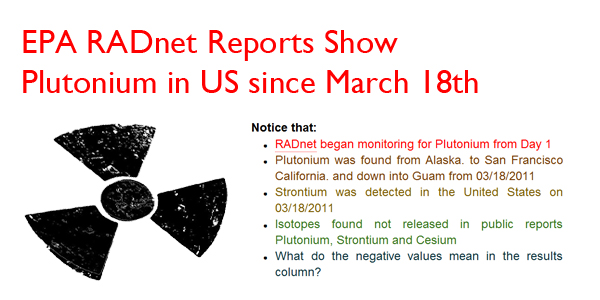
We found a more complete RADnet dataset for various radioactive isotopes we had previously not encountered.
[…]
Recently while searching the EPA RADnet database for radiation reports, we found a link to the main database. It included the RADNet monitoring data for many isotopes not released in the public reports.
Notice that:
Update 12:01 EST April, 22nd 2011
Here are the results for Plutonium.
All results were detected by actinides extraction chromatography as part of either the RadNet Radiation Network Alert or the Fukushima deployables.
To fit the data on the web page I have moved some redundant columns .
I removed the half-life column which the EPA results report as 24131 years for Plutonium-239 and for 87.75 years for Plutonium-238.
I have also removed the unit column as all amounts reported are pCi/m3 or picocuries per cubic meter.
| CITY | STATE | COLLECT END | RESULT DATE | ANALYTE NAME | AMOUNT |
|---|---|---|---|---|---|
| GUAM | GU | 3/19/2011 | 3/31/2011 | Plutonium-239 | 0.000012 |
| SAIPAN | CNMI | 3/21/2011 | 3/31/2011 | Plutonium-239 | 0.000009 |
| SAN FRANCISCO | CA | 3/18/2011 | 3/24/2011 | Plutonium-239 | 0.0000065 |
| NOME | AK | 3/20/2011 | 3/31/2011 | Plutonium-238 | 0.0000035 |
| SEATTLE | WA | 3/18/2011 | 3/24/2011 | Plutonium-238 | 0.0000025 |
| RIVERSIDE | CA | 3/15/2011 | 3/24/2011 | Plutonium-238 | 0.0000013 |
| RIVERSIDE | CA | 3/15/2011 | 3/24/2011 | Plutonium-239 | 0.0000013 |
| SAIPAN | CNMI | 3/21/2011 | 3/31/2011 | Plutonium-238 | 0 |
| SAIPAN | CNMI | 3/24/2011 | 3/31/2011 | Plutonium-239 | 0 |
| NOME | AK | 3/20/2011 | 3/31/2011 | Plutonium-239 | 0 |
| SEATTLE | WA | 3/18/2011 | 3/24/2011 | Plutonium-239 | -0.0000013 |
| ANAHEIM | CA | 3/15/2011 | 3/24/2011 | Plutonium-239 | -0.0000015 |
| DUTCH HARBOR | AK | 3/19/2011 | 3/31/2011 | Plutonium-239 | -0.0000023 |
| ANAHEIM | CA | 3/15/2011 | 3/24/2011 | Plutonium-238 | -0.000003 |
| SAN FRANCISCO | CA | 3/18/2011 | 3/24/2011 | Plutonium-238 | -0.0000037 |
| KAUAI | HI | 3/21/2011 | 3/31/2011 | Plutonium-239 | -0.0000043 |
| DUTCH HARBOR | AK | 3/19/2011 | 3/31/2011 | Plutonium-238 | -0.0000069 |
| SAIPAN | CNMI | 3/24/2011 | 3/31/2011 | Plutonium-238 | -0.000008 |
| GUAM | GU | 3/19/2011 | 3/31/2011 | Plutonium-238 | -0.000008 |
Update 1:07 EST April, 22nd 2011
Strontium-89 and 90 were detected in Environmental Matrices.
Again the half-life column has been removed to fit the data on this page. The EPA reports the half-life for the Strontium-89 is 50.55 years and the half-life for the Strontium-90 at 28.6 years.
All Strotium detections were from the RadNet Radiation Alert Network.
Agian all units reported are pCi/m3 or picocuries per cubic meter.
| CITY | STATE | COLLECT END | RESULT DATE | ANALYTE NAME | AMOUNT |
|---|---|---|---|---|---|
| ANAHEIM | CA | 3/18/2011 | 3/18/2011 | Strontium-89 | 0.0008 |
| ANAHEIM | CA | 3/18/2011 | 3/18/2011 | Strontium-89 | 0.0008 |
| ANAHEIM | CA | 3/18/2011 | 3/18/2011 | Strontium-89 | 0.0008 |
| ANAHEIM | CA | 3/18/2011 | 3/18/2011 | Strontium-89 | 0.0008 |
| RIVERSIDE | CA | 3/18/2011 | 3/18/2011 | Strontium-90 | 0.00011 |
| RIVERSIDE | CA | 3/18/2011 | 3/18/2011 | Strontium-90 | 0.00011 |
| RIVERSIDE | CA | 3/18/2011 | 3/18/2011 | Strontium-90 | 0.00011 |
| RIVERSIDE | CA | 3/18/2011 | 3/18/2011 | Strontium-90 | 0.00011 |
| RIVERSIDE | CA | 3/18/2011 | 3/18/2011 | Strontium-89 | -0.00013 |
| RIVERSIDE | CA | 3/18/2011 | 3/18/2011 | Strontium-89 | -0.00013 |
| RIVERSIDE | CA | 3/18/2011 | 3/18/2011 | Strontium-89 | -0.00013 |
| RIVERSIDE | CA | 3/18/2011 | 3/18/2011 | Strontium-89 | -0.00013 |
| ANAHEIM | CA | 3/18/2011 | 3/18/2011 | Strontium-90 | -0.00036 |
| ANAHEIM | CA | 3/18/2011 | 3/18/2011 | Strontium-90 | -0.00036 |
| ANAHEIM | CA | 3/18/2011 | 3/18/2011 | Strontium-90 | -0.00036 |
| ANAHEIM | CA | 3/18/2011 | 3/18/2011 | Strontium-90 | -0.00036 |
Update 1:29 EST April, 22nd 2011
I will be posting the cesium results in 3 seperate tables – Air, Milk and Rain so the data can be fit here.
Dr. Helen Caldicott is co-founder of Physicians for Social Responsibility.
Added: 18.04.2011
Related info:
– Dr. Helen Caldicott: How Nuclear Apologists Mislead The World Over Radiation
– Dr. Brian Moench: There Is No ‘Safe’ Exposure To Radiation
– Are There Safe Levels of Radiation? How Much Radiation Is Safe? (Must-read!!!!!)
Radiation exposure is increased by a factor of a trillion. Inhaling even the tiniest particle, that’s the danger.
Yo: So making comparisons with X-rays and CT scans has no meaning. Because you can breathe in radioactive material.
Hirose: That’s right. When it enters your body, there’s no telling where it will go. The biggest danger is women, especially pregnant women, and little children. Now they’re talking about iodine and cesium, but that’s only part of it, they’re not using the proper detection instruments. What they call monitoring means only measuring the amount of radiation in the air. Their instruments don’t eat. What they measure has no connection with the amount of radioactive material.
According to the National Academy of Sciences, there are no safe doses of radiation. Decades of research show clearly that any dose of radiation increases an individual’s risk for the development of cancer.
“There is no safe level of radionuclide exposure, whether from food, water or other sources. Period,” said Jeff Patterson, DO, immediate past president of Physicians for Social Responsibility. “Exposure to radionuclides, such as iodine-131 and cesium-137, increases the incidence of cancer. For this reason, every effort must be taken to minimize the radionuclide content in food and water.”
Dr. Helen Caldicott (Co-founder of Physicians for Social Responsibility):
“Up to a million people have already died from Chernobyl, and people will continue to die from cancer for virtually the rest of time. What we should know is that a millionth of a gram of plutonium, or less, can induce cancer, or will induce cancer. Each reactor has 250 kilos, or 500 pounds, of plutonium in it. You know, there’s enough plutonium in these reactors to kill everyone on earth.
…..
You don’t understand internal emitters. I was commissioned to write an article for the New England Journal of Medicine about the dangers of nuclear power. I spent a year researching it. You’ve bought the propaganda from the nuclear industry. They say it’s low-level radiation. That’s absolute rubbish. If you inhale a millionth of a gram of plutonium, the surrounding cells receive a very, very high dose. Most die within that area, because it’s an alpha emitter. The cells on the periphery remain viable. They mutate, and the regulatory genes are damaged. Years later, that person develops cancer. Now, that’s true for radioactive iodine, that goes to the thyroid; cesium-137, that goes to the brain and muscles; strontium-90 goes to bone, causing bone cancer and leukemia. It’s imperative … that you understand internal emitters and radiation, and it’s not low level to the cells that are exposed. Radiobiology is imperative to understand these days.”
About the plutonium found around the Fukushima nuclear plant we were told that those ‘tiny’ levels of plutonium pose no ‘human health risk‘!!!
Think again:
“Plutonium is the deadliest substance on the planet since 1 molecule of Plutonium in your body guarantees the development of cancer, according to radiation medicine experts.”
– Dr. Rima Laibow
Read moreAre There Safe Levels of Radiation? How Much Radiation Is Safe?

Exposed: this shots shows a gaping hole in the building of reactor number four. The green crane, circled, is normally used to move spent fuel rods into a 45ft deep storage pond, just out of shot. But the pool has now boiled dry and the spent rods are heating up and releasing radiation
On March 15 Michi Okugawa wrote, “The situation in Tokyo is getting worse. The number of people who are panicking is increasing with more and more people trying to get out of Tokyo or out of the country. The nuclear plant explosion is having a large effect in our daily lives. The biggest problem is transportation. Tokyo is darker now due to power saving. As I am writing this, more people have decided to evacuate from Tokyo. I am living my usual life but the surrounding is in a panic.”
The Japanese government today admitted that it is overwhelmed by unfolding events.
If millions of Japanese wondering what they need to do to get out of harm’s way are confused, there is good reason for it. The Japanese government as well as the American one and health officials around the world are themselves confused about the potential dangers to the people of the greater metropolitan Tokyo area, which is practically in the shadow of the out-of-control nuclear power station.
Imagine how they feel being so close. It’s a nuclear nightmare up there in northern Japan. Is there anyone who really wants to doubt that?
Top U.S. officials have testified before congress this week that the situation in Japan has reached catastrophic proportions on par with Chernobyl. Both the Secretary of Energy Steven Chu and Gregory B. Jaczko, the chairman of the Nuclear Regulatory Commission gave dire testimony before the House Energy and Commerce committee. This is not the same story being told in Tokyo, at least not yet. But Japan’s nuclear agency spokesman conceded that a “Chernobyl solution” of burying the reactors in sand and concrete was in the back of the authorities’ minds. A day later it is moving to the very front of their minds.
American officials in Japan continue to operate on the assumption that the danger level is higher than described by the Japanese and in this essay we continue to assume the dangers are stratospherically higher than even the American officials are admitting. At this point both the primary and secondary containment vessels at the Fukushima nuclear reactor #4 are breached. To make matters worse, radiation readings taken by the U.S. indicate that the cooling pond is empty, indicating the fuel rods are in a state of complete meltdown with no cooling to counteract the meltdown in progress. These events spell out NUCLEAR NIGHTMARE and there will be many deaths in this bad dream.
The U.S. has issued a 50-mile evacuation zone around the plant and even that might be too conservative of a radius as things get further out of hand. This is in contrast to Japanese directives that people within about 12 miles evacuate while those between 12 and 19 miles stay indoors. Yet there are strong indications that fuel rods have begun to melt and release extremely high levels of radiation, suggesting they should really start considering evacuating Tokyo.