Oct 23

- Asian economies turn to yuan (China Daily, Oct 24, 2012):

A “renminbi bloc” has been formed in East Asia, as nations in the region abandon the US dollar and peg their currency to the Chinese yuan — a major signal of China’s successful bid to internationalize its currency, a research report has said.

The Peterson Institute for International Economics, or PIIE, said in its latest research that China has moved closer to its long-term goal for the renminbi to become a global reserve currency.

Since the global financial crisis, the report said, more and more nations, especially emerging economies, see the yuan as the main reference currency when setting their exchange rate.

And now seven out of 10 economies in the region — including South Korea, Indonesia, Malaysia, Singapore and Thailand — track the renminbi more closely than they do the US dollar. Only three economies in the group — Hong Kong, Vietnam, and Mongolia — still have currencies following the dollar more closely than the renminbi, said the report, posted on the institute’s website.

The South Korean won, for example, has appreciated in sync with the renminbi against the dollar since mid-2010.

Continue reading »

Tags: , , , , , , , , , , , ,

Oct 07

- US gives nod to 800km-range S. Korean missiles (RT, Oct 6, 2012):

The US has permitted its ally South Korea to develop ballistic missiles with more than double the range it was allowed earlier. The proliferation-harming move is meant as a reaction to Pyongyang’s military build-up.

The deal was announced Sunday by Chun Young-woo, top secretary to President Lee Myung-bak for foreign and security affairs of the Korean government, after weeks of expectation. Continue reading »

Tags: , , , , , , , ,

Sep 26

- China Buys North Korea’s Gold Reserves As South Korea Increased Gold Reserves By 30% (ZeroHedge, Sep 25, 2012):

The IMF reported that various countries continued diversifying into gold in July, some significantly.

South Korean gold reserves rose a sharp 16 tonnes for a 30% increase in total gold reserves.

Paraguay became the latest central bank to begin diversifying into gold. Their gold reserves rose sharply – from a few thousand ounces to over 8 tonnes.

Desperate North Korea has exported more than 2 tons to gold hungry China over the past year to earn US $100 million. Even in tough times during the Kim Il-sung and Kim Jong-il regimes, North Korea refused to let go of its precious gold reserves.

Chosun media reports that “a mysterious agency known as Room 39, which manages Kim Jong-un’s money, and the People’s Armed Forces are spearheading exports of gold, said an informed source in China. “They are selling not only gold that was produced since December last year, when Kim Jong-un came to power, but also gold from the country’s reserves and bought from its people.”

This is a sign of the desperation of the North Korean regime and also signals China’s intent to vastly increase the People’s Bank of China’s gold reserves.

Continue reading »

Tags: , , , , , , , ,

Aug 19


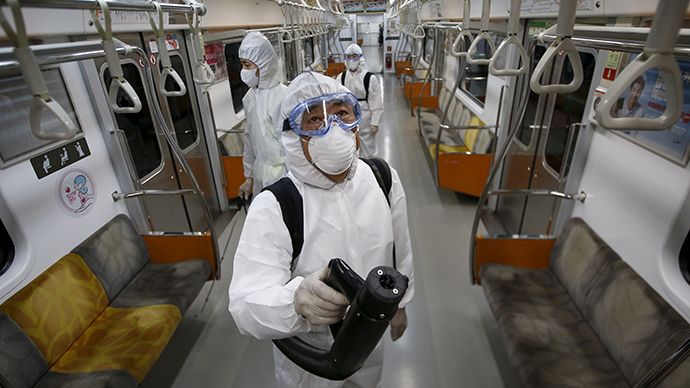
South Korean police in gas masks take part in a drill Saturday in Seoul as part of joint U.S.-South Korean military exercises

- Kim warns troops to prepare for ‘sacred war’ during US-South Korea exercises (CNN, Aug 18, 2012):

North Korean leader Kim Jong Un told his troops to be vigilant during upcoming training exercises between South Korea and the United States, saying they should be ready to lead a “sacred war,” state media reported Saturday.

Kim’s comments came during a visit on Mu Island with troops who participated in the 2010 shelling of South Korea’s Yeonpyeong Island, an attack that North Korea at the time said South Korea provoked by holding war games off their shared coast.

“He ordered the service persons of the detachment to be vigilant against every move of the enemy and not to miss their gold chance to deal at once deadly counter blows at the enemy, if even a single shell is dropped on the waters or in the area where the sovereignty of (North Korea) is exercised,” the state-run KCNA news agency reported.

Continue reading »

Tags: , , , , , , ,

Apr 08

- The Hunt For Red Pyongyang: South Korea On Alert For Naval Attack After “Losing” 4 North Korean Subs (ZeroHedge, April 6, 2012):

Just because the imminent launch of a North Korean rocket along a trajectory which will likely force Japan to strike it down, something which Pyongyang said would be equivalent to an act of war, was not enough, it now appears that South Korea has commenced the hunt for Red Pyongyang or four, as it is now “searching for four North Korean submarines that disappeared after leaving their bases on the tense peninsula.” ABC News reports that “A military source quoted in a South Korean newspaper says up to four North Korean submarines slipped out of port in recent days and have so far avoided detection. The source was also quoted as saying that Pyongyang has stepped up submarine infiltration drills as the weather has warmed.” As a result, “Seoul is now on alert for a possible strike against a South Korean naval ship.” This won’t be the first time a North Korean sub is implicated in potential wrongdoing: “The South accuses the North of using a midget submarine to sink the corvette the Cheonan two years ago, which left 46 South Korean sailors dead.”

Just more posturing, Or will Kim Jong Un force the hand of either Seoul or in a few days, Tokyo? From Al Jazeera:

Japan has completed the deployment of a land-based system of interceptor missiles in preparation for a planned North Korean rocket launch later this month.

The exercise was finalised in Okinawa on Thursday, days after a similar deployment was completed on Monday in Naha, the capital of Okinawa prefecture.

The interceptors would be ready to shoot down any parts of the rocket that veer into Japan’s airspace.

Continue reading »

Tags: , , , , , , ,

Feb 01

Korean research, a first step toward Dr. Smartphone? (Reuters, Jan 23, 2012):

Tired of long waits at the hospital for medical tests? If Korean researchers have their way, your smartphone could one day eliminate that — and perhaps even tell you that you have cancer.

A team of scientists at Korea Advanced Institute of Science of Technology (KAIST) said in a paper published in Angewandte Chemie, a German science journal, that touch screen technology can be used to detect biomolecular matter, much as is done in medical tests.

Continue reading »

Tags: , , , , , , , ,

Jan 04

See also:

- South Korea: Radioactive Seaweed At 0.76 MicroSieverts/Hour From East Coast


2011 Nov 30th South Korea rain radiation 20 microSv/hr from joytek on Vimeo.

Description:

rain sample collected from a car hood in Chuncheon, South Korea on November 30th, 2011. All cars were covered by a powdery substance that fell with the rain.

2011 Nov 30th radioactive rainout in South Korea 16 microSv/hr from joytek on Vimeo.

Description:

radioactive rain sample from South Korea, Chuncheon collected from a car hood on November 30th, 2011.

South Korea, Chuncheon, Dec 13, 2011, neighborhood radiation (0.7 microSv/hr +) from joytek on Vimeo.

Description:

This is the reading on my street in Chuncheon, South Korea, on December 13th, 2011. The pavement is reading at more than 0.7 microSv/hr while the at chest height the reading is about 0.4.

measuring device: Inspector Alert

Tags: , , , , , , , ,

Jan 03

2012 Jan 2nd, South Korea, Seaweed radioactivity test (part 1) from joytek on Vimeo.

- Breaking News: 0.76 microSv/h from Seaweed from Korean east coast (Fukushima Diary, Jan. 3, 2012):

On 1/2/2012, they measured 0.76 microSv/h from seaweed, which is from the east coast of Korea.(Unopened)

The background was 0.227 microSv/h. It picked up around by 0.53 microSv/h immediate on the package.

This suggests the sea contamination has spread to not only Pacific ocean but also the Korean / Japanese sea.

Related article http://fukushima-diary.com/2011/12/tsunami-boat-found-in-korean-japanese-sea/

Tags: , , , , , , , , , , ,

Dec 05

Flashback:

- Hilarious: Ron Paul: ‘Why Do Central Banks Hold Gold?’ Ben Bernanke: ‘Tradition’ (Video)


- Bank of Korea Says It Boosted Gold Holdings in Foreign-Exchange Reserves (Bloomberg, Dec 2, 2011):

The Bank of Korea, which controls the world’s eighth-biggest foreign-exchange reserves, boosted gold holdings for the second time this year as investors sought safer assets amid Europe’s debt crisis.

The central bank bought 15 metric tons last month, boosting holdings to 54.4 tons, which is equivalent to 0.7 percent of its total reserves, Lee Jung, head of the investment strategy team at the bank’s Reserve Management Group, told reporters in Seoul.

Central banks are expanding reserves for the first time in a generation as the precious metal is in the 11th year of a bull market. Purchases of as much as 450 tons in 2011 may be repeated next year as Asian nations and emerging economies diversify their reserves, UBS AG said Nov. 30.

“They want to diversify,” Gavin Wendt, the founder and senior resource analyst at Sydney-based Mine Life Pty., said by phone today. Investors and “central banks are pretty nervous about all currencies, not just the U.S. dollar.”

Gold has risen about 23 percent this year, reaching an all- time high of $1,921.15 an ounce on Sept. 6 and beating equities, treasuries and other commodities. The U.S. dollar, which typically moves inversely to bullion, is down about 1 percent this year against a basket of six major (worthless fiat) currencies.

Continue reading »

Tags: , , , ,

Dec 03

- Lower House committee approves nuke export deals with four nations (Japan Times, Dec. 3, 2011):

While the battle goes on to bring the Fukushima No. 1 plant under control, the government moved a step closer Friday to resuming exports of Japan’s nuclear technology as a Lower House committee approved ratification of accords with four countries.

The Democratic Party of Japan and Liberal Democratic Party both voted in favor of the bilateral agreements with Jordan, Vietnam, South Korea and Russia at the Lower House Foreign Affairs Committee.

The full chamber was to vote on the pacts later Friday, but at the request of opposition parties the action was postponed till Tuesday.

Despite the delay, the treaties are expected to be approved by the Lower House and will likely clear the Upper House before the current Diet session closes Dec. 9.

Continue reading »

Tags: , , , , , , , , , , ,