– 28-hour countdown begins for the launch of ISRO’s record 104 satellites
H/t reader kevin a.
* * *
PayPal: Donate in USD
PayPal: Donate in EUR
PayPal: Donate in GBP
The man who trades freedom for security does not deserve nor will he ever receive either. – Benjamin Franklin
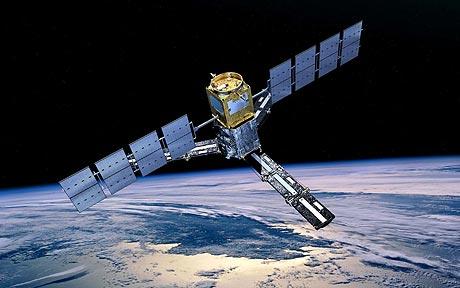
Satellites could track motorists from space if trials prove successful Photo: AFP
The cameras, which combine number plate reading technology with a global positioning satellite receiver, are similar to those used in roadworks.
The AA said it believed the new system could cover a network of streets as opposed to a straight line, and was “probably geared up to zones in residential areas.”
The Home Office is testing the cameras at two sites, one in Southwark, London, and the other A374 between Antony and Torpoint in Cornwall.
The ‘SpeedSpike’ system, which calculates average speed between any two points in the network, has been developed by PIPS Technology Ltd, an American-owned company with a base in Hampshire.
Read moreNew Speed Surveillance Cameras Trap Motorists From Space
HAMPTON, Va., Dec. 16 /PRNewswire-USNewswire/ — New measurements from a NASA satellite show a dramatic cooling in the upper atmosphere that correlates with the declining phase of the current solar cycle. For the first time, researchers can show a timely link between the Sun and the climate of Earth’s thermosphere, the region above 100 km, an essential step in making accurate predictions of climate change in the high atmosphere.
(Logo: http://www.newscom.com/cgi-bin/prnh/20081007/38461LOGO)
Scientists from NASA’s Langley Research Center and Hampton University in Hampton, Va., and the National Center for Atmospheric Research in Boulder, Colo., will present these results at the fall meeting of the American Geophysical Union in San Francisco from Dec. 14 to 18.
Earth’s thermosphere and mesosphere have been the least explored regions of the atmosphere. The NASA Thermosphere-Ionosphere-Mesosphere Energetics and Dynamics (TIMED) mission was developed to explore the Earth’s atmosphere above 60 km altitude and was launched in December 2001. One of four instruments on the TIMED mission, the Sounding of the Atmosphere using Broadband Emission Radiometry (SABER) instrument, was specifically designed to measure the energy budget of the mesosphere and lower thermosphere. The SABER dataset now covers eight years of data and has already provided some basic insight into the heat budget of the thermosphere on a variety of timescales.
The extent of current solar minimum conditions has created a unique situation for recent SABER datasets. The end of solar cycle 23 has offered an opportunity to study the radiative cooling in the thermosphere under exceptionally quiescent conditions.
“The Sun is in a very unusual period,” said Marty Mlynczak, SABER associate principal investigator and senior research scientist at NASA Langley. “The Earth’s thermosphere is responding remarkably — up to an order of magnitude decrease in infrared emission/radiative cooling by some molecules.”
Read moreNASA: Quiet Sun Means Dramatic Cooling of Earth’s Upper Atmosphere

A North Korean military unit of missile carriers during a military parade in Pyongyang: The North has put its army on full alert in the face of the annual spring military joint exercises Photo: GETTY
It has also cut off its border and telephone links with the South in protest at military exercises by American and South Korean troops which began on Monday.
Plans for a launch were first picked up by satellite imagery, with foreign intelligence agencies saying it was a test of a long-range Taepodong-2 missile with the capacity to hit parts of the United States.
The United States said it would shoot down the missile if it headed towards its territory. Japan has suggested it might try to intercept any launch, even if the payload is a communications satellite as claimed by Pyongyang.
“If the enemies recklessly opt for intercepting our satellite, our revolutionary armed forces will launch without hesitation a just retaliatory strike operation,” the general staff of the North Korean army said in a statement on state media. It singled out the United States, Japan and South Korea as targets.
“Shooting our satellite for peaceful purposes will precisely mean a war,” it said.
Read moreNorth Korea threatens full scale war if rocket is intercepted
There are various other satellite powers, such as manipulating electronic instruments and appliances like alarms, electronic watches and clocks, a television, radio, smoke detector and the electrical system of an automobile. For example, the digital alarm on a watch, tiny though it is, can be set off by a satellite from hundreds of miles up in space. And the light bulb of a lamp can be burned out with the burst of a laser from a satellite. In addition, street lights and porch lights can be turned on and off at will by someone at the controls of a satellite, the means being an electromagnetic beam which reverses the light’s polarity. Or a lamp can be made to burn out in a burst of blue light when the switch is flicked. As with other satellite powers, it makes no difference if the light is under a roof or a ton of concrete–it can still be manipulated by a satellite laser. Types of satellite lasers include the free-electron laser, the x-ray laser, the neutral-particle-beam laser, the chemical-oxygen-iodine laser and the mid-infra-red advanced chemical laser.
Read morePravda: Shocking Menace of Satellite Surveillance (Part II)
Unknown to most of the world, satellites can perform astonishing and often menacing feats. This should come as no surprise when one reflects on the massive effort poured into satellite technology since the Soviet satellite Sputnik, launched in 1957, caused panic in the U.S. A spy satellite can monitor a person’s every movement, even when the “target” is indoors or deep in the interior of a building or traveling rapidly down the highway in a car, in any kind of weather (cloudy, rainy, stormy). There is no place to hide on the face of the earth. It takes just three satellites to blanket the world with detection capacity. Besides tracking a person’s every action and relaying the data to a computer screen on earth, amazing powers of satellites include reading a person’s mind, monitoring conversations, manipulating electronic instruments and physically assaulting someone with a laser beam. Remote reading of someone’s mind through satellite technology is quite bizarre, yet it is being done; it is a reality at present, not a chimera from a futuristic dystopia! To those who might disbelieve my description of satellite surveillance, I’d simply cite a tried-and-true Roman proverb: Time reveals all things (tempus omnia revelat).
Read morePravda: Shocking Menace of Satellite Surveillance (Part I)
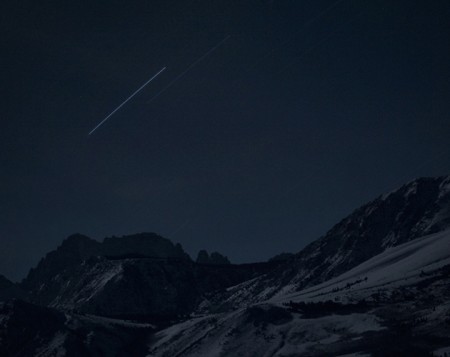
Artist Trevor Paglen’s time-exposure photographs show the streaks of light left by classified satellites.
Photo: Trevor Paglen
BERKELEY, California — For most people, photographing something that isn’t there might be tough. Not so for Trevor Paglen.
His shots of 189 secret spy satellites are the subject of a new exhibit — despite the fact that, officially speaking, the satellites don’t exist. The Other Night Sky, on display at the University of California at Berkeley Art Museum through September 14, is only a small selection from the 1,500 astrophotographs Paglen has taken thus far.
In taking these photos, Paglen is trying to draw a metaphorical connection between modern government secrecy and the doctrine of the Catholic Church in Galileo’s time.
“What would it mean to find these secret moons in orbit around the earth in the same way that Galileo found these moons that shouldn’t exist in orbit around Jupiter?” Paglen says.
Satellites are just the latest in Paglen’s photography of supposedly nonexistent subjects. To date, he’s snapped haunting images of various military sites in the Nevada deserts, “torture taxis” (private planes that whisk people off to secret prisons without judicial oversight) and uniform patches from various top-secret military programs.

The nearly vertical streak in this image shows a satellite called Keyhole 12-3 crossing the sky near the constellation of Scorpio. Photo: Trevor Paglen
While all of Paglen’s projects are the result of meticulous research, he’s also the first to admit that his photos aren’t necessarily revelatory. That’s by design. Like the blurry abstractions of his super-telephoto images showing secret military installations in Nevada, the tiny blips of satellites streaking across the night sky in his new series of photos are meant more as reminders rather than as documentation.
Read morePhotographer Documents Secret Satellites — All 189 of Them
The Defense Advanced Research Project Agency, that secretive band of Pentagon geeks that searches obsessively for the next big thing in the technology of warfare, is 50 years old. To celebrate, DARPA invited Vice President Dick Cheney, a former Defense Secretary well aware of the Agency’s capabilities, to help blow out the candles. “This agency brought forth the Saturn 5 rocket, surveillance satellites, the Internet, stealth technology, guided munitions, unmanned aerial vehicles, night vision and the body armor that’s in use today,” Cheney told 1,700 DARPA workers and friends who gathered at a Washington hotel to mark the occasion. “Thank heaven for DARPA.”
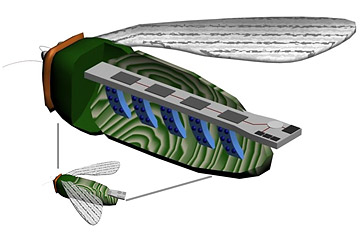
Created in the panicky wake of the Soviets’ launching of Sputnik, the world’s first satellite, DARPA’s mission, Cheney said, is “to make sure that America is never again caught off guard.” So, the Agency does the basic research that may be decades away from battlefield applications. It doesn’t develop new weapons, as much as it pioneers the technologies that will make tomorrow’s weapons better.
So what’s hot at DARPA right now? Bugs. The creepy, crawly flying kind. The Agency’s Microsystems Technology Office is hard at work on HI-MEMS (Hybrid Insect Micro-Electro-Mechanical System), raising real insects filled with electronic circuitry, which could be guided using GPS technology to specific targets via electrical impulses sent to their muscles. These half-bug, half-chip creations — DARPA calls them “insect cyborgs” — would be ideal for surveillance missions, the agency says in a brief description on its website.
 Solarflare
Solar radiation reaches an 11-year high again in 2011, making things interesting for those reliant on satellites — the U.S. military included.
As Inside the Air Force notes this week, the solar cycle — “the frequency in which sun spots and solar flares occur” — waxes and wanes every 11 years. The last one reached its apex in April 2000, so it’s gonna get warm again soon. And while solar flares can and do damage satellites even in non-peak times, 2011 still looms big.
“I think the way is now clear to stand NAO up and go warm,” said Chertoff, briefing journalists about the proposed National Applications Office.
NAO would allow US police, immigration, drug-enforcement and other officials to have access to data from various US satellites passing above America. It is understood that the information would be supplied mostly by spacecraft which at the moment are used for meteorological and geological surveying, or other scientific tasks. Satellites of this type can often deliver high-resolution images which would also be useful to law enforcement.
Read moreDHS reckons US cops’ access to sat-surveillance is go
Cost Overruns Hit $295 Billion
Government auditors issued a scathing review yesterday of dozens of the Pentagon’s biggest weapons systems, saying ships, aircraft and satellites are billions of dollars over budget and years behind schedule.
The Government Accountability Office found that 95 major systems have exceeded their original budgets by a total of $295 billion, bringing their total cost to $1.6 trillion, and are delivered almost two years late on average. In addition, none of the systems that the GAO looked at had met all of the standards for best management practices during their development stages.

Auditors said the Defense Department showed few signs of improvement since the GAO began issuing its annual assessments of selected weapons systems six years ago. “It’s not getting any better by any means,” said Michael Sullivan, director of the GAO’s acquisition and sourcing team. “It’s taking longer and costing more.”
 The looming U.S. Navy attempt to shoot down a dying satellite could demonstrate an anti-satellite capability for its missile defense system.
A successful kill would mark the first time the United States uses a tactical missile to destroy a spacecraft – assuming that the ship-based missile defense system can handle the high closing speed of more than 22,000 mph.
“Everything becomes much more stressful at these large closing speeds,” said Geoffrey Forden, MIT physicist and space expert. “But if they do hit it, that’d be very impressive, and that’d be proof that it has ASAT [anti-satellite] capability.”
Read moreSpace War: Satellite ‘Kill’ Would Prove U.S. Capability
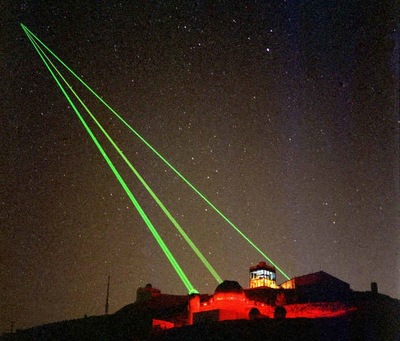
We all know that the Pentagon has more space weapons technology in mind than just a single, satellite-shooting missile. But trying to pin down how much the Defense Department is spending on space combat research — and on what projects — is an absolute bitch. The programs are spread across at least a dozen different accounts; much of the technology involved is “dual use” — meaning, it could help with another military matters, too; and that’s before you get into the Defense Department’s “black,” classified budget.
Over the years, the gang at the Center for Defense Information has done a good a job as anyone at this thankless task. They’ve just released their survey of the Pentagon’s 2009 budget, highlighting research that could lead to arms in space. By the absolute most conservative estimate, we’re talking $520 million dollars in next year’s budget. The real number is likely several multiples of that.
The projects mostly involve ways to disable potentially hostile satellites; many have other uses, as well. They include a giant laser, to help spot targets in orbit (and to improve space imaging, in the meantime); micro satellites, that could disable another country’s orbiters (or repair our own); a series of jammers, to block enemy satellite signals; and missile interceptors, based in space.
China is speeding up its military buildup and developing high-technology forces for waging wars beyond Taiwan, according to the Pentagon’s annual report on Chinese military power.“The pace and scope of China’s military transformation have increased in recent years, fueled by acquisition of advanced foreign weapons, continued high rates of investment in its domestic defense and science and technology industries, and far-reaching organizational and doctrinal reforms of the armed forces,” the report states.
The report also warned that China’s expanding military forces “are changing East Asian military balances; improvements in China’s strategic capabilities have implications beyond the Asia-Pacific region.”