And for some (idiots) this is not enough …
- Paul Krugman: QE3 Should Have Been ‘More Stronger’ (Quote Of The Day)
… versus those who can clearly see what is coming:
- Marc Faber: ‘Fed Will Destroy The World’ (Video)
From the article:
“Even when unwinding its balance sheet would mean sacrificing 30% of US GDP and, let’s be honest about it, civil war.”
- BofA Sees Fed Assets Surpassing $5 Trillion By End Of 2014… Leading To $3350 Gold And $190 Crude (ZeroHedge, Sep 14, 2012):
Yesterday, when we first presented our calculation of what the Fed’s balance sheet would look like through the end of 2013, some were confused why we assumed that the Fed would continue monetizing the long-end beyond the end of 2012. Simple: in its statement, the FOMC said that “If the outlook for the labor market does not improve substantially, the Committee will continue its purchases of agency mortgage backed securities, undertake additional asset purchases, and employ its other policy tools as appropriate until such improvement is achieved in a context of price stability.” Therefore, the only question is by what point the labor market would have improved sufficiently to satisfy the Fed with its “improvement” (all else equal, which however – and here’s looking at you inflation – will not be). Conservatively, we assumed that it would take at the lest until December 2014 for unemployment to cross the Fed’s “all clear threshold.” As it turns out we were optimistic. Bank of America’s Priya Misra has just released an analysis which is identical to ours in all other respects, except for when the latest QE version would end. BofA’s take: “We do not believe there will be “substantial” improvement in the labor market for the next 1.5-2 years and foresee the Fed buying Treasuries after the end of Operation Twist.” What does this mean for total Fed purchases? Again, simple. Add $1 trillion to the Zero Hedge total of $4TRN. In other words, Bank of America just predicted at least 2 years and change of constant monetization, which would send the Fed’s balance sheet to grand total of just over $5,000,000,000,000 as the Fed adds another $2.2 trillion MBS and Treasury notional to the current total of $2.8 trillion.
In other words, for once we actually were shockingly optimistic on the US economy. Assuming BofA is correct, and it probably is, this is how the Fed’s balance sheet will look like for the next 2 years:
Or, in terms of US GDP, the Fed’s balance sheet will have “LBOed” just shy of 30% of all US goods and services.
It gets worse: Continue reading »
Tags: Bonds, Civil war, Collapse, Commodities, Debt, Dollar, Economy, Fed, Federal Reserve, George Bush, Global News, Gold, Government, Hyperinflation, Inflation, Obama administration, Oil, Oil Prices, Politics, Quantitative Easing, U.S.
- What Does A $4 Trillion Fed Balance Sheet Mean For Gold And Oil (ZeroHedge, Sep 13, 2012):
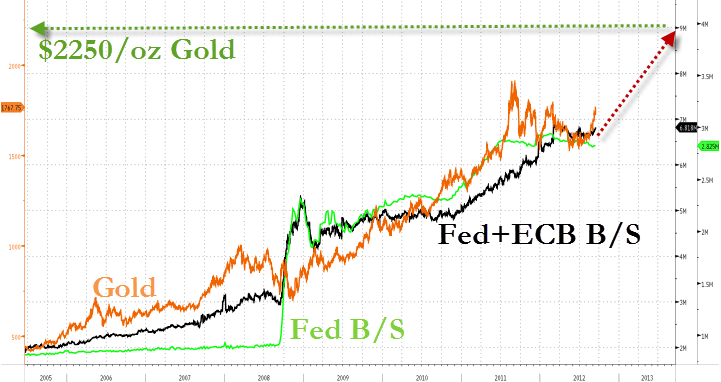
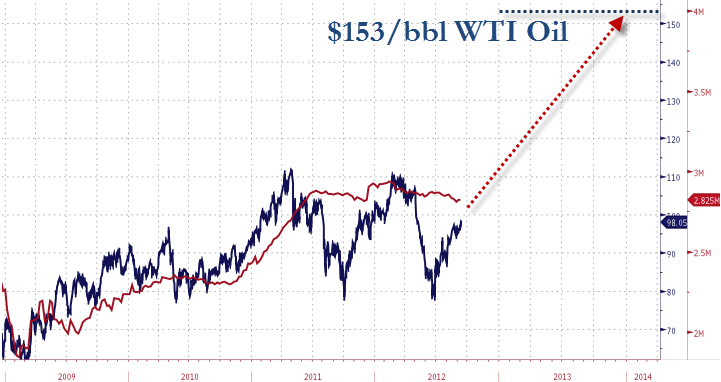
Earlier we explained why Bernanke’s actions today mean that the Fed Balance Sheet will likely grow to over $4 trillion by the end of 2013. Critically this flood of liquidity will raise the nominal price of every asset (from whimsical pieces of stockholder paper to barbarous relics and black gold). Some of these assets, like stock prices and high-yield credit spreads do have point-in-time ‘value limits’ to their price – though at times it seems a dream that fundamentals would ever matter again; but some have less of a binding constraint – such as gold. Should the Fed proceed, as seems likely, and do its worst/best to blow its balance sheet wad then we estimate Gold will be priced at least $2250 per ounce by the end of 2013(of course higher if the Fed sees no evidence of recovery). Meanwhile, deeper underground, the world’s mainstay source of energy, WTI Crude oil, could jump to record highs over $150 per barrel(which just happens to coincide with the ‘pegged’ value of oil in gold). It will be interesting indeed to see how the world’s socio-economic infrastructure hangs together should that occur – can’t happen? Different this time? Indeed it is now that Ben hit the big red ‘panic’ button.Gold vs Fed and ECB balance sheets… notably for QE2, gold priced in all the Fed balance sheet expansion within around half the period (around six months from Jackson Hole) and then overshot – this would infer we see Gold $2250 around the end of the first quarter next year – and expect some overshoot…
Oil vs Fed balance sheet… (which fits nicely into the 0.07 oz of Gold per barrel ‘peg’ that seems to have been ‘agreed’ with the world’s oil producers).
Charts: Bloomberg
Tags: Ben Bernanke, Bonds, ECB, Economy, Fed, Federal Reserve, Global News, Gold, Government, Obama administration, Oil, Oil Prices, Politics, Quantitative Easing, U.S.
- Venezuela Ramps up China Oil Exports Unsettling Washington (OILPRIZE, Aug 21, 2012):
The biggest geostrategic change of the past decade overlooked by Washington policy wonks in their fixation on their self-proclaimed “war on terror” is that Latin America has been throwing off the shackles of the Monroe Doctrine.
These ignored developments may well soon refocus Washington’s attention on the Southern Hemisphere, as Venezuela’s President Hugo Chavez reorients his country’s to China.
Tags: China, Economy, Government, Oil, Politics, U.S., Venezuela
- ATP Oil And Gas Files For Bankruptcy, CEO Blames Obama (ZeroHedge, Aug 18, 2012):
Now that the “alternative energy” industry is in shambles following one after another solar company bankruptcy, as the realization that at current prices, alternative energy business models are still just too unsustainable, no matter how much public equity is pumped into them, more “traditional” companies have resumed circling the drain. First, it was Patriot Coal, which finally succumbed to reality a month ago. Now it is the turn of ATP Oil and Gas, which filed Chapter 11 in Texas last night. And sure enough, in a world in which nobody is to blame, and everything is someone else’s fault, the CEO promptly made a case that he is blameless and it is all Obama’s fault. According to Forbes: “The founder and chairman of [ATP Paul Bulmahn] wants the world to know that the Obama Administration—and its illegal ban on deepwater drilling in the wake of the BP disaster—is to blame for the implosion of his company. Not him. “It is all directly attributable to what the government did to us,” he rails. “This Administration has gone out of its way to create problems for my company, the company that I formed from scratch.”
Forbes continues:
Tags: Bankruptcy, Economy, Global News, Government, Obama administration, Oil, Politics, U.S.
- What To Do When Every Market Is Manipulated (ZeroHedge, Aug 16, 2012):
Hint: cut the strings
If you don’t know who the sucker at the card table is, it’s you.
~ old gambler’s saying
What do the following have in common?
LIBOR, Bernie Madoff, MF Global, Peregrine Financial, zero-percent interest rates, the Social Security and Medicare entitlement funds, many state and municipal pension funds, mark-to-model asset values, quote stuffing and high frequency trading (HFT), and debt-based money?
The answer is that every single thing in that list is an example of market rigging, fraud, or both.
Tags: Banking, Economy, Fraud, Gold, Goldman Sachs, Government, Libor, MF Global, Oil, Oil Prices, Ponzi schemes, SEC, Society, Standard Chartered, U.S.
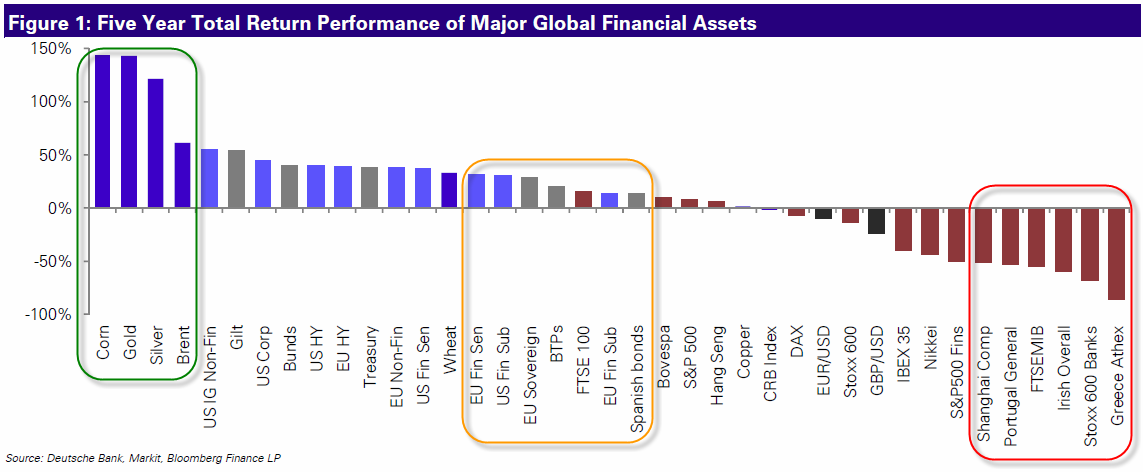
- Gold, Silver, Corn, And Brent Are Best Performers On The 5-Year Anniversary Of The Great Financial Crisis (ZeroHedge, Aug 9, 2012):
Five years ago today BNP Paribas stopped withdrawals from three of their investment funds – because they couldn’t value their holdings following the subprime fallout – and arguably marked the start of the Great Financial Crisis as money markets seized up and the ECB did its first emergency liquidity pump. In the five years hence, as Deutsche’s Jim Reid notes, its been a pretty good run for commodities and most fixed income assets. Given all that’s gone on over this period it’s fair to say that returns have been pretty good if you’ve been in the right areas. The authorities have played a big part in ensuring the period wasn’t a disaster even if there have been frightening periods and very poor returns in some areas. Given that there are still numerous unresolved issues, the authorities need to continue to be on full alert for the next 5 years to ensure that when we do the 10 year anniversary there haven’t been set-backs in many of these assets.
Source: Deutsche Bank
Tags: Commodities, Corn, Economy, Global News, Gold, Oil, Oil Prices, Silver
FYI.
- Oil And Gold Seasonals Suggest BTFD (ZeroHedge, July 23, 2012):
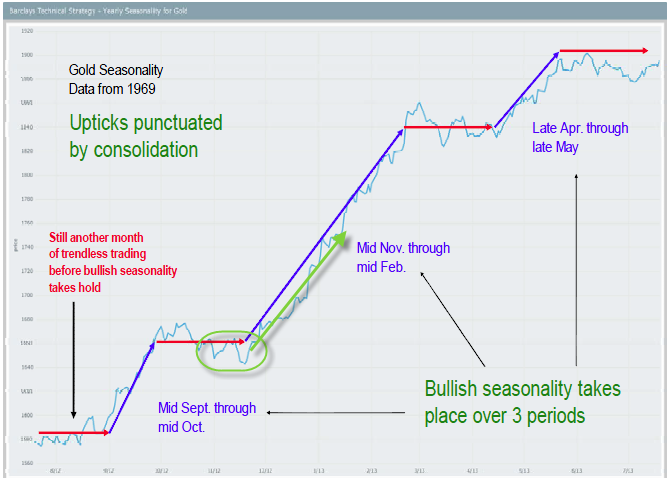
The long-term seasonal data for gold and oil has not just remained relatively highly correlated over time but, as Barclays points out today, has very clear periods of bearishness, consolidation, and bullishness. While Gold may have another month of treading water, the period from September to mid-October is empirically bullish while Brent’s August to mid-October period is the most bullish segment of the year. Given gold’s stability in the past month or so since the EU Summit, and oil’s surge (and modest pull-back very recently), seasonals certainly provide some technical support for BTFD here in these QE-sensitive, real assets.
Brent Crude’s two major bullish seasonals…
and Gold’s three periods of bullish seasonality…
Source: Barclays
Tags: Barclays, Economy, Global News, Gold, Oil, Oil Prices, Quantitative Easing
- 11 International Agreements That Are Nails In The Coffin Of The Petrodollar (The Economic Collapse, July 18, 2012):
Is the petrodollar dead? Well, not yet, but the nails are being hammered into the coffin even as you read this. For decades, most of the nations of the world have used the U.S. dollar to buy oil and to trade with each other. In essence, the U.S. dollar has been acting as a true global currency. Virtually every country on the face of the earth has needed big piles of U.S. dollars for international trade. This has ensured a huge demand for U.S. dollars and U.S. government debt. This demand for dollars has kept prices and interest rates low, and it has given the U.S. government an incredible amount of power and leverage around the globe. Right now, U.S. dollars make up more than 60 percent of all foreign currency reserves in the world. But times are changing. Over the past couple of years there has been a whole bunch of international agreements that have made the U.S. dollar less important in international trade. The mainstream media in the United States has been strangely quiet about all of these agreements, but the truth is that they are setting the stage for a fundamental shift in the way that trade is conducted around the globe. When the petrodollar dies, it is going to have an absolutely devastating impact on the U.S. economy. Sadly, most Americans are totally clueless regarding what is about to happen to the dollar. Continue reading »
Tags: Africa, Australia, Brazil, Chile, China, Dollar, Economy, Fed, Federal Reserve, Global News, Government, India, Iran, Japan, Oil, Politics, Russia, South Africa, U.S., United Arab Emirates
YouTube Added: Jul 17, 2012
Description:
In this episode, Max Keiser and co-host, Stacy Herbert, discuss how market participants are never more than a few milliseconds away from the next act of fraud and how a teaspoon of collateral leads to economic martial law. They also discuss German economists proposing that the wealthy be forced to buy bonds while in Spain the government and EU force bank losses on cooks and pensioners. In the second half of the show, oil analyst, Chris Cook, about how, despite sanctions, oil will always find a home; the Enron technique of pre-pay now being used by Enron’s former counterparties; and how stability is the death for the oil market middlemen.
Tags: Bonds, Debt, Economy, EU, Europe, Fraud, Germany, Government, Max Keiser, Oil, Oil Prices, Politics, Society, Spain


![[Most Recent Quotes from www.kitco.com]](http://www.kitconet.com/charts/metals/gold/t24_au_en_usoz_2.gif)