May 15

- Bank Of Japan Head:”No Bubble Here” As Nikkei Rises 45% In 2013 (ZeroHedge, May 15, 2013):

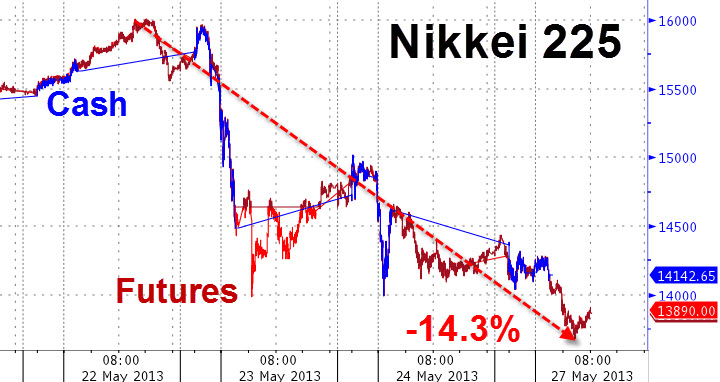
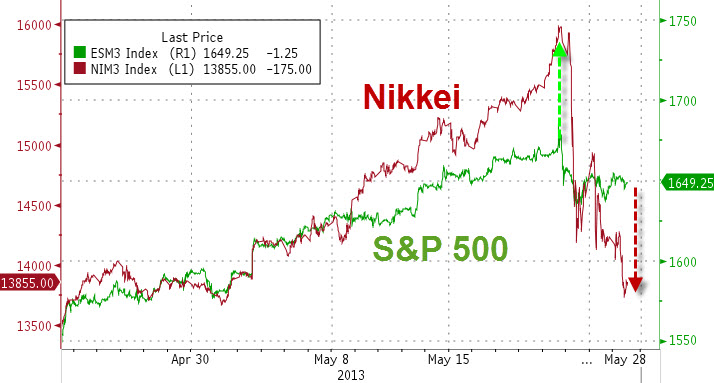
Take a good look at the chart of the Nikkei below:

Supposedly this is the same chart that the new BOJ head, Haruhiko Kuroda, was looking at when he was responding to Japanese lawmakers during a session of the upper-house budget committee, where he flatly rejected an opposition-party member’s argument that the recent rapid rise in the Tokyo stock market is out of line with Japan’s real economy. “At this moment I do not think they are in a bubble,” Kuroda said. And everyone believes him, just Because central bankers are so good at objectively observing how contained subrpime is big the asset bubbles their ruinous policies create.

Incidentally, all this happens as the Nikkei225 closed at 15096, and is up 45% in 2013 alone! It will easily surpass the Dow Jones Industrial Average in absolute terms once tonight’s trading session begins, considering the ongoing pounding the Yen is sustaining in today’s session.

From the WSJ:

Continue reading »

Tags: , , , , ,

Jun 09

Before:

- Tepco Shares Close Down Record 27.6% After Talk Of Bankruptcy (Business Insider, June 6, 2011)


- Japan’s TEPCO shares plunge 20% to new low (AFP, June 8, 2011):

TOKYO — Shares in Japan’s TEPCO hit an all-time low Thursday, falling 20 percent on uncertainty over government plans to ensure the company can meet compensation bills over the crisis at its nuclear plant.

Shares of the embattled Tokyo Electric Power (TEPCO) fell to 160 yen by noon, after hitting a new intraday low of 159 yen.

The shares have lost more than 90 percent of their value since the day before the March 11 earthquake and tsunami, which crippled cooling systems at the Fukushima Daiichi nuclear plant, triggering reactor meltdowns.

Continue reading »

Tags: , , , , ,

Jun 06

Before:

- S&P Cuts TEPCO’s Credit Rating To Junk (Likelihood Of A Default Increased To 53 Percent)


- Tepco Closes Down 27.6% — Its Worst Day Yet — After Talk Of Bankruptcy (Business Insider, June 6, 2011):

Tokyo Electric shares fell a record 27.6 percent today on talk of bankruptcy. Since the March 11 earthquake, Tepco shares are down 90 percent.

The head of Tokyo Stock Exchange, Atsushi Saito, was quoted as saying he thought Tepco should go through a court-led restructuring. An exchange spokesman explained that this was Saito’s personal opinion, according to Reuters.

With Tepco crashing, the Nikkei average closed at an 11-week low.

Meanwhile more trouble at Fukushima. Radiation jumped to record levels at reactor No. 1 and pools of radioactive water are on the verge of flooding.

Tags: , , , ,

Mar 16

And the real crisis has only just begun:

- Japan Nuclear Meltdown: US Calls Radiation Levels ‘Extremely High’ – Fuel Pool Has Burned Dry At The No. 4 Reactor, Leaving Fuel Rods Stored There Exposed And Bleeding Radiation

In other news:

- Japanese shares slide again on reactor deterioration (ABC News)

- Yen hits record-high against US dollar as Nikkei falls (BBC News)


It appears the earlier speculation by PTI that the BOJ would inject ¥13.8 Trillion in the market to preserve asset prices was a little premature. The BOJ just released the official number and it is a measly ¥5 trillion.

And by measly we mean US$63 billion. Add this to the ¥28 trillion already deployed by the BOJ and get an even more modest ¥33 billion, or roughly $420 billion, which is the cost to preserve the Nikkei from plunging for a 4th consecutive day.

Yet even with this latest injection, the Nikkei is down almost 4% as of this writing. Should headline newsflow from Fukushima deteriorate, we anticipate that the full PTI number will be not only reach by surpassed very promptly as no amount of taxpayer capital will be deemed too great to preserve the wealth of those invested in Japanese stocks.

From Reuters:

The Bank of Japan on Thursday offered to inject a further 5 trillion yen ($61 billion) into the banking system, continuing its effort to calm markets in the wake of the yen’s spike to a record high against the dollar.

That came on top of a total of 28 trillion yen already offered in same-day operations this week in the aftermarth of last Friday’s devastating earthquake and tsunami.

Continue reading »

Tags: , , , , , , ,

Mar 15

- Japanese Market Plummets 20% in 2 Days on Radiation Threat (Business Insider):

The Nikkei slid 14% last night (3/15/11), and recovered 3% to end net 11% down for the day after the Japanese government banned brokerages from selling. This was after a 6% down day on 3/14 and a poor prior week.

Both the TOPIX and the Nikkei are now down more than 20% for the year on the risk that nuclear radiation will pose a threat to Tokyo.

- JAPAN MARKETS-Hedge funds lead worst 2-day stock rout since ’87 (Reuters):

* TOPIX, Nikkei hit 2-yr lows, hedge funds lead way

* More than $700 bln in market cap lost in 2 days

* TSE volumes hit record for second day running

* Yen falls and later recovers on intervention talk

* Insurers seen selling bonds, yields rise despite stock
rout

TOKYO, March 15 (Reuters) – Japanese stocks plunged 10.6
percent on Tuesday, posting the worst two-day losing streak
since 1987, on reports of rising radiation near Tokyo,
suggesting any deterioration at a quake-hit nuclear plant could
trigger more panic selling led by hedge funds.

The yen tripped on talk of intervention and bond yields rose
as investors sold debt to offset losses in the stock market. The
scale and speed of the equity selloff, on record volume for a
second day running, forced fund managers to sit on the
sidelines.

Continue reading »

Tags: , , , , , , ,

Mar 14

Update:

- Fears of meltdown with fuel rods ‘fully exposed’ at Japan reactor (Sydney Morning Herald)


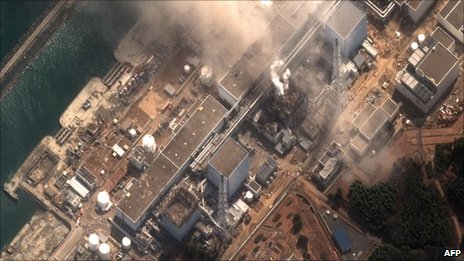
A satellite photo of the Fukushima Daiichi plant showed the damage done to reactors 1 and 3, where there was an explosion on Monday

- Meltdown alert at Japan reactor (BBC NEWS):

Technicians are battling to stabilise a third reactor at a quake-stricken Japanese nuclear plant, which has been rocked by a second blast in three days.

The fuel rods inside reactor 2 at the Fukushima Daiichi plant have been fully exposed on two separate occasions, raising fears of a meltdown.

Sea water is being pumped into the reactor to try to prevent overheating.

A cooling system breakdown preceded explosions at the plant’s reactor 3 on Monday and reactor 1 on Saturday.

The latest hydrogen blast injured 11 people, one of them seriously. It was felt 40km (25 miles) away and sent a huge column of smoke into the air.

The outer building around the reactor was largely destroyed.


Japanese Nuclear Crisis Escalates

Japan is racing against time to prevent a potential nuclear disaster after a third reactor at the quake-stricken power plant north of Tokyo went into meltdown on Monday.

Engineers have been battling for three days to prevent a nuclear disaster at Tokyo Electric Power’s Daiichi plant in Fukushima. But they have faced successive setbacks trying to cool down three reactors whose cooling systems were damaged after Japan was struck by a devastating 8.9 magnitude earthquake and tsunami on Friday.

The International Atomic Energy Agency on Monday evening said Japan had requested “expert missions” to help tackle the escalating nuclear crisis.

Tepco said elevated radiation levels were detected nearby after water levels at reactor No. 2 fell dangerously low for several hours. Early Tuesday morning in Japan, Tepco said coolant water inside the No. 2 reactor fell dangerously low for a second time on Monday night, leaving its fuel rods completely exposed

In the first full day of trading since the earthquake, Japan’s equity market reacted violently even as the Bank of Japan announced it would inject a record Y21,800bn ($265bn) in funds to financial institutions. The Nikkei plunged 6.2 per cent, its biggest drop in more than two years.

Continue reading »

Tags: , , , ,

Mar 14

TOKYO (Reuters) – A massive selloff on the Tokyo Stock Exchange wiped out some 23.5 trillion yen ($287 billion) from the market’s value on Monday with investors dumping stocks as the country recoiled from a devastating earthquake and struggled to avert nuclear disaster.

The selloff triggered record volumes and slashed the market’s value to roughly 289 trillion yen.

The Nikkei average tumbled 6.2 percent, its biggest decline in a single day since October 2008, and more than 4.88 billion shares changed hands on the exchange’s first section, the highest number since World War 2.

Continue reading »

Tags: , , , ,

Jun 28

1 of 4:

Continue reading »

Tags: , , , , , , , , , , , , , , , , , , , , , , , , , , , ,

Dec 29

What a difference 20 years makes.

The Japanese stock market on Tuesday morning completed its investment year with its usual half-day, Dec. 30 session. That won it the dubious honor of being the first major global stock market to put its 2008 performance in the books — and its double-digit loss is likely to be followed by most of the rest of the world.


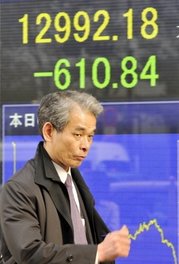
The Nikkei Stock Average’s glory days above 38000 are a distant memory, as the Japanese stock market has completed its dismal 2008 investment year. Pictured, a trader in Tokyo earlier this month. Associated Press

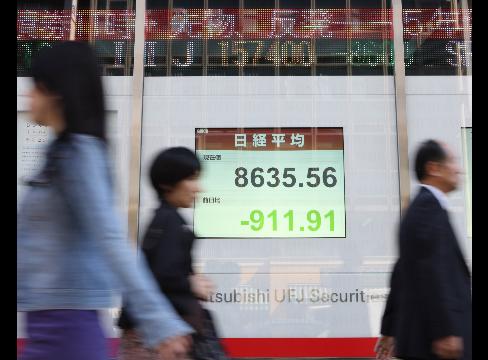
The Nikkei closed up 1.3% to finish at 8859.56, booking its worst year ever with a loss of 42%. This follows an 11.1% decline for 2007. On a positive note, the index marked its first positive month since May.

More striking is the Nikkei’s comedown from its heights two decades ago. In 1989, on the last trading day of that year, Tokyo’s blue-chip index had touched an all-time high of 38915.86.

On Monday, the final full trading session of the year, the Nikkei had closed at 8747.17, down 7.65 points or 0.09%.

Insurance stocks in Tokyo on Monday surged in the wake of reports that Mitsui Sumitomo Insurance Group, Aioi Insurance and Nissay Dowa General Insurance were in talks to integrate their operations by next autumn.

In a statement posted on its Web site, Mitsui Sumitomo wrote that “no decision that needs to be disclosed has been made.” Mitsui Sumitomo rose 8.3%, Aioi soared 19% and Nissay Dowa jumped 15%.

Continue reading »

Tags: , , ,

Oct 27


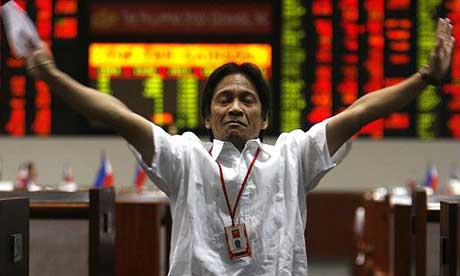
A trader at the Philippines stock exchange as business is halted. Photograph: Cheryl Ravelo/Reuters

Stockmarkets around the world crashed again today as the prospect of a deep worldwide recession continued to haunt investors.

Fears that the financial crisis is spreading to emerging nations sparked another day of panicky selling, despite speculation of another round of interest rate cuts to try to stimulate the global economy,

As the current crisis sparked by the failure of Lehman Brothers entered a seventh week, Japan’s Nikkei index fell 6.4% to its lowest level since 1982, extending its recent slump. It has now lost 20% of its value in the last week.

Hong Kong also saw shares routed, with the Hang Seng index plunging almost 12% in late trading – putting it on track for its biggest daily fall since 1997. And the Chinese stockmarket tumbled over 6%, bringing more pain to small investors who have watched the Shanghai Composite index fall 70% from last year’s peak.

With India’s stockmarket losing 8%, shares across Europe are also expected to fall sharply when trading begins. The Dow Jones index is tipped to fall by another 400 points, or 5%, later today.
(The Dow fell only 2,42% today.)

Continue reading »

Tags: , , , , , , , , , ,