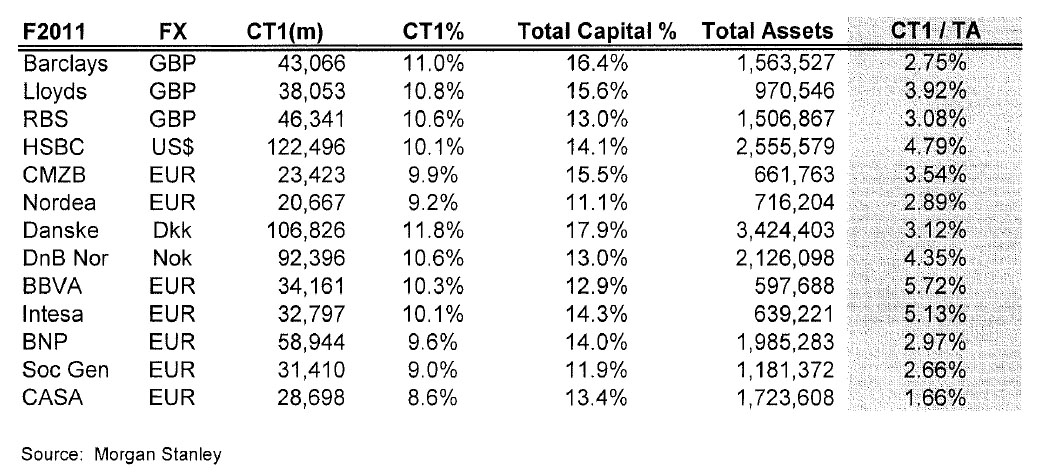
- Europe’s WTF Chart (ZeroHedge, Feb 5, 2013)
See also:
- Ten Things You Should Know about the LTRO (ZeroHedge, Jan 24, 2013)
- Europe’s WTF Chart (ZeroHedge, Feb 5, 2013)
See also:
- Ten Things You Should Know about the LTRO (ZeroHedge, Jan 24, 2013)
- Friday Humor: The ECB Explains What A Ponzi Scheme Is; Awkward Silence Follows (ZeroHedge, Nov 2, 2012):
From the ECB’s Virtual Currency Schemes, aka the “Bash Bitcoin Boondoggle” (p. 27):
A Ponzi scheme is an investment fraud that involves the payment of purported returns to existing investors from funds contributed by new investors. Ponzi scheme organizers often solicit new investors by promising to invest funds in opportunities claimed to generate high returns with little or no risk. In many Ponzi schemes, the fraudsters focus on attracting new money to make promised payments to earlier-stage investors and to use for personal expenses, instead of engaging in any legitimate investment activity
Considering that this elucidation comes from the very same entity that launched the SMP, LTRO, OMT, EFSF, ESM, oh, and of course, TARGET2, and whose head said to not short the EUR as there is “no risk” whatsoever in holding said currency, one would expect that this definition is absolutely spot on…
* * *
And as an added bonus, here is the part in which the ECB appears to be so worried about BitCoin taking over as legitimate “legal tender” from the EUR (which the ECB’s Coeure said two days ago is as “solid and longlasting as a diamond”) it dedicated an entire report to bash the recently conceived electronic currency: Continue reading »
Tags: Central Bank, ECB, Economy, EFSF, ESM, EU, Europe, Global News, LTRO, OMT, SMP
- The “Bond King”: Buy Gold, Not Bonds (ZeroHedge, Sep 10, 2012):
The “Bond King” – Pimco boss Bill Gross – says:
[There's] a diminished or dying cult of both bonds and stocks from the standpoint of a belief that they can return 10% ….
Gold can’t be reproduced. It could certainly be taken out of the ground in an increasing rate but there’s a limiting amount of gold.
And there has been an unlimited amount of paper money over the past 20 to 30 years and now – in this period of central bank expansion where it’s QE1 or QE2, or whether it’s the LTROs of the ECB or this potential new program … then central banks are at their leisure to basically print money.
Gold is a fixed commodity that has a considerable store of value that paper money has not….
When a central bank starts writing checks and printing money in the trillions of dollars, it’s best to have something tangible that can’t be reproduced, such as gold.
***
Gold … is a better investment than a bond or a stock, which probably will only return a 3 to 4 percent return over the next 5 to 10 years.
Gross doesn’t believe that gold is a crowded trade at this point.
Has Mr. Gross been reading Zero Hedge?
Tags: Bonds, Central Bank, Debt, ECB, Economy, Global News, Gold, LTRO, PIMCO
- “Spain Requests Bailout On September 14″ – Goldman’s Definitive Post-Mortem On Europe’s Third Bond Buying Attempt (ZeroHedge, Sep 6, 2012):
Yesterday, when Bloomberg leaked every single detail of today’s ECB announcement, which thus means today’s conference was not a surprise at all, yet the market sure would like to make itself believe it was, we noted that everything that was leaked, and today confirmed, came from a Goldman memorandum issued hours before. Simply said everything that happens at the ECB gets its marching orders somewhere within the tentacular empire headquartered at 200 West. Which is why when it comes to the definitive summary of what “happened” today, we go to the firm that pre-ordained today’s events weeks ago. Goldman Sachs.Perhaps the most important part is this: “September 13-14: Spain to make formal request for EFSF support at the Eurogroup meeting. With a large (and uncovered) redemption looming at the end of October (and under pressure from other Euro area governments), we expect Spain to move towards seeking support.” In other words, Rajoy has one more week before he is sacked and the Spanish festivities begin. Continue reading »
Tags: Bailout, Debt, ECB, EFSF, ESM, EU, Europe, Germany, Global News, Goldman Sachs, Government, IMF, LTRO, Spain
- With September Knocking, Here Is An Annotated European Event Calendar (ZeroHedge, Aug 28, 2012)
Tags: ECB, Economy, ESM, EU, Europe, Germany, Global News, Government, Greece, Holland, Italy, LTRO, Politics, Spain
- On GRExit, SPAilout, And Draghi’s White Knight (ZeroHedge, Aug 13, 2012):
Via Mark E. Grant, author of Out of the Box,
“There was a free lunch just once. It was when Eve gave the apple to Adam and we all know how that turned out.”
-The Wizard
As I stare out at the Maginot Line I will endeavor to predict the upcoming events in Europe for the balance of the year. I called Greece, Ireland and Portugal correctly so I have some standing here and while we all are only as good as our last call; I have my own small pin on which to dance. I think first and foremost that Greece falls by the wayside. I think as a matter of political reality, given the German polls, that Berlin will refuse to adequately fund Greece and that they will be forced back to the Drachma as a matter of Ms. Merkel’s desire for re-election. When this happens it will be a quite messy affair with some $1.3 trillion going into default which will also require the re-capitalization of the ECB and there will be a $90 billion hit in derivative contracts which may well affect certain banks past the point of what is currently recognized. The Greek banks, bankrupt now, will train off into the abyss and will be replaced by other European institutions. The honest truth is that the Greek debts have become so large and so impossible to pay that unless there is absolute debt forgiveness, which I think is politically impossible in Germany and a number of other European countries; the country must roll over as a matter of fiscal reality. Continue reading »
Tags: Banking, Bonds, Debt, ECB, Economy, Europe, France, Germany, Government, Greece, Italy, LTRO, Mario Draghi, Politics, Spain
- Dummies Guide To Europe’s Ever-Increasing Jumble Of Acronyms (ZeroHedge, July 12, 2012):
It seems every week there are new acronyms or catchy-phrases for Europe’s Rescue and Fiscal Progress decisions. Goldman Sachs provides a quick primer on everything from ELA to EFSM and from Two-Pack (not Tupac) to the Four Presidents’ Report.
Rescue Programs
EFSF
European Financial Stability Facility. A temporary special purpose vehicle financed by members of the euro area to address the European sovereign debt crisis by providing financial assistance to euro area states in economic difficulty. The ESFS can issue bonds or other debt instruments in the market to raise funds needed to provide loans to euro area countries under financial stress, recapitalize banks (through loans to governments) or buy sovereign debt; these bonds are guaranteed by the Euro area member states. Euro area member states’ capital guarantees total €780 billion and the facility has a lending capacity of €440 billion. Since it began operations in August 2010, money has been lent to Ireland, Portugal, and Greece and is in the process of being lent to Spain and Cyprus.EFSM
European Financial Stabilization Mechanism. An emergency funding program for EU member states in economic difficulty, which is reliant on funds raised in the financial markets and guaranteed by the European Commission (EC) using the budget of the European Union as collateral. The fund has the authority to raise up to €60 billion and has made loans to Ireland and Portugal (in conjunction with the European Financial Stability Facility (EFSF) since its May 2010 inception. Continue reading »
Tags: ECB, Economy, EFSF, EFSM, ESM, EU, Europe, Global News, Government, IMF, LTRO, SMP
Former Goldman Sachs managing director & ‘European Central Bank President Mario Draghi is contemplating taking interest rates into a twilight zone shunned by the Federal Reserve’
What could possibly go wrong?
- Europe’s “Monetary Twilight Zone” Neutron Bomb: NIRP (ZeroHedge, June 27, 2012):
Just because ZIRP is so 2009 (and will be until the end of central planning as the Fed can not afford to hike rates ever again), the ECB is now contemplating something far more drastic: charging depositors for the privilege of holding money. Enter NIRP, aka Negative Interest Rate Policy.
Bloomberg reports that “European Central Bank President Mario Draghi is contemplating taking interest rates into a twilight zone shunned by the Federal Reserve. while cutting ECB rates may boost confidence, stimulate lending and foster growth, it could also involve reducing the bank’s deposit rate to zero or even lower. Once an obstacle for policy makers because it risks hurting the money markets they’re trying to revive, cutting the deposit rate from 0.25 percent is no longer a taboo, two euro-area central bank officials said on June 15… “The European recession is worsening, the ECB has to do more,” said Julian Callow, chief European economist at Barclays Capital in London, who forecasts rates will be cut at the ECB’s next policy meeting on July 5. “A negative deposit rate is something they need to consider but taking it to zero as a first step is more likely.” Should Draghi elect to cut the deposit rate to zero or lower, he’ll be entering territory few policy makers have dared to venture. Sweden’s Riksbank in July 2009 became the world’s first central bank to charge financial institutions for the money they deposited with it overnight.”
There is only one problem when comparing the Riksbank with the ECB: at €747 billion in deposits parked at the ECB as of yesterday, the ECB is currently paying out 0.25% on this balance, a move which may or may not be a reason for the depositor banks, primarily of North European extraction, to keep their money parked in Frankfurt. However, once this money has to pay to stay, it is certain that nearly $1 trillion in deposit cash, currently in electronic format, would flood the market. What happens next is unknown: the ECB hopes that this liquidity flood will be contained. The reality will be vastly different. One thing is certain: inflating the debt is the only way out for the status quo. The only question is what format it will take.
More from Bloomberg:
“It won’t help the prospect of a functioning money market because banks won’t be compensated for the risk they’re taking,” said Orlando Green, a fixed-income strategist at Credit Agricole Corporate & Investment Bank in London. It would make more sense to lower the benchmark rate, thus reducing the interest banks pay on ECB loans, and keep the deposit rate where it is, Green said. Continue reading »
Tags: Banking, Bonds, Collapse, Debt, ECB, Economy, EU, Europe, Fed, Federal Reserve, Global News, Government, Hyperinflation, Inflation, LTRO, NIRP, Politics, ZIRP
- Italy Pays More For 6 Month Debt Than America Pays For 30 Year, As LTRO Claims Its First Bank Insolvency (ZeroHedge, June 27, 2012):
Today Italy had a rather critical Bill auction in which it sold €9 billion in debt due six months from today. Obviously, since the maturity is well inside of the LTRO, the auction itself was rather meaningless from a risk standpoint. Still, the good news is that Italy managed to place the entire maximum amount targeted. The bad news: it cost Italy more to raise 6 months of debt, or 2.957%, than it costs the US to borrow for 30 years (2.70%). Not only that but the average yield 2.957% was the highest since December when the Italian 10 Year was north of 7%, and nearly 50% higher compared to the 2.104% at auction on May 29, or less than a month ago. The Bid/Cover of 1.62 was unchanged compared to the 1.61 at the May 29 auction. From Reuters: “Today’s bill sale points to the sovereign getting this supply away but at yield levels sufficiently elevated to leave a niggling doubt at least as to the medium-term sustainability of the country’s public finances,” said Richard McGuire, a rate strategist at Rabobank. On Tuesday, Spain paid 3.24 percent to sell six-month bills. Madrid is seen at risk of having to ask for more aid after formally requesting a European rescue for its banks this week. But doubts are also growing on Italy’s ability to keep funding its 1.95 trillion euro debt, which makes it the world’s fourth-largest sovereign debtor. Domestic appetite has so far allowed the Treasury to complete 56 percent of its 445-billion-euro annual funding plan.”
It gets worse. Recall that the LTRO was conceived back in December 2011 precisely to facilitate the sovereign debt ponzi in a way where domestic banks would borrow from the ECB only to buy their own sovereign debt, a circumvention of the ECB’s prohibition to buy sovereign debt in the primary market, and a plan that was so circular those who actually could see through it would scream a warning to anyone who cared. Six months later, the chickens have come home to roost: Continue reading »
Tags: Banking, Bonds, Collapse, Debt, ECB, Economy, EU, Europe, Global News, Government, Italy, LTRO, Politics