Apr 27

- Everyone’s Missing the Bigger Picture in the Reinhart-Rogoff Debate (ZeroHedge, April 27, 2013)

Tags: , , , , , , , , , , , , , , ,

Apr 13

-The Entire Economy Is a Ponzi Scheme (ZeroHedge, April 13, 2013):

Bill Gross, Nouriel Roubini, Laurence Kotlikoff, Steve Keen, Michel Chossudovsky, the Wall Street Journal and many others say that our entire economy is a Ponzi scheme.

Former Reagan budget director David Stockman just agreed:


YouTube Added: 10.04.2013

So did a top Russian con artist and mathematician.

Even the New York Times’ business page asked, “Was [the] whole economy a Ponzi scheme?

In fact – as we’ve noted for 4 years (and here and here) – the banking system is entirely insolvent. And so are most countries. The whole notion of one country bailing out another country is a farce at this point. The whole system is insolvent.

As we noted last year: Continue reading »

Tags: , , , , , , , , , , , , , , , , , , , , , ,

Jan 26

- Taleb On “Skin In The Game” And His Disdain For Public Intellectuals (ZeroHedge, Jan 26, 2013):

Nassim Taleb sits down for a quite extensive interview based around his new book Anti-Fragile. Whether the Black Swan best-seller is philosopher or trader is up to you but the discussion is worth the time as Taleb wonders rigorously from the basic tenets of capitalism – “being more about disincentives that incentives” as failure (he believes) is critical to its success (and is clearly not allowed in our current environment) – to his intellectual influences (and total disdain for the likes of Krugman, Stiglitz, and Friedman – who all espouse grandiose and verbose work with no accountability whatsoever). His fears of large centralized states (such as the US is becoming and Europe is become) being prone to fail along with his libertarianism make for good viewing. However, his fundamental premise that TBTF banks should be nationalized and the critical importance of ‘skin in the game’ for a functioning financial system are all so crucial for the current ‘do no harm’ regime in which we live. Grab a beer (or glass of wine, it is Taleb) and watch…

Via Redmond Weissenberger of the Ludwig von Mises Institute Of Canada,

A must see interview with Nassim Taleb

Nassim Nicholas Taleb is a former trader and hedge fund manager, a best-selling author, and a ground-breaking theorist on risk and resilience.

Taleb drew wide attention after the 2007 publication of The Black Swan: The Impact of the Highly Improbable, which warned that our institutions and risk models aren’t designed to account for rare and catastrophic events. Among other things, the book cautioned that oversized and unaccountable banks using flawed investment models could bring on a financial crisis. He also warned that the government-sanctioned housing finance agencies, Fannie Mae and Freddie Mac, were sitting on a “barrel of dynamite.”

One year after The Black Swan was published, a global banking crisis was brought on by the very factors he identified. Continue reading »

Tags: , , , , , , , , , , ,

Dec 16

- Mainstream Media Finally Awakens to the Fact that Big Banks Are Criminal Enterprises (ZeroHedge, Dec 16, 2012)

Tags: , , , , , , , , , , , , , , , , , , , ,

Nov 29


YouTube

See also:

- George Carlin: The Illusion Of Freedom – ‘This Country Finshed!’ (Video):

- George Carlin: The American Dream (Video):

Tags: , , , , , , , , , , , , , , ,

Sep 21

AGAIN: This is the ‘Greatest Depression’.


- Have the Last 5 Years Been Worse than the Great Depression? (ZeroHedge, Sep 21, 2012):

What Do Economic Indicators Say?We’ve repeatedly pointed out that there are many indicators which show that the last 5 years have been worse than the Great Depression of the 1930s, including:

Mark McHugh reports:

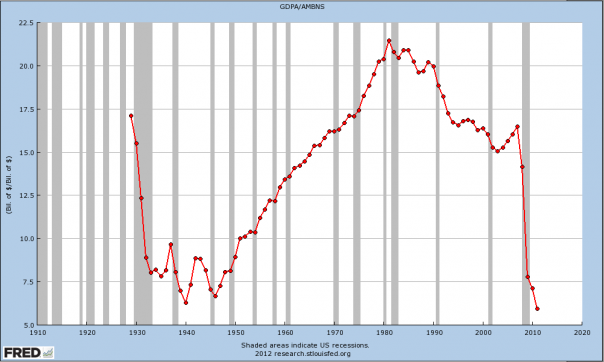
Velocity of money is the  frequency with which a unit of money is spent on new goods and services.   It is a far better indicator of economic activity than GDP, consumer prices, the stock market, or sales of men’s underwear (which Greenspan was fond of ogling).  In a healthy economy, the same dollar is collected as payment and subsequently spent many times over.  In a depression, the velocity of money goes catatonic.  Velocity of money is calculated by simply dividing GDP by a given money supply.  This VoM chart using monetary base  should end any discussion of what ”this” is and whether or not anybody should be using the word “recovery” with a straight face:

In just four short years, our “enlightened” policy-makers have slowed money velocity to depths never seen in the Great Depression.

(As we’ve previously explained, the Fed has intentionally squashed money multipliers and money velocity as a way to battle inflation. And see this)

Indeed, the number of Americans relying on government assistance to obtain basic food may be higher now that during the Great Depression.  The only reason we don’t see the “soup lines” like we did in the 30s only because of the massive food stamp program.

Continue reading »

Tags: , , , , , , , , , , , , , , , , , , , , , ,

Sep 10

- The Bill Clinton Myth (ZeroHedge, Sep 9, 2012):

Earlier this week, former U.S. president Bill Clinton gave the keynote address to the Democractic National Convention in an effort to lend some of his popularity to Barack Obama.  With the unemployment rate still stubbornly high at 8.1%, Obama has lost many of the enthused voters who put him into the Oval Office in 2008.  Clinton was tapped to deliver the speech not only because of his image of a wonkish pragmatist but because of his presiding over the booming economy of the late 1990s.  Like a prized mule, Clinton was dragged out to give Democrats someone to point to and say that his policies were the hallmark of smart governance. Continue reading »

Tags: , , , , , , , , , , , , , , , ,

Aug 05

- US shirked its responsibility to the global economy – top Russian economist (RT, August 04, 2011):

The former head of Russia’s Central Bank has said that the US is to some extent Indebted to the entire world and that in a unipolar system which keeps pursuing globalization, this spells an inevitable collapse.

­RT: Mr. Gerashchenko, hello and thank you very much for being here. You became head of Centrobank [Russia's Central Bank] when Russia began pursuing its ‘shock therapy’ policy, following advice from American experts. How would you advise your American colleagues now, with the situation they are facing?

Viktor Gerashchenko: Live within your means, that’s all. That’s just what they told us back then, with no idea at all about our economic and social situation at the time. That was in 1992, when we began – well, parts of the government began – to listen to their advice after Russia joined the IMF that year. Later, they wrote – and the famous Stieglitz, a Nobel laureate and former economic advisor to Clinton, was among them – that they were doing everything wrong. What they were telling us was all wrong. Continue reading »

Tags: , , , , , , , , , ,

Oct 03

It is correct that the euro, the dollar and the pound will not survive and that a new world currency will be proposed as the only solution to all problems.

Deficit spending (Keynesianism) is an invention of elite criminals that want to loot and bankrupt the people:

“In the absence of the gold standard, there is no way to protect savings from confiscation through inflation. … This is the shabby secret of the welfare statists’ tirades against gold. Deficit spending is simply a scheme for the confiscation of wealth. Gold stands in the way of this insidious process. It stands as a protector of property rights. If one grasps this, one has no difficulty in understanding the statists’ antagonism toward the gold standard.”
- Alan Greenspan

“When a country embarks on deficit financing and inflationism you wipe out the middle class and wealth is transferred from the middle class and the poor to the rich.”
- Ron Paul

“Deficits mean future tax increases, pure and simple. Deficit spending should be viewed as a tax on future generations, and politicians who create deficits should be exposed as tax hikers.”
- Ron Paul


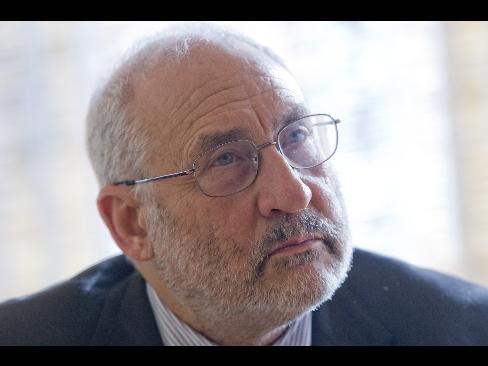
Joseph Stiglitz, one of the world’s leading economists, has warned that the future of the euro is “looking bleak” and the fragile European economic recovery could be irreparably damaged by a “wave of austerity” sweeping the continent.
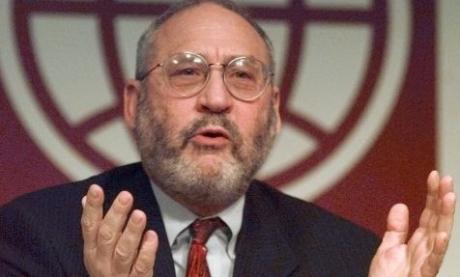

Joseph Stiglitz, the Nobel prize winner, warned that speculators are putting pressure on Spain

The former chief economist of the World Bank and a Nobel prize winner also predicted that short-term speculators in the market could soon start putting pressure on Spain, which is struggling with a large deficit and high unemployment. Last week, Moody’s cut the country’s credit rating from AAA to Aa1.

The former adviser to President Bill Clinton also says that the banking sector has gone back to “business as usual” too quickly and that there are still risks of another financial crisis despite some improvements in regulation.

Mr Stiglitz, now a professor at Columbia Business School, makes the arguments in an updated edition of his book, Freefall, on the credit crunch. In the new material, exclusively extracted in today’s Sunday Telegraph, he reveals fears that governments around the world will attempt to cut their deficits too quickly and risk a double dip recession.

Tomorrow, George Osborne will outline the Government’s latest plans for multi-billion pound public sector cuts to tackle the historically-high UK deficit. He has faced criticism that the Coalition is in danger of cutting too hard and too fast but the Chancellor has said that without a credible programme for getting the UK economy into balance, interest rates will rise and growth will be choked off.

“The worry is that there is a wave of austerity building throughout Europe and even hitting America’s shores,” Mr Stiglitz said. “As so many countries cut back on spending prematurely, global aggregate demand will be lowered and growth will slow – even perhaps leading to a double-dip recession.

“America may have caused the global recession but Europe is now responding in kind.”

Mr Stiglitz warned that Spain, similarly to Greece, was now in the speculators’ sights.

Continue reading »

Tags: , , , , , ,

Mar 05

joseph-stiglitz
Joseph Stiglitz

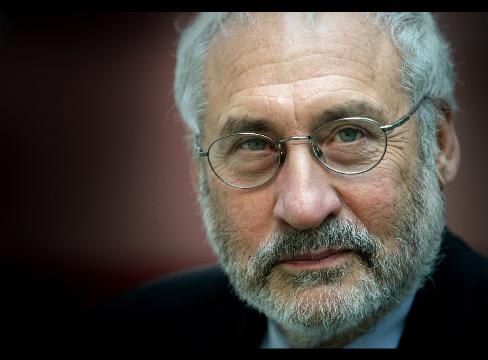
Joseph Stiglitz – former head economist at the International Monetary Fund (IMF) and a nobel-prize winner – said yesterday that the very structure of the Federal Reserve system is so fraught with conflicts that it is “corrupt” and undermines democracy.

Stiglitz said:

If we [i.e. the IMF] had seen a governance structure that corresponds to our Federal Reserve system, we would have been yelling and screaming and saying that country does not deserve any assistance, this is a corrupt governing structure.

Stiglitz pointed out that – if another country had presented a plan to reform its financial system, and included a regulatory regime that copied the makeup of the Federal Reserve system – “it would have been a big signal that something is wrong.”

Stiglitz stressed that the Fed banks have clear conflicts of interest, since the banks are largely governed by a board of directors that includes officers of the very banks they’re supposed to be overseeing:

So, these are the guys who appointed the guy who bailed them out … Is that a conflict of interest?

They would say, ‘no conflict of interest, we were just doing our job. But you have to look at the conflicts of interest”…

The reason you talk about governance is because in a democracy you want people to have confidence … This is a structure that will undermine confidence in a democracy.

Indeed, by all objective measures, the Fed has performed horribly (and see this). Continue reading »

Tags: , , , , , ,