https://youtu.be/JEHxI_AERbQ
* * *
PayPal: Donate in USD
PayPal: Donate in EUR
PayPal: Donate in GBP
The man who trades freedom for security does not deserve nor will he ever receive either. – Benjamin Franklin
https://youtu.be/JEHxI_AERbQ
* * *
PayPal: Donate in USD
PayPal: Donate in EUR
PayPal: Donate in GBP
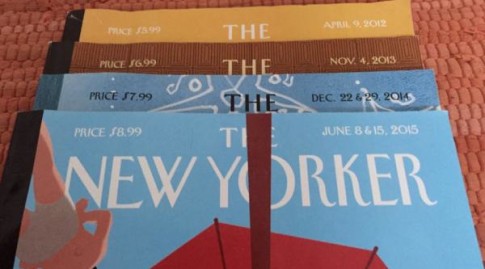
– Inflation Hidden in Plain Sight:
Can we be honest and say that many of the reductions in value, quantity and quality are actually instances of fraud?
Yesterday, I showed how Consumer Prices Have Soared 160% Since 2001 for everything from burritos to healthcare. This enormous loss of purchasing power is not reflected in the official measure of inflation, which claims inflation is subdued (1% or so annually).
But price inflation doesn’t necessarily reflect all the inflation that’s hidden in plain sight in smaller quantities and declining quality. We’ve all observed prices of consumer items remaining the same while the amount of the product we receive for our money is less than it was a few years ago.

– The Burrito Index: Consumer Prices Have Soared 160% Since 2001:
Calculating the real inflation rate
In our household, we measure inflation with the “Burrito Index”: How much has the cost of a regular burrito at our favorite taco truck gone up?
Since we keep detailed records of expenses (a necessity if you’re a self-employed free-lance writer), I can track the real-world inflation of the Burrito Index with great accuracy: the cost of a regular burrito from our local taco truck has gone up from $2.50 in 2001 to $5 in 2010 to $6.50 in 2016.
That’s a $160% increase since 2001; 15 years in which the official inflation rate reports that what $1 bought in 2001 can supposedly be bought with $1.35 today.
Read moreThe Burrito Index: Consumer Prices Have Soared 160% Since 2001
In what may be merely a peculiar case of serendipity, just last night we mentioned the name of the infamous president of Weimar Republic’s Reichsbank, Rudolf von Havenstein, in the context of the BOJ’s proud announcement that it now held more than a third of all Japanese government bonds at the end of March (so even more currently).
BOJ SAYS IT HELD 33.9% OF JGBS AT END-MARCH.
First one to 100% wins the Rudy von Havenstein economics prize— zerohedge (@zerohedge) June 16, 2016
Well, either Citi’s Gregory Marks was following our amused observation, or in an act of odd confluence of thought invoked the spirit of Rudy von Havenstein completely independently, when overnight he unleashed a furious tirade at both negative rates and “utterly misguided” central bank policies in general and negative rates in particular in “Let’s Take Stock: The Efficacy and Merit of Negative Rates.”
The full note, which is on par with Deutsche Bank’s just as angry recent rant against the ECB, is presented in its entirety below.

– LIES, LIES AND OMG, MORE LIES:
It’s that time of year again. It’s open enrollment for health plans at my employer. They are biggest employer in Philly and have the most leverage possible with the insurance companies. They have such good leverage that my premiums are going up “only” 9.8% this year for a basic HMO plan. Based on what I hear from others, I should be thankful for just a 9.8% increase.
This isn’t a new development. Since I’ve been tracking all my expenditures using Quicken since 1991, I know exactly what my annual health insurance costs have been every year. Obamacare was passed in 2009 and began to be implemented in 2010. Obama declared that families could expect $2,500 of savings per year. I know for a fact my annual medical expenses were $2,000 higher in 2015 than they were in 2010.
“Everything calls peace, Schalom! Then it will occur – a new Middle East war suddenly flames up, big naval forces are facing hostiley in the Mediterranean – the situation is strained. But the actual firing spark is set on fire in the Balkan: I see a “large one” falling, a bloody dagger lies beside him – then impact is on impact. …”
There is not much information about Alois Irlmaier available on the internet in English and even less good quality information.
He made his predictions before, during and after WW2.
For more and accurate information I recommend this book (in German):
He predicted the migrant crisis.
He predicted hyperinflation, financial collapse, revolution, civil war, WW3 and the “3 Days Of Darkness”, which will set in during WW3 and will put an immediate end to all combat operations.
He saw (around 1950) people using smartphones in the future.
When Germany was occupied territory he was visited by General Lucius D. Clay’s sister and could clearly describe her home without ever being there. General Clay invided Irlmaier to come to Frankfurt, but he declined. Additionally he was offered and invited many times by a lot of people to come to America (Amerika in German) and earn a lot of money there with his abilities, but he declined. He clearly stated that he was not interested in earning a lot of money.
In case you think that foreseeing the future is impossible I give you some examples of his abilities:
Alois Irlmaier, my favorite seer, warned the citizens of his hometown during the end of WW2 April, 25, 1945, that at the moment of his warning British bombers were started in England and would arrive within a few hours to bomb the city of Freilassing in Bavaria.
He told the people where to go to be safe and he pointed out exactly to some people, which houses will be destroyed, partially destroyed or which houses will survive almost unharmed or totally unharmed.
He warned people in Rosenheim, Bavaria days ahead of the heavy bombardment on April 18, 1945. He told the people, that when going into the bunker to NOT go to the safest spot, which is in the middle, but to stay near the entrance, because the roof of the bunker would collapse in the middle. It happened just as he predicted and so only a few soldiers who ridiculed and ignored Irlmaier’s warning were buried.
You could give him a picture of any soldier and he could tell you exactly in what condition that soldier was at the moment: Well, injured or dead.
He clearly saw all of this right in front of his eyes, as a picture or like a movie. He did not want to have this ability at all.
It would take an entire book to describe his abilities, his life and what has been said about him.
Here is what lies ahead of us according to him:
A migrant crisis, high inflation, then hyperinflation, financial economic collapse, chaos, revolution, civil war in Italy (Pope will have to flee the Vatican, most priests will be killed), France (Paris will burn, will be set on fire by its own people), Germany, etc.
If my interpretation of what he said is correct, then the greatest revolution of all times will happen in America.
The crisis in the middle east will escalate even further, a highranked (at the level of Trump) will be killed, then within 24h Russian tanks will be rolling all over Europe.
The U.S. will use drones & advanced chemical weapons to create a death strip to cut of the Russian ordnance.
The Russians drop a bomb (nuclear weapon) into the North Sea, creating a gigantic tsunami, which will flood parts of England, France, Holland, Germany and Denmark.
The start of WW3 is predicted to happen “when the grain will be ready for harvest” (perfect timing!), that means around late July, beginning of August. A lot of other seers have seen the same time of the outbreak of WW3 in their visions.
The war will last around 3 months, then the earth changes will set in. Irlmaier saw a heavenly body, which is probably responsible for the “3 Days Of Darkness”.
The “3 Days of Darkness” will include a pole shift. So you need to be living in a high place, having a safe place that is pretty much airtight, protecting against the (big) dust particles from the heavenly body and you need lots of supplies and water.
After that he predicts a peaceful time.
“….After these events a long, lucky time comes. Those, who will experience it, will be very happy and can praise themselves lucky. But the people have to begin there, where their grandfathers began.”
And because of the climatic changes, caused by the pole shift, oranges will grow in Bavaria.
The events mentioned in the following article are not in the correct chronological order, but luckily for us somebody made the effort to translate what Irlmaier said.

(1894-1959)
– The Prophecies Of Alois Irlmaier
On this page statements of Alois Irlmaier are listed, which refer to a big war in the future. Conrad Adlmaier got these statements when discussing with Alois Irlmaier and published them later. In addition also statements are listed, which Conrad Adlmaier did not publish in his books, but indicated to a third person orally. In these statements Alois Irlmaier shows an almost precise description of a large battle in the future.
What causes the war?
“Everything calls peace, Schalom! Then it will occur – a new Middle East war suddenly flames up, big naval forces are facing hostiley in the Mediterranean – the situation is strained. But the actual firing spark is set on fire in the Balkan: I see a “large one” falling, a bloody dagger lies beside him – then impact is on impact. …”
“Two men kill a third highranked. They were paid by other people. …”
“The third murder occurred. Then the war starts. …”
– Hyperinflating Venezuela Used 36 Boeing 747 Cargo Planes To Deliver Its Worthless Bank Notes:
The weeks ago, when we showed “What The Death Of A Nation Looks Like: Venezuela Prepares For 720% Hyperinflation“, we said that after looking at a chart of Venezuela’s upcoming hyperinflation…
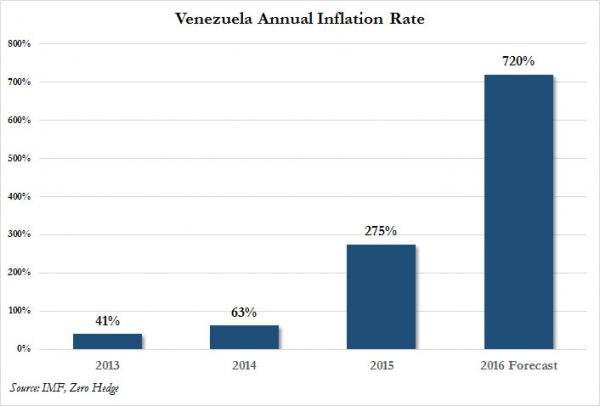
… a hyperinflation in which the soaring stock market has failed to keep pace with the collapsing currency, thereby mocking all erroneous thought experiments that under hyperinflation being long the stock market is a sure hedge to currency destruction…
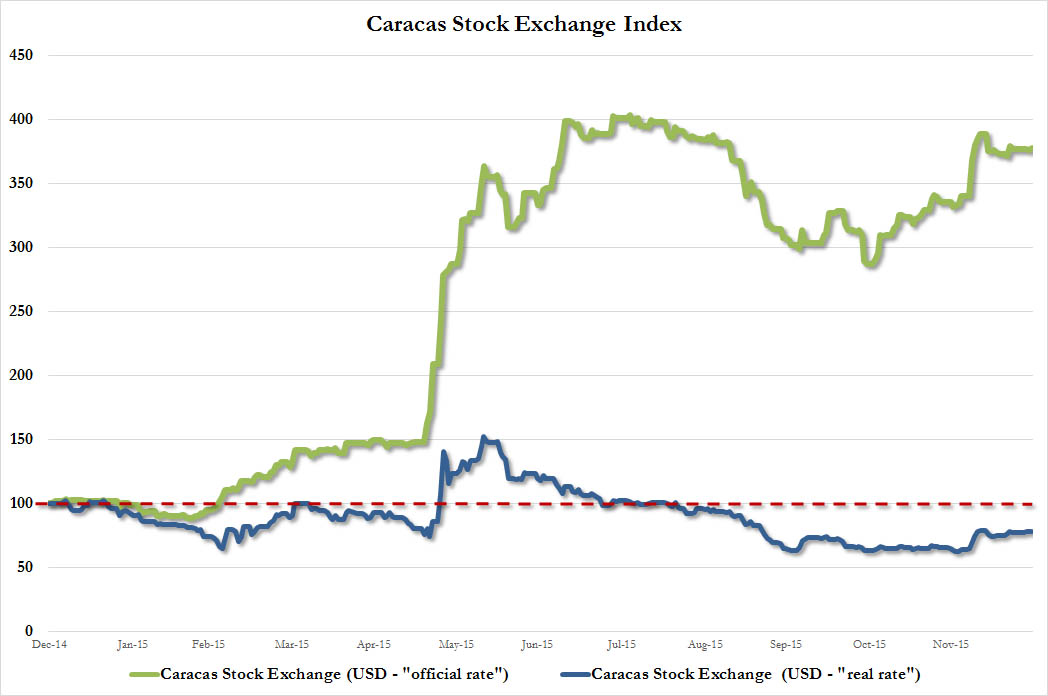
… we joked that it is unclear just where the country will find all the paper banknotes it needs for all its new currency.
Due to a “perfect storm” of inflationary factors – not the least of which being the continuing drop in oil prices – Canadians are seeing the effects of a weakening currency reflected in food prices at the supermarket.
$3 cucumbers, $8 for a head of cauliflower, grapes at $10 per bag – the spiraling cost of foods, particularly those imported from Canada’s neighbor to the south, has consumers there reeling from sticker shock.
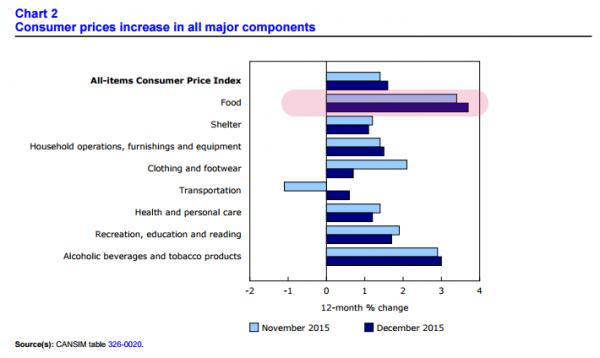
Earlier this month, we documented the surging price of fresh produce in Canada, where the plunging loonie is creating a nightmare for shoppers in grocery aisles across the country.
Because Canada imports more than three quarters of its fresh fruits and vegetables, the inexorable decline of the Canadian dollar has driven up prices on everything from cucumbers to cauliflower to tomatoes, and as we showed via a series of tweets from incredulous supermarket shoppers, Canadians are not pleased.
“Three bucks. For a cucumber,” one shopper wrote.
“Had a similar reaction when I saw the price of cauliflower,” another said. “Welcome to the future..”
FYI.
https://www.youtube.com/watch?v=LmRtt-_ol4c
Sep 12, 2015
Ron Paul speaks on the upcoming financial collapse that will be far worse than the 2008 collapse. It’s not a matter of if but when it will happen.

H/t reader squodgy:
I often wondered what happened to the predicted hyperinflation following QE.
It never happened.
OK, inflation in school fees, obamacare etc has been negated by cheap oil, and yes, food costs are indeed rising, but the expected rampant inflation across the board never happened….why?
It made the doom-mongers look daft.
Here’s why…..we never saw it, it all went to the club.
– I was asked: Whatever Happened to Inflation after all this Money-Printing?
* * *
In my opinion real hyperinflation (incl. consumer price inflation) is coming and the euro, the dollar and the Japanese yen will become worthless.
It will take just a little longer.
– Kiev announces 44% inflation in 2015:
Ukraine’s Central Bank has reported a 44 percent hike in inflation this year. However, Kiev’s economists are optimistic about 2016 as they announced a 12 percent inflation target.According to Central Bank head Natalya Gontareva, the 44 percent rise is an improvement on 60.9 percent inflation in April.
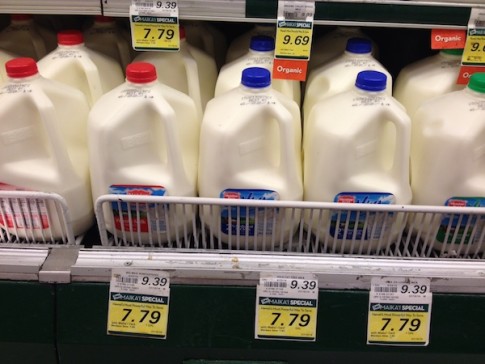
– 12 examples of Hawaii food prices that may shock you! *PHOTOS*:
HILO, Haw. (INTELLIHUB) — After looking through our monthly expenses for our family of three, I was shocked to find that we are spending well over $2000 a month on groceries locally. So when I went to the grocery store I snapped a few pictures that may shock you as Hawaii food prices continue to skyrocket.
…
– El Nino hits dinner table; food costs soar most in 3 years:
The effects of El Nino are starting to reach the dinner table, with global food prices rising the most in three years on supply concerns for everything from New Zealand milk to sugar in Brazil and Southeast Asian palm oil.
An index of 73 food prices increased 3.9 percent, the biggest jump since July 2012, to 162 in October, the United Nations Food & Agriculture Organization wrote in a report Thursday.
The return of the El Nino weather phenomenon is changing weather conditions around the world, damaging crops with too much rain in some areas and not enough in others.
– Inflation Watch – Butter Prices Hit All-Time Record High:
Butter prices hit $3.10 per lb today in Chicago trading – a record high – as it appears the expectations of production increases after the EU milk quota system expired in March have proved “wildly optimistic.” Of course, no one should complain at the rising cost of staples like butter (or toilet paper), just ask Jamie Dimon… “let them eat iPhones.”
– LIES, DAMNED LIES & STATISTICS (Washington’s Blog, July 19, 2015):
The government released their monthly CPI report this week. Even though it came in at an annualized rate of 3.6%, they and their mouthpieces in the corporate mainstream media dutifully downplayed the uptrend. They can’t let the plebs know the truth. That might upend their economic recovery storyline and put a crimp into their artificial free money, zero interest rate, stock market rally. If they were to admit inflation is rising, the Fed would be forced to raise rates. That is unacceptable in our rigged .01% economy. There are banker bonuses, CEO stock options, corporate stock buyback earnings per share goals and captured politician elections at stake.
The corporate MSM immediately shifted the focus to the annual CPI figure of 0.1%. That’s right. Your government keepers expect you to believe the prices you pay to live your everyday life have been essentially flat in the last year. Anyone who lives in the real world, not the BLS Bizarro world of models, seasonal adjustments, hedonic adjustments, and substitution adjustments, knows this is a lie. The original concept of CPI was to measure the true cost of maintaining a constant standard of living. It should reflect your true inflation of out of pocket costs to live a daily existence in this country.

– Japan’s Economic Disaster – Real Wages Lowest Since 1990, Record Numbers Describe “Hard” Living Conditions (Liberty Blitzkrieg, July 13, 2015):
With so much attention rightly focused on China at the moment (see: Chinese Authorities Arrest Over 100 Human Rights Activists and Lawyers in Desperate Crackdown on Dissent), people aren’t paying enough attention to the budding economic calamity unfolding in Japan.
While “Abenomics” has succeeded in boosting the stock market and food prices, it has utterly failed to raise wages. In fact, wages adjusted for inflation have plunged to the lowest since 1990. As such, a record number of households now describe their living conditions as “somewhat hard” or “very hard.”
Confused where all the inflation that the Fed is either unable, or simply refuses to measure, is hiding? The answer: right under your roof.
– The Mystery Of The “Missing” Inflation Solved: Record Number Of US Renters Can’t Afford Housing (ZeroHedge, June 24, 2015)

– The War On Cash: Officially Sanctioned Theft (Of Two Minds, June 13, 2015):
While the benefits to banks and governments of banning physical cash are self-evident, there are downsides to the real economy and to household resilience.
You’ve probably read that there is a war on cash being waged on various fronts around the world. What exactly does a war on cash mean?It means governments are limiting the use of cash and a variety of official-mouthpiece economists are calling for the outright abolition of cash. Authorities are both restricting the amount of cash that can be withdrawn from banks, and limiting what can be purchased with cash.These limits are broadly called capital controls.The War On Cash: Why Now?
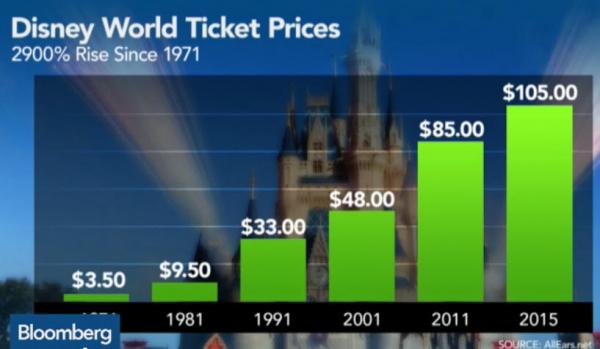
– Inflation Watch: Prices To “The Happiest Place On Earth” Are Up 2900% Since 1971 (ZeroHedge, May 25, 2015):
Having previously shown that money can buy happiness, it appears, as Bloomberg reports, that the cost of buying that happiness is soaring. With well-managed government-provided statistics on inflation, why would one look elsewhere for clues as to the declining standards of living across much of America… but look we did and with wages stagnant, the 2900% surge in prices to Disneyland since 1971 makes ‘the happeist place on earth’ a place only the wealthy can afford to visit.