Nov 21

Turkey is reported to be in negotiations with the International Monetary Fund for a $40 billion loan. Very shortly, the Baltic States and at least a dozen developing countries will be filing for IMF handouts. But how will the venerable lender of last resort fund itself?

According to a fact sheet posted on its website in October, the IMF had $200 million available for emergency loans to the third-world, and another $50 billion in “additional resources”. But the IMF’s liquidity is rapidly dwindling. Between the crisis facilities concluded with Ukraine, Hungary, Serbia, Iceland and Pakistan, and the expected spate of new loan requests, the IMF should be running out of money within the first quarter of next year. Quite simply, unless the rich nations (including American tax-payers) can add to the IMF’s funding capabilities, the global recession will cause unprecedented havoc, chaos, hunger and turmoil in the world’s poverty pockets.

Continue reading »

Tags: , , , , , , , , , , ,

Nov 08

A woman waited last month for a bank to open in Reykjavik, where everyone has been affected by the financial failure.

REYKJAVIK, Iceland - The collapse came so fast it seemed unreal, impossible. One woman here compared it to being hit by a train. Another said she felt as if she were watching it through a window. Another said, “It feels like you’ve been put in a prison, and you don’t know what you did wrong.”

This country, as modern and sophisticated as it is geographically isolated, still seems to be in shock. But if the events of last month - the failure of Iceland’s banks; the plummeting of its currency; the first wave of layoffs; the loss of reputation abroad - felt like a bad dream, Iceland has now awakened to find that it is all coming true.

It is not as if Reykjavik, where about two-thirds of the country’s 300,000 people live, is filled with bread lines or homeless shanties or looters smashing store windows. But this city, until recently the center of one of the world’s fastest economic booms, is now the unhappy site of one of its great crashes. It is impossible to meet anyone here who has not been profoundly affected by the financial crisis.

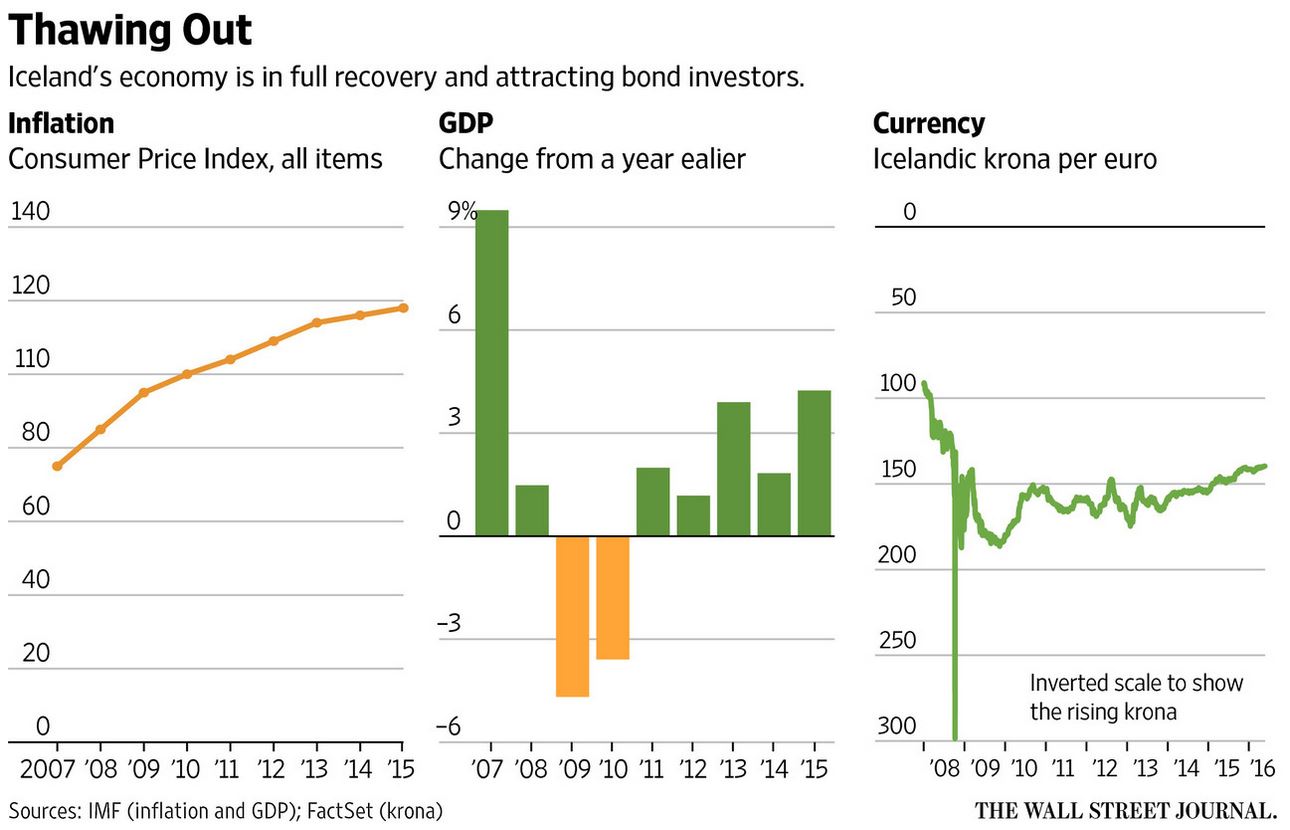
Overnight, people lost their savings. Prices are soaring. Once-crowded restaurants are almost empty. Banks are rationing foreign currency, and companies are finding it dauntingly difficult to do business abroad. Inflation is at 16 percent and rising. People have stopped traveling overseas. The local currency, the krona, was 65 to the dollar a year ago; now it is 130. Companies are slashing salaries, reducing workers’ hours and, in some instances, embarking on mass layoffs.

“No country has ever crashed as quickly and as badly in peacetime,” said Jon Danielsson, an economist with the London School of Economics.

Continue reading »

Tags: , , ,

Oct 28

The International Monetary Fund may soon lack the money to bail out an ever growing list of countries crumbling across Eastern Europe, Latin America, Africa, and parts of Asia, raising concerns that it will have to tap taxpayers in Western countries for a capital infusion or resort to the nuclear option of printing its own money.

IMF's work in countries such as Turkey is only just beginning
IMF’s work in countries such as Turkey is only just beginning

The Fund is already close to committing a quarter of its $200bn (£130bn) reserve chest, with a loans to Iceland ($2bn), Ukraine ($16.5bn), and talks underway with Pakistan ($14.5bn), Hungary ($10bn), as well as Belarus and Serbia.

Neil Schering, emerging market strategist at Capital Economics, said the IMF’s work in the great arc of countries from the Baltic states to Turkey is only just beginning.

“When you tot up the countries across the region with external funding needs, you get to $500bn or $600bn very quickly, and that blows the IMF out of the water. The Fund may soon have to start calling on the West for additional funds,” he said.

Brad Setser, an expert on capital flows at the Council for Foreign Relations, said Russia, Mexico, Brazil and India have together spent $75bn of their reserves defending their currencies this month, and South Korea is grappling with a serious banking crisis.

“Right now the IMF is too small to meet the foreign currency liquidity needs of the larger emerging economies. We’re in a dangerous situation and there is the risk of extreme moves in the markets, as we have seen with the Brazilian real. I hope policy-makers understand how serious this is,” he said.

The IMF, led by Dominique Strauss-Kahn, has the power to raise money on the capital markets by issuing `AAA’ bonds under its own name. It has never resorted to this option, preferring to tap members states for deposits.

The nuclear option is to print money by issuing Special Drawing Rights, in effect acting as if it were the world’s central bank. This was done briefly after the fall of the Soviet Union but has never been used as systematic tool of policy to head off a global financial crisis.

“The IMF can in theory create liquidity like a central bank,” said an informed source. “There are a lot of ideas kicking around.”

Continue reading »

Tags: , , , , , , , , , , , , , , , , , , , , , ,

Oct 28


Pedestrians leave the Central Bank of Iceland in Reykjavik, Iceland, on Oct. 7, 2008. Photographer: Arnaldur Halldorsson/Bloomberg News

Oct. 28 (Bloomberg) — Iceland’s central bank unexpectedly raised the benchmark interest rate to 18 percent, the highest in at least seven years, after the island reached a loan agreement with the International Monetary Fund.

Policy makers raised the key rate by 6 percentage points, the Reykjavik-based bank said in a statement today, taking the rate to the highest since the bank began targeting inflation in 2001.

“I don’t think 6 percentage points will make the krona any more attractive,” said Henrik Gullberg, a strategist at Deutsche Bank AG in London. “Basically what we’re seeing is a complete liquidation of everything in emerging markets, and Iceland, even in the emerging-market universe, is very vulnerable. Six percent isn’t worth a lot if the currency drops another 15 percent.”

The central bank is raising rates as Iceland, the first western nation to seek financial help from the IMF since the U.K. in 1976, faces an economic contraction, coupled with possible hyperinflation and rising joblessness. The economy will shrink as much as 10 percent next year, the IMF forecasts. Iceland will receive about $2.1 billion from the Washington-based fund, according to a deal struck on Oct. 24.

Continue reading »

Tags: , , , , , , , , , , ,

Oct 23

FRANKFURT (Reuters) - German banks lent the most to Icelandic borrowers and were owed $21 billion before the recent financial storm swept markets, according to figures released by the Bank for International Settlements.

The research shows that German banks, as well as handing out almost one third of loans in the Nordic outpost, are the most exposed to some of Europe’s fragile economies, such as Spain and Ireland.

In a snapshot taken at the end of June, Germany’s banks lent far more in crisis-stricken Iceland than had rivals in Britain, who were owed just $4 billion, or Iceland’s neighbor Sweden with less than $400 million.

Despite being Europe’s biggest economy, Germany’s levels of lending to countries such as Iceland are disproportionately high.

And in the week that Berlin launched a rescue plan for its banks, the first signs were emerging that lending at the height of the Icelandic bubble had come back to haunt Germany.

BayernLB, a state-backed regional lender that was the first to seek government help this week, said it expected to write off 800 million euros ($1.03 billion) of its 1.5 billion euro exposure to the tiny island state.

Continue reading »

Tags: , , , , ,

Oct 22

Oct. 22 (Bloomberg) — Investors are taking losses of up to 90 percent in the $1.2 trillion market for collateralized debt obligations tied to corporate credit as the failures of Lehman Brothers Holdings Inc. and Icelandic banks send shockwaves through the global financial system.

The losses among banks, insurers and money managers may spark the next round of writedowns on CDOs after $660 billion in subprime-related losses. They may force lenders to post more reserves against losses after governments worldwide announced $3 trillion in financial-industry rescue packages since last month, according to Barclays Capital.

“We’ll see the same problems we’ve seen in subprime,” said Alistair Milne, a professor in banking and finance at Cass Business School in London and a former U.K. Treasury economist. “Banks will take substantial markdowns.”

The collapse of Lehman Brothers, Washington Mutual Inc. and the three banks in Iceland prompted Susquehanna Bancshares Inc., a Lititz, Pennsylvania-based lender, to lower the value of $20 million in so-called synthetic CDOs by almost 88 percent last week.

Continue reading »

Tags: , , , , , , , , , , , ,

Oct 14

Shares on the Reykjavik stock exchange plunged by 76 per cent when trading resumed after three days of closure as Iceland’s economy continued to teeter on the brink of collapse.

Shares later recovered to leave the OMX Iceland 15 index down 47 per cent in morning trade.

Market officials said the astounding figure was misleading since the country’s three largest banks - Kaupthing, Landsbanki, Glitnir - which had accounted for three quarters of the exchange’s value, had been removed from the index after they were nationalised last week.

Other financial stocks would remain on the index but would not resume trading until Iceland’s Financial Services Authority gave the green light, the bourse said.

Not counting financial shares, the main index had shed 5 per cent in early afternoon trading.

Trading in three other financial stocks - Straumur-Burdaras, Reykjavik Savings Bank (Spron) and Exista - remain suspended.

The exchange had been suspended since Thursday with the last official trade coming on Wednesday.

Continue reading »

Tags: , , , , ,

Oct 13


Reykjavik, Iceland, on Monday, Oct. 13, 2008. After a four-year spending spree, Icelanders are flooding the supermarkets one last time, stocking up on food as the collapse of the banking system threatens to cut the island off from imports. Photographer: Arnaldur Halldorsson/Bloomberg News

Oct. 13 (Bloomberg) — After a four-year spending spree, Icelanders are flooding the supermarkets one last time, stocking up on food as the collapse of the banking system threatens to cut the island off from imports.

“We have had crazy days for a week now,” said Johannes Smari Oluffsson, manager of the Bonus discount grocery store in Reykjavik’s main shopping center. “Sales have doubled.”

Bonus, a nationwide chain, has stock at its warehouse for about two weeks. After that, the shelves will start emptying unless it can get access to foreign currency, the 22-year-old manager said, standing in a walk-in fridge filled with meat products, among the few goods on sale produced locally.

Continue reading »

Tags: , , , , , , , , ,

Oct 06

Trading in the shares of Icelandic banks was suspended in Reykjavik ahead of an announcement and because of concerns over the pricing of their shares.


Icelandic Prime Minister Geir Haarde is facing a financial meltdown

The suspension covers trading in all financial instruments issued by Kaupthing, Landsbanki, Glitnir, the Icelandic lender bailed out by the government after its short-term funding dried up, Straumur-Burdaras, Exista and Spron.

Iceland’s Financial Services Authority requested the move, the OMX Nordic Exchange in Iceland said. The exchange said: “This decision is made in order to safeguard the equality of investors while awaiting an announcement.”

Iceland’s prime minister Geir Haarde has confirmed the country’s major banks have agreed to “sell their foreign assets and decrease their activity abroad”, as pressure mounted for the government to secure a rescue deal for its ailing financial system.

Continue reading »

Tags: , , , ,

Oct 06

Economy is in turmoil as currency collapses and inflation soars

Iceland was seeking the financial help of the US and Scandinavian countries last night as politicians and businessmen scrambled to save the country’s economy.

Officials were locked in meetings for most of the weekend, with the Government hoping to come to some sort of resolution before stock markets open this morning. The country’s banking problems led to the nationalisation last week of Glitnir, one of its largest lenders, as depositors pulled out their funds.

Continue reading »

Tags: , , , ,