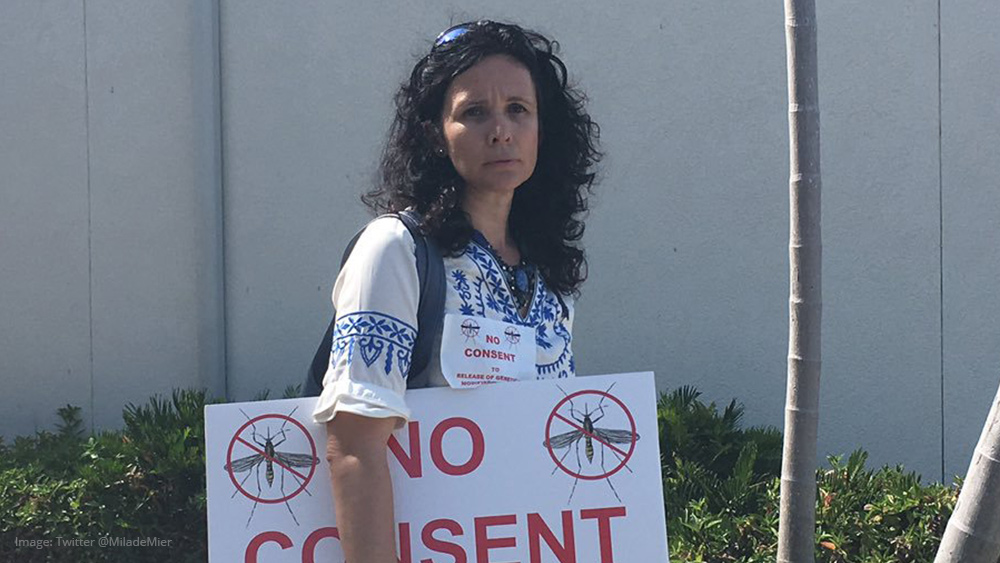
An activist who opposed genetically engineered mosquitoes has been found dead in the swimming pool of a Washington D.C. hotel, just hours before she was due to submit a petition with over 200,000 signatures to the EPA.
Derrick Broze of Activist Post has investigated the story and spoken to a close friend of the victim, whose name is Mila de Mier from Key West, Florida (see below).
The mysterious death has also been covered by WJLA, which reports:
The D.C. Fire Department says the reported incident happened at the Cambria Hotel & Suites Washington, D.C. Convention Center on 899 O Street, NW. They say they were called to the scene at around 9:35 a.m. Medical crews say they attempted to treat the victim but later pronounced her dead.
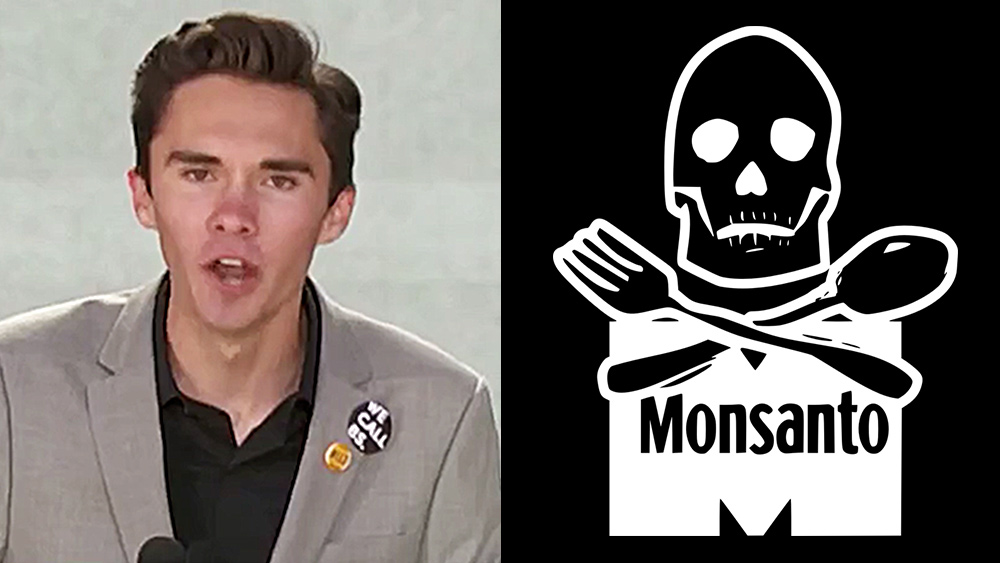
Aside from being the “Hitler Youth” fascist front man for the anti-liberty, anti-gun propagandists of the Left, David Hogg also aligns with Monsanto, one of the most evil corporations in the world. In a recent televised interview (see video clips, below), David Hogg claims that atrazine herbicide doesn’t cause hormone disruption, speaking in lockstep with Monsanto, the anti-science pesticide chemical giant that spends millions of dollars a year funding “black ops” character assassins to defame critics of GMOs, glyphosate and atrazine.
David Hogg, who has arisen as a “Hitler Youth” fascist who demands the government take away the rights of Americans because he feels personally angry, attacked Infowars’ Alex Jones during a recent C-Span interview, falsely claiming that atrazine herbicide chemicals have no effect on hormone disruption in humans. (Yes, C-Span is now allowing an 18-year-old high school non-graduate to lecture America on science, if you can believe that…)
During the Gun Policy & Safety segment on C-Span, Hogg stated:
For example, on InfoWars, one of his most famous statements is saying that tap water turns frogs gay, and it will turn you gay, too. First off, gay people are awesome, I don’t think that’s a problem at all…
The conversation went on to imply that Alex Jones must be insane for thinking that chemical contaminants in the water supply might alter sex hormone expression in mammals — even though this has been exhaustively documented throughout the scientific and medical literature.
American scientists recently found that RT and Sputnik outscored competitors from the US on the number of articles they publish on GMOs. The researchers expressed fears that the activity of the Russian media could harm the American GMO industry, which intends to establish a dictatorship over the global food market.
Source: Tsargrad TV, By Kamran Hasanov (Translated by Sustainable Pulse)
Does the Russian media write too much about GMOs or do the American media write too little?
At the end of February, researchers from Iowa State University published the results of a study in which it was revealed that RT and Sputnik released more articles including the word “GMO” than the old-timers of the American media industry – Huffington Post, Fox News, CNN, Breitbart News and MSNBC – put together.
The largest rural movements in Brazil, representing well over a million farmers, are protesting a new Brazilian regulation that would allow release of gene drives, the controversial genetic extinction technology, into Brazil’s ecosystems and farms.
On February 3rd and 4th, the National Coalition of Farmworkers and Rural, Water and Forest Peoples met near São Paulo, Brazil and sounded the alarm about new Brazilian regulatory changes – a resolution passed on January 15th by Brazil’s National Technical Commission on Biosafety that would allow the release of gene drive organisms into the environment. The effect of this change is that Brazil becomes the first country in the world to establish a legal channel for the release of gene drives into the environment. The new rule could potentially make it even easier to release a living gene drive organism than a GMO seed.
The farmers organizations are concerned about agribusiness giants spreading more transgenic seeds, but also attempts to directly change the nature of wild plants and animals.
The European Court of Justice has been considering whether organisms obtained by mutagenesis are exempt from the EU’s Genetically Modified Organisms Directive.
That might sound esoteric or gobbledygook but both pro- and anti-GMO camps are keenly awaiting the outcome as many believe it will determine the legal status in the EU of the “new genetic engineering techniques”.
It almost certainly won’t but it might set the stage – or one of them.
These techniques are usually and erroneously lumped together and called gene (more properly genome) editing; chief of which is the much vaunted – some might say irresponsibly over hyped and promoted – CRISPR-Cas. Together with “synthetic biology” they make up what has been called GMO 2.0 and are seen by proponents and opponents as the future – direction and/or battleground – of genetic engineering in food and farming.
A genetically modified (GM) rice product developed by a group of Chinese scientists has acquired the US Food and Drug Administration (FDA) approval, the first such Chinese product allowed to enter the US market.
However, neither China nor the US has approved mass cultivation of the rice amid low acceptance from the Chinese public for GM food.
Huahui No.1 rice, developed by the Huazhong Agricultural University, is genetically engineered to resist a wide range of insects, thus reducing the use of pesticides.
On Monday, the U.S. Environmental Protection Agency issued a new report declaring that the weed killer glyphosate does not pose any meaningful risk to humans, but the report is not likely to end the debate over the safety of the world’s most widely used pesticide. The new report from the EPA is the latest in a string of conflicting reports from various health agencies around the world. Reuters first reported on the assessment:
“The EPA, in a draft risk assessment report issued on Monday, also said it found ‘no other meaningful risks to human health’ when glyphosate, the world’s biggest-selling weed killer, is used according to its label instructions.”
The EPA’s decision conflicts with a March 2015 report from the International Agency for Research on Cancer that found that glyphosate “probably” contributes to non-Hodgkin lymphoma in humans and classified it as a ‘Group 2A’ carcinogen. “There was sufficient evidence in animals, limited evidence in humans and strong supporting evidence showing DNA mutations and damaged chromosomes,” Aaron Blair, a scientist emeritus at the National Cancer Institute and lead author of the study, told Reuters at the time.
Dr. Thierry Vrain, former genetic engineer and soil biologist with Agriculture Canada, spoke with us today about his concerns with genetically engineered crops (GMOs) and more importantly, the use of Glyphosate (RoundUp). Dr. Vrain’s background in the field of genetic engineering (for 30 years), makes him an expert on this gene technology. He explained how a cell is genetically engineered and what happens after this random insertion process through a gene gun and how it can have unknown effects.
Since leaving Agriculture Canada 12 years ago, he has learned much more about the process of genetic engineering and the BT process (insect resistant) and the HT (herbicide resistant) crops that make up about 500 million acres. His primary concern at this time is the widespread use of Glyphosate which is a powerful herbicide, mineral chelator and a patented antibiotic. Dr. Vrain stated when speaking about Glyphosate:
“It’s almost as if the entire population of North American is on a low-grade antibiotic diet day in day out from birth, everyday, so this is the reality.”
It seems the Department of Defense wants to get in on the GMO craziness, but not in what you would consider the normal way.
No, the Pentagon has not announced a military-wide transition to genetically modified foods; rather, DARPA— the Defense Advanced Research Project Agency — says it is working on developing a new way to collect battlefield intelligence: Genetically-modified plants.
What could go wrong?
As reported by Futurism, DARPA is calling the project the Advanced Plant Technologies program, and it seeks to transform plants into next-generation surveillance technology.
You might be aware that organic food is better for you than GMO options, but sometimes the price difference can be prohibitive. If you’ve ever stood in the produce section of the supermarket and asked yourself if the higher price tag on organic offerings is worth it, the results of a peer-reviewed study published recently in the International Journal of Human Nutrition and Functional Medicine will probably help make that decision a lot easier.
The survey of 3,256 people found that 28 conditions could be reversed by switching to a mostly non-GMO and organic diet. This research is consistent with physician reports that show the power of making this type of dietary improvement.
The respondents were asked, among other questions, what conditions or symptoms they have seen improve since making the switch to a GMO-free diet. For each of the 28 symptoms listed, they chose between “some mild improvement,” “moderate improvement,” “significant improvement,” “nearly gone,” “complete recovery” and “not applicable,” which was the default.
When scientists deactivated the gene responsible in part for developing and shaping the heads of scarab beetles, the insects hatched with an extra set of compound eyes in the middle of their heads, sometimes forming together into one big third eye. And now, the scientists have learned that the extra eyes actually work.
Biologists from Indiana University discovered last year how a gene called orthodenticle prevented scarab beetles from developing these extra eyes during development. When the biologists disabled the gene, the beetles developed an extra eye (or pair of eyes). It’s a common practice in science: Learn how something works, take it apart one piece at a time and see what changes.
The Bulgarian Parliament has passed ammendments to the Food Act on Thursday prohibiting the promotion of unhealthy foods, including food containing GMOs, to children. 102 Bulgarian MPs voted for the changes to the law, only one voted against, and 29 abstained.
Advertisers in Bulgaria will now be stopped from targeting children in promotional material on TV and in print for foods deemed unhealthy, including those containing GMOs. The unique law also prohibits children from taking part in commercials promoting unhealthy foods.
The importance of regulating advertisements on the internet and other remote sales of food was included in the law.
This website uses cookies to improve your experience. We'll assume you're ok with this, but you can opt-out if you wish.AcceptRejectRead More https://infiniteunknown.net/dsgvo/
Privacy & Cookies Policy
Privacy Overview
This website uses cookies to improve your experience while you navigate through the website. Out of these, the cookies that are categorized as necessary are stored on your browser as they are essential for the working of basic functionalities of the website. We also use third-party cookies that help us analyze and understand how you use this website. These cookies will be stored in your browser only with your consent. You also have the option to opt-out of these cookies. But opting out of some of these cookies may affect your browsing experience.
Necessary cookies are absolutely essential for the website to function properly. This category only includes cookies that ensures basic functionalities and security features of the website. These cookies do not store any personal information.
Any cookies that may not be particularly necessary for the website to function and is used specifically to collect user personal data via analytics, ads, other embedded contents are termed as non-necessary cookies. It is mandatory to procure user consent prior to running these cookies on your website.