If the government’s official statistics are to be believed the U.S. economy is moving full steam ahead. Consumers are spending, the job market is expanding, real estate has recovered, stocks are soaring and the U.S. dollar is stronger than it has been in a decade.
But if you have yet to realize it, it’s all a lie. So says billionaire investor Eric Sprott of Sprott Global, which manages hundreds of millions of dollars in contrarian investment funds for clients all over the world. Well known for his long-term bullishness on the resource sector, specifically precious metals, Sprott joined First Mining Finance chairman Keith Neumeyer in a must-see interview where the pair discuss everything from the state of the global economy and trade to gold market manipulation and the inevitable breakdown of highly leveraged paper trading exchanges.
Eric Sprott
Eric Sprott, Gold & Silver Update (Video)
28.02.2015
Eric Sprott: ‘Manipulation Of Gold By Central Banks Cannot Continue In 2014’
– Sprott: “Manipulation Of Gold By Central Banks Cannot Continue In 2014” (ZeroHedge, Jan 17, 2014):
With Deutsche Bank quitting the price-setting panel for gold and Bafin bearing down on the manipulators, Eric Sprott provides some more color on where the manipulation in the precious metals markets is underway (and when it will end)…
Submitted by Eric Sprott of Sprott Global Resource Investments,
Introduction
As we very well know, 2013 was a difficult but also puzzling year for precious metals investors. The price of gold, silver and their related equities declined by a significant amount while demand for physical bullion from emerging markets and their Central Banks was exceptionally strong.
Read moreEric Sprott: ‘Manipulation Of Gold By Central Banks Cannot Continue In 2014’
Marc Faber On Central Banker Actions: ‘Insane People Don’t Realize They’re Insane’ (Video)
– Marc Faber On Central Banker Actions: “Insane People Don’t Realize They’re Insane” (ZeroHedge, July 30, 2013):
While we know that the Fed will be forced to taper in the short-term as it desperately avoids the ‘appearance’ of outright monetization that a falling deficit will create, Marc Faber sums up the endgame perfectly in this clip: “I don’t think they will come to their senses for the simple reason that insane people don’t realize that they are insane.” Faber adds, “they think they’re doing a great job,” and in fact they believe – in general – that “if anything, we need to do more, not less.” The ‘forced-taper-to-plunge-to-untaper’ progression means it’s going to get worse; as Faber notes, QE/printing will continued indefinitely “until the system breaks down.” Having printed this much money with such dismal results, Faber concludes, “the Fed is completely clueless.”
Faber covers a wide-range of topics in this excellent interview – from Fed insanity and cluelessness to Gold confiscation and from China’s dishonesty to the destabilizing reality of Stability-hoping Keynesianism…
Will the Fed stop printing?
Read moreMarc Faber On Central Banker Actions: ‘Insane People Don’t Realize They’re Insane’ (Video)
Silver Is Winning India’s ‘War On Gold’
Sprott had its origins in Sprott Securities Ltd., a brokerage firm founded in 1981 by Eric Sprott.
Today, Sprott manages approximately $10 billion in assets and operates through four businesses:
- Asset Management
- Physical Bullion
- Private Equity and Debt
- Wealth Management
– Silver is winning India’s “War on Gold” (ZeroHedge, July 2, 2013):
As India continues to wage war with gold, investors are seeking out the yellow metal through any means available. Reports today suggest that there is not enough room on commercial flights into Dubai for all those investors seeking to purchase gold. “I cannot find a place for transporting gold on Emirates, on BA or Swiss Airlines this weekend,” lamented Tarek El Mdaka, the managing director of Kaloti Gold in Dubai adding he is shipping as much as 2 tonnes of gold every day.1 As we had suspected, it would appear that the Indian gold trade has moved offshore to avoid the restrictions on imports and extra taxes imposed. However, this is not the biggest change in the Indian precious metals market – silver imports have exploded.
Billionaire Eric Sprott: Silver To Skyrocket Hundreds Of Dollars
– Eric Sprott – Silver To Skyrocket Hundreds Of Dollars in Price (King World News, April 27, 2013)
The Secret World Of Gold (Documentary)
– The Secret World Of Gold (ZeroHedge, April 21, 2013):
In a wide-ranging look at the history and present of the barbarous relic, CBC’s Ann-Marie MacDonald has gathered many perspectives (pro and con) on gold. The following documentary moves from historical shipwrecks to Nazi ‘death gold’ and England’s war chest to recent years where widespread economic uncertainty has given the yellow metal a “new lustre in the world of high finance.” Valued for its permanence, beauty and scarcity, people will lie, cheat, steal and kill in the name of gold; and the clip provides color on many of the market manipulations of the last few years. As MacDonald says, whether it’s a few gold coins or gold bars stored in one of the many vaults around the world, many investors are taking a shine to gold. But there’s not a lot of it. It is said that, even melted down, there would not be enough to fill an Olympic swimming pool. Some claim that much of the gold held by the Bank of Canada, the Bank of England, the Federal Reserve and Fort Knox is gone – that for every 100 ounces of gold traded, there exists only one ounce of real, physical gold. So, where is the gold – and who really owns it?
Part 1
Part 2
Part 3
Why Societe Generale Is Wrong About Gold’s Imminent ‘Demise’
– Sprott: Why SocGen Is Wrong About Gold’s Imminent ‘Demise’ (ZeroHedge, April 5, 2013):
A Retort to SocGen’s Latest Gold Report
Société Générale (“SocGen”) recently published a special report entitled “The end of the gold era” that garnered far more attention than we think it deserved. The majority of the report focused on SocGen’s “crash scenario” for gold wherein they suggest that gold could fall well below their 2013 target of US$1,375/oz. It also included a classic criticism that we’ve heard so many times before: that the gold price is in “bubble territory”. We have problems with both suggestions.
To begin, the report’s authors appear to view gold as a commodity, rather than as a currency. This is a common misconception that continues to plague most gold market analysis. Gold doesn’t really work as a commodity because it doesn’t get consumed like one. The vast majority of gold mined throughout history remains in existence today, and the total global gold stockpile grows in small increments every year through additional mine supply. This is also precisely why gold works so well as a currency. Total gold supply can only grow marginally, while fiat money supply can grow exponentially through printing programs. This is why gold’s monetary value is so important – it’s the only “currency” in play that is immune to government devaluation.
Chart A illustrates the relationship between the growth of central bank balance sheets in the US, EU, UK and Japan and the price of gold. This relationship has an extremely high correlation with an R2 of about 95%. As central banks increase the size of their balance sheets through ‘open market operations’ to buy bonds, mortgage-backed securities (“MBS”) and the like, they inject more fiat dollars into their respective banking systems. As gold has a relatively stable supply, if there are more dollars available, the price of gold should rise in dollar terms. It’s really a very simple and intuitive relationship – as it should be.
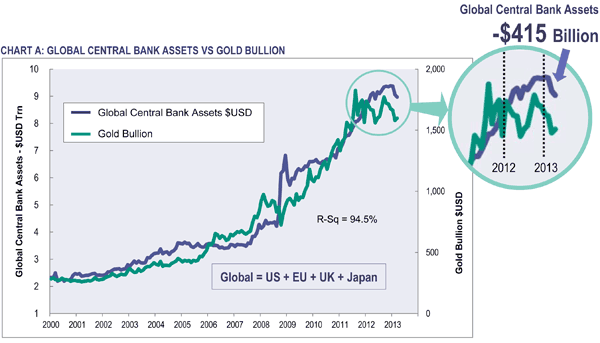
Source: Bloomberg and Sprott Asset Management LP
This relationship between central bank printing and gold has existed since the beginning of the gold bull market in 2000. In fact, this relationship shows that for every US$1 trillion increase in the collective central banks’ balance sheets, the price of gold has generally appreciated by an average of US$210/oz.
Read moreWhy Societe Generale Is Wrong About Gold’s Imminent ‘Demise’
Sprott: China’s Gold Reserves: Watch What They Do, Not What They Say
Sprott had its origins in Sprott Securities Ltd., a brokerage firm founded in 1981 by Eric Sprott. Today, Sprott manages approximately $10 billion in assets and operates through four businesses:
- Asset Management
- Physical Bullion
- Private Equity and Debt
- Wealth Management
– China’s Gold Reserves: Watch What They Do, Not What They Say (ZeroHedge, March 18, 2013):
Yi Gang, Vice Governor of the People’s Bank of China (PBOC), recently made the headlines with his comments on Chinese gold reserves. On Wednesday, Mr. Yi stated that China’s gold reserves remain static at 1,054 tonnes, and suggested that a sizeable increase in those reserves would be unlikely in the future. “We need to take into account both the stability of the market and gold prices,” Mr. Yi stated, adding that as the world’s largest gold producer and importer, China produces about 400 tonnes of gold annually, and imports an additional 500 to 600 tonnes of gold every year. “Compared with China’s 3.3-trillion-U.S.-dollar foreign exchange reserves, the size of the gold market is too small,” Yi said, rejecting speculation that China would further diversify its foreign reserve investments into the precious metal. “If the Chinese government were to buy too much gold, gold prices would surge, a scenario that will hurt Chinese consumers … We can only invest about 1-2 percent of the foreign exchange reserves into gold because the market is too small,” Yi stated.
If Yi’s comments are to be believed, he is implying that the Chinese government has not added a single gold bar to its reserves since 2009 – which was the year the Chinese government officially announced its gold reserve increase to 1,054 tonnes. Given the production and import numbers stated above, we find that extremely hard to believe.
Mr. Yi’s comments stand in stark contrast to earlier comments made by Chinese government officials regarding the need to increase China’s gold reserves to ensure economic and financial safety, promote yuan globalization and act as a hedge against foreign-reserve depreciation. In 2009, a State Council advisor known as “Ji” said that a team of experts from Shanghai and Beijing had set up a task force to consider expanding China’s gold reserves. Ji was quoted as saying “we suggested that China’s gold reserves should reach 6,000 tons in the next 3-5 years and perhaps 10,000 tons in 8-10 years”.
Read moreSprott: China’s Gold Reserves: Watch What They Do, Not What They Say
Eric Sprott And Charles Biderman On Paper Vs. Physical Gold (Video)
– Sprott And Biderman On Paper Vs. Physical Gold (ZeroHedge, Jan 5, 2013):
With gold prices dropping (notably divergent from the ever expanding global central bank balance sheets) but record-breaking levels of physical gold being purchased, we continue to reflect on the other ‘Great Rotation’ that we suspect is occurring as the New Year begins – that from paper gold to physical gold. Who better to discuss the nuances of this dilemma than Eric Sprott as he outlines to TrimTabs’ Charles Biderman the relative strengths and weaknesses of ETFs like GLD and SLV, physical-based ETFs such as PHYS and PSLV, and physical holdings themselves. While the new meme is that the Fed may be considering pulling back (on its ‘flow’) sooner than expected, reality is far different (as Bill Gross recently agreed with us) and that fact makes the following brief clip even more compelling.
Eric Sprott: Why Are (Smart) Investors Buying 50 Times More Physical Silver Than Gold?

– Why are (Smart) Investors Buying 50 Times More Physical Silver than Gold? (Sprott Global Resource Investments):
By: Eric Sprott
As long-time students of precious metals investing, there are certain things we understand. One is that, historically, the availability ratio of silver to gold has had a direct influence on the price of the metals. The current availability ratio of physical silver to gold for investment purposes is approximately 3:1. So, why is it that investors are allocating their dollars to silver at a much higher ratio? What is it that these “smart” investors understand? Let’s have a look at the numbers and see if it’s time for investors to do as a wise man once said and “follow the money.”
Average annual gold mine production is approximately 80 million ounces, which together with an estimated average 50 million ounces of annual recycled gold, totals around 130 million ounces available per year. In comparison, annual mined silver production has averaged around 750 million ounces, while recycled silver is estimated at 250 million ounces per year, which adds up to approximately 1 billion ounces. Using this data, there is roughly 8 times more silver available to buy than there is gold. However, not all gold and silver is available for investment purposes, due to their use in industrial applications. It is estimated that for investment purposes (jewelry, bars and coins), the annual availability of gold is roughly 120 million ounces, and of silver it is 350 million ounces. Therefore, the ratio of physical silver availability to gold availability is 350/120, or ~3:1.1
Now, let’s examine how investors are allocating their investments between gold and silver. The data below is from the US Mint showing gold and silver sales in ounces:
Read moreEric Sprott: Why Are (Smart) Investors Buying 50 Times More Physical Silver Than Gold?
The Physical Silver Market Is Getting Dangerously Tight
– The physical silver market is getting dangerously (Hang The Bankers, July 18, 2012):
With continued volatility in global stock markets, and gold staging a big rally off of the lows, today King World News interviewed one of the wealthiest and most street-smart pros in the business, Rick Rule. Rule told KWN that when it comes to silver, “there is the strong case for some very substantial upside.”
Rule, who is now part of Sprott Asset Management, discussed silver and gold at length. He also talked about the problems the world currently faces. But first, here is what Rule had to say about Sprott’s very successful offering in the Sprott Physical Silver Trust: “I think it’s evidence of two things: One, we felt we had reasonably good chances of buying the silver if we raised the money. Second, this points to the continuing strength of the high end retail investment market for silver in North America.”
Read moreThe Physical Silver Market Is Getting Dangerously Tight
Billionaire Eric Sprott: ‘There Isn’t A Solution To The Problem’ – ‘If The People Had Any Sense They Would Be Buying (PHYSICAL) Gold And/Or Silver’
– Sprott – We’re Being Lied To, Even The 1% Is Having Problems (King World News, June 29, 2012):
Today billionaire Eric Sprott gave King World News an extraordinary interview, and it’s not the kind of thing you are going to see in the mainstream media. Sprott told KWN, “…as much as we knew the 99% was having a problem, I can guarantee you the 1% is having a big problem today.” Sprott, who is Chairman of Sprott Asset Management, also said, “the markets go up because the central planners want the markets to go up … The system is imploding on itself, but the central planners want everyone to think it’s fine. They just lie to us.”
…
I’ve been asked before, is there a solution to the problem? There isn’t a solution to the problem. There’s things that might happen. There’s a default that could happen. There’s hyperinflation that could happen, but none of those would be deemed as solutions to the problem. But one or the other or both is going to happen.
People should, rightly, have fear of having their money in paper instruments, whether it’s in a bank account or a bond. If they had any sense they would be buying (physical) gold and/or silver. That’s the only way to maintain your purchasing power.
…
Eric Sprott: ‘When Fundamentals No Longer Apply, Review the Fundamentals’
– Eric Sprott: “When Fundamentals No Longer Apply, Review the Fundamentals” (ZeroHedge, April 28, 2012):
When Fundamentals No Longer Apply, Review the Fundamentals
This may not come as a surprise, but we’re still not seeing it. We’re not seeing a US recovery.
Here we are, well into 2012, and the fact remains that the US housing situation is still a bust. There is simply no housing recovery happening in the United States. US New Home Sales fell for the fourth time in a row month-overmonth in March, representing a seasonally-adjusted annual rate of 328,000, down from 353,000 in February.1 Do you know what the annual rate of New Home Sales was back in 2006? About 1.21 million.2 No recovery there.
Same goes for US Existing Home Sales, which fell unexpectedly by 2.6% in March to an annual rate of 4.48 million units.3 Again – would you care to know where they were in the same month back in 2006, before the financial system fell apart? Approximately 6.92 million units.4 No recovery there either.
Then there’s unemployment. Judging by all the recent earnings-release cheerleading, March’s jobs numbers seem to have been forgotten, but they were plainly weak. The US Labor Department showed US hiring slowing to a mere 120,000 new jobs in March, below expectations of 200,000+.5 That’s not a recovery. That’s simply weak data.
Same goes for the most recent jobless claims numbers, which have been running above 380,000 for the last two weeks, above the 375,000 threshold that supposedly signals future unemployment increases.6 Again – this is not positive data, this is weak data. How high will it have to go before the economists admit that it’s weak? 400,000? 425,000? We’re asking – we’d like to know.
Then there are US tax receipts, which continue to point in the same direction. If the US is recovering so strongly, then why are employment tax receipts only up 2%? ($484 billion fiscal year-to-date as of March 2012 vs. $475 billion over the same period to March 2011).7 A 2% increase is explainable by inflation alone, which was last reported running at 2.7% according to the Bureau of Labour Stastics.8 Shouldn’t the tax receipts be much higher than that? Wasn’t unemployment down so far this year? As the Associated Press plainly states, “The unemployment rate has fallen to 8.2% in March [2012] from 9.1% in August [2011]. Part of the drop was because people gave up looking for work. People who are out of work but not looking for jobs aren’t counted among the unemployed.”9 Oh! Sorry,… now the numbers make more sense. There hasn’t been any net new employment at all. Question: if everyone “gives up” looking for work next week, will the US unemployment rate go to zero? We’re asking – we’d like to know.
Read moreEric Sprott: ‘When Fundamentals No Longer Apply, Review the Fundamentals’
Sprott’s Chief Investment Strategist John Embry: ‘The Current Financial System Will Be Totally Destroyed’
Related info:
– Eric Sprott To Buy $1.5 BILLION In PHYSICAL Silver
– Sprott’s John Embry:“The Current Financial System Will Be Totally Destroyed“ (ZeroHedge, Feb. 17, 2012):
Sprott strategist John Embry has never been a fan of the existing financial system. Today, he makes that once again quite clear in this interview with Egon von Grayerz’ Matterhorn Asset Management in which he says: “I think that the current financial system, as we know it, will be totally destroyed, probably sooner rather than later. The next system will require gold backing to have any legitimacy. This has happened many times in history.” Needless to say, he proceeds to explain why a monetary system based on gold, one in which one, gasp, lives according to one’s means, is better. Logically, he also explains why the status quo, whose insolvent welfare world has nearly a third of a quadrillion in the form of unfunded future liabilities, will never let this happen. Much more inside.
From Matterhorn Asset Management
“The Current Financial System Will Be Totally Destroyed“
John Embry, the chief investment strategist at Sprott Asset Management, talks in this exclusive interview about the motives and the means of certain interests to prevent a free gold market; tells the reason why the gold price will remain high; shows the opportunities in silver; and explains: “Gold is about the furthest thing from a bubble that I can think of.“
Eric Sprott Fights PM Manipulation Fire With Fire: Calls Silver Producers To Retain Silver Produced As ‘Cash’
See also:
– Eric Sprott To Buy $1.5 BILLION In PHYSICAL Silver
Flashback:
– James G. Rickards of Omnis Inc.: Get Your Gold Out Of The Banking System
In what is likely the most logical follow up to our post of the day, namely the news of the lawsuit between HSBC and MF Global over double-counted gold, or physical – not paper – that was “commingled” via rehypothecating or otherwise, we present readers with the monthly note by Eric Sprott titled “Silver Producers: A Call to Action” in which the Canadian commodities asset manager has had enough of what he perceives as subtle and/or not so subtle manipulation of the precious metal market, and in not so many words calls the silver miners of the world “to spring to action” and effectively establish supply controls to silver extraction to counteract paper market manipulation in the paper realm by treating their product as a currency and retaining it as “cash”. To wit: “instead of selling all their silver for cash and depositing that cash in a levered bank, silver miners should seriously consider storing a portion of their reserves in physical silver OUTSIDE OF THE BANKING SYSTEM. Why take on all the risks of the bank when you can hold hard cash through the very metal that you mine? Given the current environment, we see much greater risk holding cash in a bank than we do in holding precious metals. And it serves to remember that thanks to 0% interest rates, banks don’t pay their customers to take on those risks today.” And the math: “If silver miners were therefore to reinvest 25% of their 2011 earnings back into physical silver, they could potentially account for 21% of the approximate 300 million ounces (~$9 billion) available for investment in 2011. If they were to reinvest all their earnings back into silver, it would shrink available 2011 investment supply by 82%. This is a purely hypothetical exercise of course, but can you imagine the impact this practice would have on silver prices?” And there you go: Sprott ‘reputable’ entity to propose to fight manipulation with what is effectively collusion, which in the grand scheme of things is perfectly normal – after all, all is fair in love and war over a dying monetary model. Who could have thought that the jump from “proletariats” to “silver miners” would be so short.
From Eric Sprott
Silver Producers: A Call to Action
Eric Sprott To Buy $1.5 BILLION In PHYSICAL Silver

– Silver wars: Eric Sprot to purchase $1.5 billion in physical silver for fund (Examiner, Nov. 23, 2011):
As the price and predictions of silver futures have dropped over the past several days, one leading management firm is creating a new silver fund, and it will require the purchase of over $1.5 billion in physical silver bullion to fill customer requirements.
Let the silver war begin.
On November 23rd, Eric Sprott of
EricSprott Asset Management, filed a prospectus to purchase $1.5 billion dollars worth of physical silver bullion to accomodate a new exchange traded fund, the PSLV.Canadian-based
EricSprott Asset Management CEO Eric Sprott filed a follow up prospectus for the purchase of an additional $1.5 billion of silver bullion to cover expected demand for the company’s exchange traded fund, PSLV.Combined with the recent decline in the PSLV premium to spot silver to 14 percent from the typical 20 percent, along with Sprott’s reported sale of some of its holdings of PSLV at the rich premium, it appears a familiar hallmark of a gigantic $580 million silver bullion purchase in December of last year emerges once again. Since demand for silver products at Sprott remain brisk, it should come as no surprise to the silver world that Sprott needs more silver. – profitimes.com
The ramifications of a $1.5 billion dollar purchase of physical silver could lead to a massive rise in the price of the metal over the near and middle terms. According to Harvey Organ’s recent inventory report, the total number of silver ounces outstanding with the Comex is 1,485,000. At the current futures price of $31.99, the value of that outstanding silver is $47,505,150.
Hedge-Fund Manager Eric Sprott: Silver Will Keep Outshining Gold
* Hedge fund boss says more dollars flows favor silver
* Wary of investing in base metal due to uncertain economy


TORONTO, March 8 (Reuters) – Silver is likely to keep outperforming gold thanks to strong dollar flows, though both are still good investments compared with copper and other base metals, according to Eric Sprott, the hedge-fund manager and Canadian investment guru.
“I watch where the money goes and the money’s going into silver. There’s as much money going into silver as into gold in dollar terms,” said Sprott in an interview with Reuters.
Sprott, who heads Toronto-based hedge-fund Sprott Asset Management, said it is important to note that silver available to buy is relatively scarce in terms of value, and that bodes well for further gains.
“There is 75 times more dollars worth of gold to buy than silver, but the money’s going in one to one,” says Sprott, while speaking on the sidelines of an investor event held in conjunction with the annual PDAC mining convention in Toronto.
Silver stocks in COMEX warehouses are near their lowest since April 2006, when the metal traded at $5 an ounce. Demand for silver coins has also picked up, especially in the United States, where it was at record levels early this year.
“My biggest thing is silver — I think silver is going to go up a lot here. Gold’s right in there, but not as good as silver,” said Sprott, following a presentation to hundreds of investors in a resplendent ballroom at Toronto’s Royal York Hotel.
Read moreHedge-Fund Manager Eric Sprott: Silver Will Keep Outshining Gold
Eric Sprott on Silver: ‘THERE IS NOTHING LEFT’
And this is the Greatest Depression!
Eric Sprott made an appearance at Casey Research Gold and Resource Summit where in addition to providing a succinct summary of all his monthly letters from the past year, whose forecasts are all gradually panning out, he spoke about the prospects for gold, and particularly silver.
We will leave it to readers to parse through the brief must watch clip, but here is the punchling for those wondering why increasingly more distributors are reporting indefinite lack of physical silver inventory:
“There’s $22 billion of silver available in the world, of which the ETFs already own half, and between you guys and us we probably own the other half… Which means there’s nothing left.”
Submitted by Tyler Durden on 02/23/2011 15:05 -0500
Source: ZeroHedge
Eric Sprott: Expect $50 Silver, Gold Possibly $2,150 by Spring
With gold and silver rallying off the lows today, King World News interviewed Eric Sprott, Chairman of Sprott Asset Management which has $8 billion under management.
…..
“We had to go into the market and buy about 15 million net ounces from third parties and it took us about ten weeks. It was a very, very long process and the one thing we can read out of it is obviously there weren’t 15 million ounces sitting around somewhere.”
…..
“I haven’t had time to study where the bars came from, but I can tell you by looking at the pictures of the bars they look like they came right out of the refineries. So I suspect it’s a hand to mouth situation in silver.
…
When asked about price targets for both gold and silver Eric responded, “Our best technical advisor, he thinks (gold) it’s going to $2,150, and he thinks it is going to $2,150 this spring.
…
I think silver is a little easier to predict because I think it’s going to change relative to gold which is a more predictable event and more timely. I’ve always thought that silver should touch $50, and I’m not going to be surprised if it touches it by the middle of this year as people realize there is an absolute shortage.”
Full article here: KingWorldNews
Read moreEric Sprott: Expect $50 Silver, Gold Possibly $2,150 by Spring