YouTube Added: 12.12.2012
economics
Vice Chairman Of Germany’s CDU Party Demands Gold As Collateral From European Bailout Recipients
– Vice Chairman Of Germany’s CDU Party Demands Gold As Collateral From European Bailout Recipients (ZeroHedge, August 23, 2011):
Yesterday we had the Bundesbank making a very strong case for why a pan-European bailout (funded by Germany), would need a “fundamental change of regime occurs involving an extensive surrender of national fiscal sovereignty” (beneficial for Germany), today we see the next and final stage of the proposed annexation of Europe by Germany – that which focuses on procuring that which is really important. Hint: not spam. From Spiegel: “Minister Ursula von der Leyen pushes the hard line: any financial aid for euro countries should only come against collateral – as gold reserves or industrial holdings.” More google-translated conditionality: “The CDU politician wants to ensure future aid allocations from the rescue fund through extensive security of the country. The ARD Berlin Studios said the minister, who is also vice-chairman of the CDU party, many of these countries had large reserves of gold and industrial holdings, which they could use for such collateral.” And now we know the next steps: i) Eurobonds will come after there is a change to the European constitution which make Germany supreme ruler, and ii) at that point Germany will have all the gold in Europe pledging its bailout. Yes, gold…. not spam.
More from Spiegel:
“Some states are making great efforts to service their debts,” she said. “This must be honored. This, however, efforts are also required to maintain long term, it is the collateral,” argued the politician. “In fact we have such an effective European debt brake,” said von der Leyen,the “Hannover Allgemeine Zeitung”.
‘End Of The World’ Inflation: 47% In Six Months
Back in October, Zero Hedge discussed a Costco offer for Shelf-Reliance THRIVE’s one year’s supply of dehydrated, freeze dried food, better known as “apocalypse rations.” Six months ago a one year’s supply of food for one person which included 5,011 total servings (84 #10 cans) could be purchased for $799.99 (the link for the offering is here, or rather was, here).
A series of events made us encounter a comparable THRIVE offering at Costco. To our amazement in six months, the real price inflation in apocalypse rations, when factoring proportioning, is almost 50%!
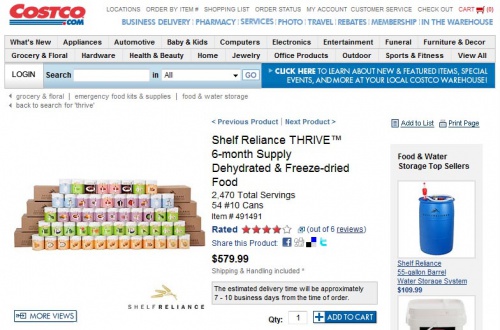
While the original set that was presented back in October is no longer available, what Costco does offer is a Shelf Reliance THRIVE 6 month supply supply for the price of $579.99: this represents the pinnacle of that ultimate in inflation disguising techniques: cutting the price by X while cutting the amount offered by Y>>>X.
Indeed, to last a person a full year, one would need to be two of the 6 month supplies for a price of $579.99 or $1,159.98. And even that has to be indexed: the current set has 2,470 total servings, whereas the previous offer had 5,011, or 203% more. In other words, to index for the proper serving ratio the final price is actually $1,176.65.
We can only hope that there are those who purchased this product when we first presented it (and don’t worry, with a 25 year shelf life, it lasts a looooong time) and saved themselves the 47% inflation in 6 months!
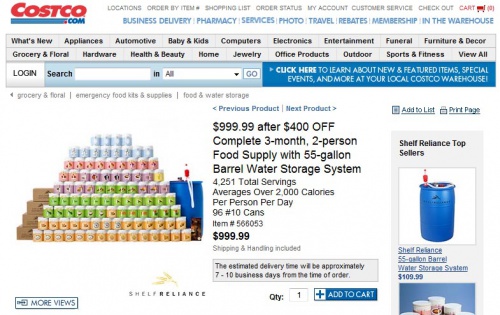
And then there are non THRIVE product offerings, such as the one below for 2 people for 3 months for $999.99 (and includes its own 55 gallon water storage set), which represents price inflation well over 100% for those who need a little extra caloric kick (and, naturally, post-apocalypse social status with the neighbors). Something tells us in another 6 months, the Costco price today will be just as lamented as the price from 6 months ago currently is.
Then (link):

And now:
And for those for whom greeting apocalypse in style means price is no object…

A description of the “cost-effective” apocalypse ration: