The Eurozone is about to get totally destroyed.
Continue to prepare for collapse.
– Why The Eurozone Will Self-Destruct
* * *
PayPal: Donate in USD
PayPal: Donate in EUR
PayPal: Donate in GBP
The man who trades freedom for security does not deserve nor will he ever receive either. – Benjamin Franklin
The Eurozone is about to get totally destroyed.
Continue to prepare for collapse.
– Why The Eurozone Will Self-Destruct
* * *
PayPal: Donate in USD
PayPal: Donate in EUR
PayPal: Donate in GBP
https://www.youtube.com/watch?v=1WsonqY4f0I
Published on Aug 25, 2016
* * *
PayPal: Donate in USD
PayPal: Donate in EUR
PayPal: Donate in GBP
– Deutsche Bank CEO Warns Of “Fatal Consequences” For Savers:
Deutsche Bank’s war of words with the ECB is not new: it was first unveiled in February when, as we wrote at the time “A Wounded Deutsche Bank Lashed Out At Central Bankers: Stop Easing, You Are Crushing Us.” Europe’s largest bank, with the massive derivatives book, then upped the ante several months later in June, when its chief economist Folkerts-Landau launched a shocking anti-ECB rant in which it warned of social unrest and another Great Depression.
Ironically, these infamous diatribes hurt more than helped: telegraphing to the market just how hurt DB was as a result of the ECB’s monetary policy, the market punished its stock, which has been recently trading within spitting distance of all time lows, in effect making Deutsche Bank’s life even harder as it now has to contend not only with its own internal profitability problems, but also has to maintain a market-facing facade that all is well. So far, it has not worked out very well, prompting numerous comparisons to another infamous bank.
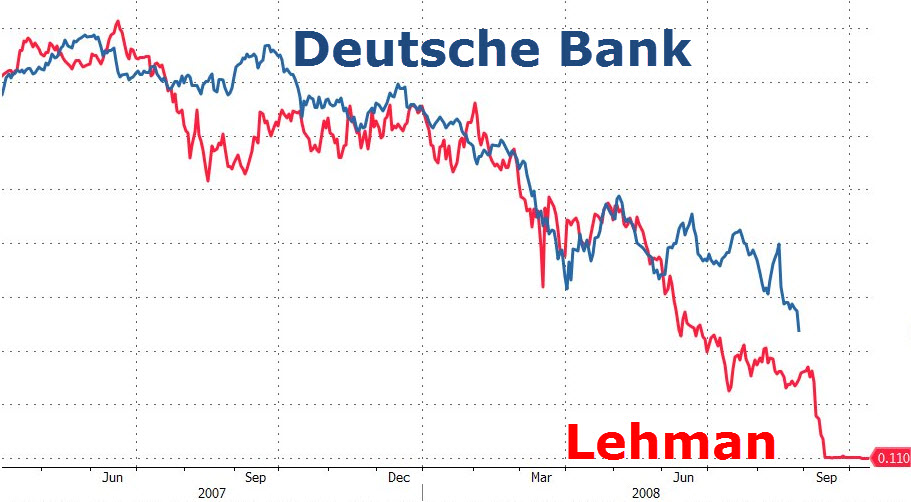
So, in what may have been DB’s loudest cry for help against the ECB’s unwavering commitment to rock-bottom interest rates, the bank’s CEO, John Cryan, warned in a guest commentary ahead of the Handelsblatt Banking Summit titled, appropriately enough “Banks in Upheaval”, to be held in Frankfurt on August 31 and September 1, that “monetary policy is now running counter to the aims of strengthening the economy and making the European banking system safer.“
Read moreDeutsche Bank CEO Warns Of “Fatal Consequences” For Savers
The ECB is still purchasing €80 BILLION of ‘bonds’ every month!

– Revealed: ECB Secretly Hands Cash to Select Corporations:
In June, the ECB began buying the bonds of some of the most powerful companies in Europe as well as the European subsidiaries of foreign multinationals. This pushed the average yield on euro investment-grade corporate debt to 0.65%. Large quantities of highly rated corporate debt with shorter maturities are trading at negative yields, where brainwashed investors engage in the absurdity of paying for the privilege of lending money to corporations. By August 12, the ECB had handed out over €16 billion in freshly printed money in exchange for corporate bonds.
Throughout, the public was given to understand that the ECB was buying already-issued bonds trading in secondary markets. But the public has been fooled.
Now it has been revealed by The Wall Street Journal that the ECB has also secretly been buying bonds directly from companies, thus handing them directly its freshly printed money.
Read moreRevealed: ECB Secretly Hands Cash to Select Corporations
– Two More Banks Start Charging Select Clients For Holding Cash:
Last weekend, when we reported that Germany’s Raiffeisenbank Gmund am Tegernsee – a community bank in southern Germany – said it would start charging retail clients a fee of 0.4% on deposits of more than €100,000 we said that “now that a German banks has finally breached the retail depositor NIRP barrier, expect many more banks to follow.”
Not even a week later, not one but two large banks have done just that.

Overnight, the Irish Times reported that Bank of Ireland is set to become the first domestic financial institution to pass on the ECB’s negative rates to customers for placing their money on deposit with the bank. The newspaper has learned that Bank of Ireland, which is 14% owned by the State, has informed its large corporate and institutional customers that it plans to charge them a negative rate of -0.1% for deposits of €10 million or more starting in October.
Read moreTwo More Banks Start Charging Select Clients For Holding Cash
– A German Bank Finally Caves: Will Charge Retail Investors A Negative 0.4% Deposit Rate:
On June 5, 2014 when the ECB officially announced that the rate on its deposit facility would go negative, we posted “NIRP Has Arrived: Europe Officially Enters The “Monetary Twilight Zone.” However, while NIRP has already led to a dramatic upheaval across Europe’s economies as a result of a perfectly “unexpected” surge in the savings (as we warned would happen last October, and as the WSJ “discovered” last week) one key aspect of this “zone” was missing for the past two years: banks charging negative rates to ordinary, retail depositors.
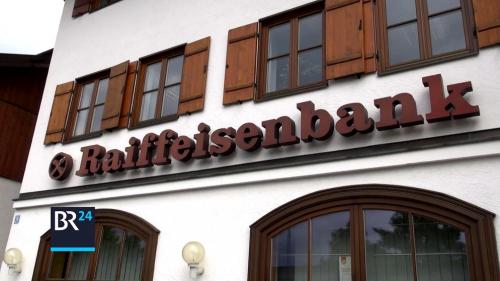
However, after a two year wait, this final piece of the NIRP puzzle was revealed when earlier this week, Raiffeisen Gmund am Tegernsee, a German cooperative savings bank in the Bavarian village of Gmund am Tegernsee, with a population 5,767, finally gave in to the ECB’s monetary repression, and announced it’ll start charging retail customers to hold their cash.
Starting September, for savings in excess of €100,000 euros, the community’s Raiffeisen bank will charge a 0.4% rate. That represents the first direct pass through of the current level of the ECB’s negative deposit rate on to retail depositors.
Read moreA German Bank Finally Caves: Will Charge Retail Investors A Negative 0.4% Deposit Rate
H/t reader squodgy:
“The vultures gather….”
– Look Who’s Frantically Demanding that Taxpayers Stop Italy’s Bank Meltdown:
It was a perfect gift to a desperate market. All that was needed was a gentle hint that Italy’s troubled banks and their bondholders might not be hung out to dry. A “public backstop” for Italy’s weakest lenders would be a “very useful” measure in these “exceptional times,” ECB President Mario Draghi said.
Most Italian and European bank stocks surged.
The ECB is the second member of the institutional triad formerly known as the Troika to have called for a taxpayer funded bailout of Italy’s banking system. Earlier this month the IMF used its article IV consultation – an annual economic and financial health check – to warn of “global spillovers” from a full-blown Italian banking crisis, “given Italy’s systemic weight.”
Read moreLook Who’s Frantically Demanding that Taxpayers Stop Italy’s Bank Meltdown
– The First Casualty Of Brexit: Italy Prepares €40 Billion Bank Bailout:
Barely has the market had time to digest last week’s Brexit vote by the UK, a vote which may never actually be implemented if the “sturm und drang” campaign unleashed by the EU and the ECB on UK capital markets succeeds in changing the mind of enough “Leavers” to the point that the entire referendum is called off and Boris Johnson never triggers the Article 50 clause, and already Europe’s most financially troubled nation, Italy, is using Brexit as a pretext to unleash a €40 billion ($44 billion) bailout of its insolvent banks.
Read moreThe First Casualty Of Brexit: Italy Prepares €40 Billion Bank Bailout
https://www.youtube.com/watch?v=QfnlNe0ipGg
Jun 16, 2016
* * *
PayPal: Donate in USD
PayPal: Donate in EUR
PayPal: Donate in GBP
In what may be merely a peculiar case of serendipity, just last night we mentioned the name of the infamous president of Weimar Republic’s Reichsbank, Rudolf von Havenstein, in the context of the BOJ’s proud announcement that it now held more than a third of all Japanese government bonds at the end of March (so even more currently).
BOJ SAYS IT HELD 33.9% OF JGBS AT END-MARCH.
First one to 100% wins the Rudy von Havenstein economics prize— zerohedge (@zerohedge) June 16, 2016
Well, either Citi’s Gregory Marks was following our amused observation, or in an act of odd confluence of thought invoked the spirit of Rudy von Havenstein completely independently, when overnight he unleashed a furious tirade at both negative rates and “utterly misguided” central bank policies in general and negative rates in particular in “Let’s Take Stock: The Efficacy and Merit of Negative Rates.”
The full note, which is on par with Deutsche Bank’s just as angry recent rant against the ECB, is presented in its entirety below.
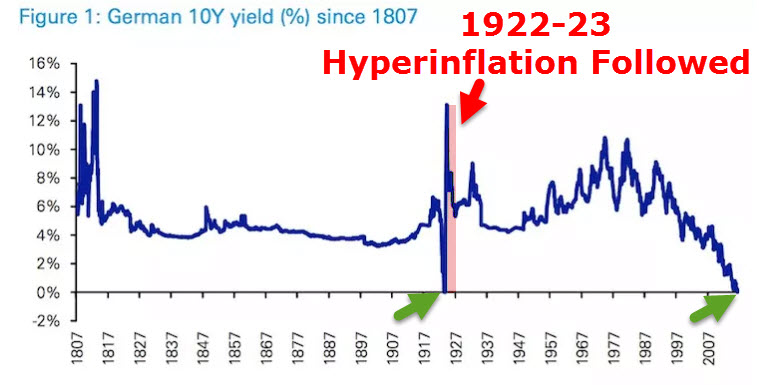
– Question of the Day: When Was the Last Time the Yield on German 10-Year Bonds Went Negative?:
Think back. Many readers have been trading for 10 or 20 years. A few have been trading for 30 or more years. What was it like the last time German 10-year bond yields went negative?
That is sort of a trick question. Most likely you were not alive, no matter how old you are.
As translated from Spanish, my friend Guru Huky posted the answer on his blog today: And the last time the German bond stood negative was …. surprise surprise.
German 10-Year Yield Since 1807
H/t reader squodgy:
“Very worrying.”

PDF: GPF-germanys-invisible-crisis
* * *
PayPal: Donate in USD
PayPal: Donate in EUR
PayPal: Donate in GBP

– A Central Banker Officially Loses It: “We Are Magic People”:
Over the years, first on fringe blogs who dared to point out long ago that the emperors are actually naked, and increasingly everywhere else there has been speculation that locked deep inside the ivory towers of central banks one could find either career academics or Goldman Sachs alumni who were convinced they were all powerful, all capable deities, who in addition to printing money out of thin air, are comfortable micromanaging not only the world’s capital markets but also economies. Just like gods, or “magicians”… but really just insane nutjobs.
Read moreECB Central Banker Officially Loses It: “We Are Magic People”
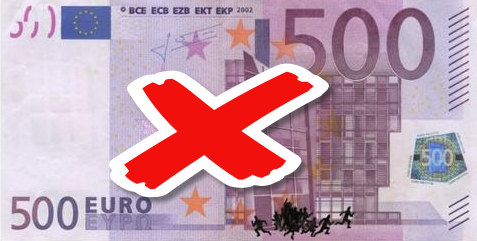
– The War On Paper Currency Officially Begins: ECB Ends Production Of €500 Bill:
Following the denial in February that this action is in any way about reducing cash, The ECB has made its decision on the EUR500 Bill:
- *ECB ENDS PRODUCTION AND ISSUANCE OF €500 BANKNOTE
- *ECB SAYS ISSUANCE OF EU500 NOTE TO STOP AROUND THE END OF 2018
- *ECB SAYS OTHER EURO BANKNOTES WILL STAY IN PLACE
- *ECB: EU500 CAN BE EXCHANGED AT CEN BANKS FOR UNLIMITED TIME
And just like that the second highest denominated European bank note in circulation (after the CHF1000 Bill) is dead…
Read moreThe War On Paper Currency Officially Begins: ECB Ends Production Of €500 Bill
– Deutsche Bank Unveils The Next Step: “QE Has Run Its Course, It’s Time To Tax Wealth”:
Helicopter money may be on the horizon, but if Deutsche Bank has its way, there is at least one intermediate step.
According to DB’s Dominic Konstam, now that the benefits QE “have run their course”, it is time for the next, and far more drastic step: “the ECB and BoJ should move more strongly toward penalizing savings via negative retail deposit rates or perhaps wealth taxes. With this stick would also come a carrot – for example, negative mortgage rates.”
Read moreDeutsche Bank Unveils The Next Step: “QE Has Run Its Course, It’s Time To Tax Wealth”
FYI.
https://www.youtube.com/watch?v=XAN4-LG8wys
* * *
PayPal: Donate in USD
PayPal: Donate in EUR
PayPal: Donate in GBP
By Reggie Middleton
It’s official, I’m calling a banking crisis in Europe. Things didn’t go well the last time I did this. Of course, many will say, “But the rating agencies have learned their collective lessons. They would most assuredely warn us if the European banks are close to going bust, right?!!!”. Yeah, right! Reference our past research note on so-called trusted parties in private blockchains for banks. Those interested in purchasing the 22 page report on what is likely the first major bank to fall victim to the coming Pan-European Banking Crisis can do so here. All others, feel free to read on…
Here are some key points:
Full article here:
– Exposed – How Two Janet Yellen Phone Calls Saved The World:
Thanks to the just released February diary of Fed chief Yellen, we now know exactly when she called Bank of England Governor (and former Goldman Sachs employee) Marc Carney and ECB President (and former Goldman Sachs employee) Mario Draghi.
Can you guess when?
The answer:
…
* * *
PayPal: Donate in USD
PayPal: Donate in EUR
PayPal: Donate in GBP

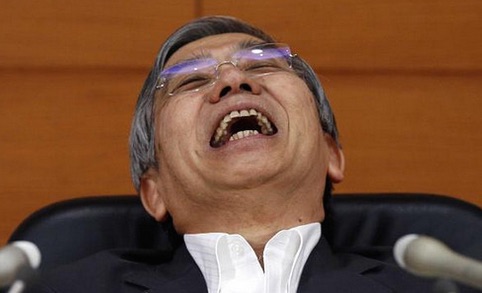
– YELLEN, DRAGHI, KURODA: DERANGED LAB RATS:
The stock market has regained all of its loses year to date as economic indicators continue to flash red, corporate profits continue to plunge, consumers continue to spend less at retailers, real wages continue to fall, and housing sales continue to decline. The entire dead cat bounce has been generated through corporate stock buybacks, Wall Street lemmings trying to make up for their terrible year to date investing performance, and central bankers who will stop at nothing to verbally manipulate markets higher – since their monetary machinations over the last seven years have been a miserable failure in reviving the real economy.
As John Hussman points out, the market is poised to deliver nothing over the next decade, with a 40% to 55% “dip” in the foreseeable future. I wonder how many barely sentient, iGadget addicted, non-questioning, normalcy bias dependent zombies are prepared for a third Federal Reserve generated market collapse in the last 15 years?
– Greece Orders Banks To Record “Personal Data” On Anyone Who Was Hoarding Cash:
Over the course of documenting the ECB’s push to phase out the €500 note, we stumbled upon something rather interesting that’s taking place at Greek banks.
Courtesy of a reader, we learned that Piraeus Bank (among others) has begun charging a fee to exchange large denomination bills for small. The charge is listed as 0.15% by the bank and Kathimerini would later report that across the Greek banking sector “exchanging one 500-euro note for smaller bills, [will cost you] 3-5 euros (depending on the bank), while the maximum charge comes to 200-250 euros regardless of the amount a customer wishes to exchange.”
Read moreGreece Orders Banks To Record “Personal Data” On Anyone Who Was Hoarding Cash
– The Germans React To Draghi’s Monetary “Tidal Wave”:
Having discussed the market’s disturbing reaction to Mario Draghi’s desperate “all in” monetary gamble – one which saw an early bout of euphoria followed by one of the most aggressive Euro spikes in history, second only to the “December debacle” and the Fed’s March 2009 announcement of QE1, we were waiting for the just as important reaction by the ECB’s nemesis: the one country that not only has seen hyperinflation first hand (and appears to recall it vividly), but is just as aware where the ECB’s monetary lunacy ends: the Germans.
We got it from Germany’s Handelsblatt, when in an article titled “The dangerous game with the money of the German savers”, the authors provide a metaphorical rendering of what is happening in Europe as follows:

They also paint an oddly accurate caricature of the man behind this last ditch monetary policy:

And write the following:
A determined ECB chief Mario Draghi plows ahead with his negative interest rate policy. The positive effects on the economy are low. Great, however, are the risks: this is the greatest redistribution of wealth in Europe since World War II.
Read moreThe Germans React To Draghi’s Monetary “Tidal Wave”