Dec 18

Paul Craig Roberts was Assistant Secretary of the Treasury during President Reagan’s first term. He was Associate Editor of the Wall Street Journal. He has held numerous academic appointments, including the William E. Simon Chair, Center for Strategic and International Studies, Georgetown University, and Senior Research Fellow, Hoover Institution, Stanford University.

paul-craig-roberts
Dr. Paul Craig Roberts

- The Fiscal Cliff Is A Diversion: The Derivatives Tsunami and the Dollar Bubble (Paul Craig Roberts, Dec 17, 2012):

The “fiscal cliff” is another hoax designed to shift the attention of policymakers, the media, and the attentive public, if any, from huge problems to small ones.

The fiscal cliff is automatic spending cuts and tax increases in order to reduce the deficit by an insignificant amount over ten years if Congress takes no action itself to cut spending and to raise taxes. In other words, the “fiscal cliff” is going to happen either way.

The problem from the standpoint of conventional economics with the fiscal cliff is that it amounts to a double-barrel dose of austerity delivered to a faltering and recessionary economy. Ever since John Maynard Keynes, most economists have understood that austerity is not the answer to recession or depression.

Regardless, the fiscal cliff is about small numbers compared to the Derivatives Tsunami or to bond market and dollar market bubbles.

Continue reading »

Tags: , , , , , , , , , , , , , , , , , , , , ,

Dec 06


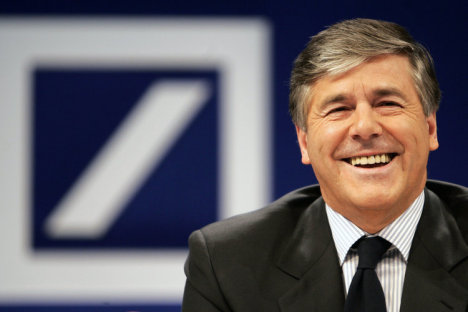
Former CEO of Deutsche Bank Josef Ackermann in 2008

- Bombshell: Deutsche Bank Hid $12 Billion In Losses To Avoid A Government Bail-Out (ZeroHedge, Dec 5, 2012):

Forget the perfectly anticipated Greek (selective) default. This is the real deal. The FT just released a blockbuster that Europe’s most important and significant bank, Deutsche Bank, hid $12 billion in losses during the financial crisis, helping the bank avoid a government bail-out, according to three former bank employees who filed complaints to US regulators. US regulators, whose chief of enforcement currently was none other than the General Counsel of Deutsche Bank at the time!

From the FT:

The three complaints, made to regulators including the US Securities and Exchange Commission, claim that Deutsche misvalued a giant position in derivatives structures known as leveraged super senior trades, according to people familiar with the complaints.

All three allege that if Deutsche had accounted properly for its positions – worth $130bn on a notional level – its capital would have fallen to dangerous levels during the financial crisis and it might have required a government bail-out to survive. Continue reading »

Tags: , , , , , , , , , , , , ,

Dec 05

- The Coming Derivatives Panic That Will Destroy Global Financial Markets (Economic Collapse, Dec 4, 2012):

When financial markets in the United States crash, so does the U.S. economy.  Just remember what happened back in 2008.  The financial markets crashed, the credit markets froze up, and suddenly the economy went into cardiac arrest.  Well, there are very few things that could cause the financial markets to crash harder or farther than a derivatives panic.  Sadly, most Americans don’t even understand what derivatives are.  Unlike stocks and bonds, a derivative is not an investment in anything real.  Rather, a derivative is a legal bet on the future value or performance of something else.  Just like you can go to Las Vegas and bet on who will win the football games this weekend, bankers on Wall Street make trillions of dollars of bets about how interest rates will perform in the future and about what credit instruments are likely to default.  Wall Street has been transformed into a gigantic casino where people are betting on just about anything that you can imagine.  This works fine as long as there are not any wild swings in the economy and risk is managed with strict discipline, but as we have seen, there have been times when derivatives have caused massive problems in recent years.  For example, do you know why the largest insurance company in the world, AIG, crashed back in 2008 and required a government bailout?  It was because of derivatives.  Bad derivatives trades also caused the failure of MF Global, and the 6 billion dollar loss that JPMorgan Chase recently suffered because of derivatives made headlines all over the globe.  But all of those incidents were just warm up acts for the coming derivatives panic that will destroy global financial markets.  The largest casino in the history of the world is going to go “bust” and the economic fallout from the financial crash that will happen as a result will be absolutely horrific.

There is a reason why Warren Buffett once referred to derivatives as “financial weapons of mass destruction”.  Nobody really knows the total value of all the derivatives that are floating around out there, but estimates place the notional value of the global derivatives market anywhere from 600 trillion dollars all the way up to 1.5 quadrillion dollars.

Keep in mind that global GDP is somewhere around 70 trillion dollars for an entire year.  So we are talking about an amount of money that is absolutely mind blowing.

So who is buying and selling all of these derivatives? Continue reading »

Tags: , , , , , , , , ,

Nov 29

“This is the greatest bank robbery in world history and the banks are doing the robbing.”
- Gerald Celente


YouTube Added: 26.11.2012 

Description:

Watch the first two ‘Madness’ micro-docs:

Madness 1:
http://www.youtube.com/watch?v=fOshw4kIGR4

Madness 2:
http://www.youtube.com/watch?v=WRvjufH29vE

Another ‘Black Friday’ has come and gone. And it has left us with further evidence of the complete madness of the populace of our nation. America has been dealt a fatal blow by corporate greed, Bankster malfeasance and the insidious nature of collectivism — and it’s all been done to us by design.

The once proud and independent people of the United States have, in large part, been reduced to servants of the State. As Aldous Huxley famously noted, “People can actually be made to LOVE their servitude.”

Featuring Mike Krieger, Rob Kirby, Chris Duane, Gerald Celente, Bill Murphy and many others, ‘Madness 3′ offers one last ‘fair warning’ for those with the eyes to see and the ears to hear. Continue reading »

Tags: , , , , , , , , , , , , , , , , , , , , , ,

Nov 19

- The Powers That Be Don’t Want Sovereign Bonds… They Want Gold (ZeroHedge, Nov 19, 2012):

Last week I outlined the issue of collateral and how it is the most critical issue in the financial system today. For a review of that article, click here now.

If you want further evidence that the financial elites are already preparing for a default from Spain and a collateral crunch, you should consider that the large clearing houses (ICE, CEM and LCH which oversee the trading of the $700+ trillion derivatives market) have ALL begun accepting Gold as collateral.

Gold as Collateral Acceptable for Margin Cover Purposes

From 28 August 2012 unallocated Gold (Loco London) will be accepted by LCH.Clearnet Limited (LCH.Clearnet) as collateral for margin cover purposes.

This addition to acceptable margin collateral will be subject to the following criteria; Continue reading »

Tags: , , , , , , , , , , , , , , , , , , , ,

Oct 17

These are interesting times:

- European Banks Need To Sell Up $4.5 TRILLION In Assets In Next 14 Months, IMF Warns


- Derivative Meltdown and Dollar Collapse (Batr, Oct 17, 2012):

The frightening prospects from a derivative meltdown, well known for years, seem to deepen with every measure to prop up a failing international financial system. The essay Greed is Good, but Derivatives are Better, characterizes the gamble game in this fashion:

“The elegance of derivatives is that the rules that defy nature are not involved in intangible swaps. The basic value in the payment from the risk is always dumped on the back of the taxpayer. Ponzi schemes are legal when government croupiers spin loaded balls on their fudged roulette tables.”

Under conventional international trading settlement, the world reserve currency is the Dollar. The loss of confidence in the Federal Reserve System causes a corresponding decline in value in U. S Treasury obligations. Add into this risk equation, derivative instruments that are deadly threats that can well destroy national currencies. One such response to this unchecked danger can be found in a Bloomberg Businessweek perceptive article, A Shortage of Bonds to Back Derivatives Bets, makes a stark forecast.

“Starting next year, new rules will force banks, hedge funds, and other traders to back up more of their bets in the $648 trillion derivatives market by posting collateral. While the rules are designed to prevent another financial meltdown, a shortage of Treasury bonds and other top-rated debt to use as collateral may undermine the effort to make the system safer.”

Continue reading »

Tags: , , , , , , , , , , ,

Sep 19


YouTube Added: 17.09.2012

If Nostradamus were alive today, he’d have a hard time keeping up with Gerald Celente.
– New York Post

When CNN wants to know about the Top Trends, we ask Gerald Celente.
– CNN Headline News

There’s not a better trend forecaster than Gerald Celente. The man knows what he’s talking about.
- CNBC

Those who take their predictions seriously … consider the Trends Research Institute.
– The Wall Street Journal

A network of 25 experts whose range of specialties would rival many university faculties.
– The Economist

Tags: , , , , , , , , , , , , , , , , , , , , , , , , , , , , , , , , , , , , , , , , , , , , , , , , , , , , , , , , , , , , , , , , , , ,

Sep 16


YouTube Added: 15.09.2012

- Janet Tavakoli: Understanding Derivatives and Their Risks (ZeroHEdge, Sep 15, 2012):

Global financial markets are awash in hundreds of trillions of dollars worth of derivatives. By some estimates, the total amount exceeds one quadrillion.

Derivatives played a central role in the 2008 credit crisis, as they had a brutal multiplying effect on the magnitude of the carnage. As a bad asset was written down, oftentimes there were derivative contracts written against it that resulted in total losses 10x greater than the initial write-down.

But what exactly are derivatives? How do they work?

Continue reading »

Tags: , , , , , , , , , , , ,

Sep 15

- US infrastructure on brink of thermodynamic breakdown (PressTV, Sep 14, 2012):

Federal Reserve Chairman Ben Bernanke has warned that the country’s unemployment situation “remains a grave concern” as the hiring process in the job market stays sluggish.

“Fewer than half of the eight million jobs lost in the recession have been restored and at 8.1 percent, the unemployment rate is nearly unchanged since the beginning of the year and is well above normal levels,” Bernanke told reporters on Thursday, AFP reported.

Bernanke also pointed out that the Federal Reserve does not have the means to offset the economic shock from the public spending cuts and tax hikes, scheduled for the end of 2012.

Press TV has conducted an interview with Webster Griffin Tarpley, author and historian from Washington, to further talk over the issue. the following is an approximate transcript of the interview.

Press TV: The Fed has announced that it will resume its policy of pumping more money into the economy. Will that be enough to stave off the unemployment?

Tarpley: No, it cannot. Right now we have an economic depression in the United States and around the world and the real unemployment in this country is much higher than the Federal Reserve seems to want to admit. It is about 30 million people minimum that are out of work which is significantly more than the government estimates.

The problem with the Federal Reserve is that they see their task as saving failed banks; we have to call them ‘zombie banks’ because they are bankrupt entities that sit there; they absorb government and Federal Reserve resources; they do not provide investment; they do not create jobs; there is no plan and equipment or capital goods investment going on.

Continue reading »

Tags: , , , , , , , , , , , , , , , , ,

Sep 11

- $648 Trillion Derivatives Market Faces New Collateral Concentration Risks (ZeroHedge, Sep 11, 2012):

In a sad case of deja vu all over again, the over-reliance on ‘shaky’ collateral and concentration of risk is building once more – this time in the $648 trillion derivatives market. New Clearing House rules (a la Dodd-Frank) mean derivatives counterparties are required to pledge high quality collateral with the clearing houses (or exchanges) in a more formalized manner to cover potential losses. However, the safety bid combined with Central Banks monetization of every sovereign risk asset onto their balance sheet has reduced the amount of quality collateral available; this scarcity of quality collateral creates liquidity problems. The dealers, ever willing to create fee-based business, have created a repo-like program to meet the needs of the desperate derivative counterparties – to enable them to transform lower-quality collateral into high quality collateral – which can then be posted to the clearing house or exchange.This collateral transformation, while meeting a need, runs the risk of concentrating illiquid low quality assets on bank balance sheets – as Bloomberg cites Darrel Duffie: “The dealers look after their own interests, and they won’t necessarily look after the systemic risks that are associated with this.” Regulators are aware of this but as always will be slow to react – until it becomes too big to fix. The CME already accepts corporate bonds as collateral, but the re-collateralization and potential for vicious circle cash calls or forced selling become notably higher as “We just keep piling on lots of operational risk as we convert one form of collateral into another,” said Richie Prager, global head of trading at New York-based BlackRock.

Continue reading »

Tags: , , ,