Fascism…
* * *
Please support I. U. … if you can …
PayPal: Donate in USD
PayPal: Donate in EUR
PayPal: Donate in GBP
The man who trades freedom for security does not deserve nor will he ever receive either. – Benjamin Franklin
Fascism…
* * *
Please support I. U. … if you can …
PayPal: Donate in USD
PayPal: Donate in EUR
PayPal: Donate in GBP
…and much worse than even Peter Schiff is telling you.
Maybe he knows that it will get much worse, but doesn’t want to tell you,…
…what I’ve been telling you for a loooooooong time.
https://youtu.be/XCY10ZaONkU
* * *
PayPal: Donate in USD
PayPal: Donate in EUR
PayPal: Donate in GBP
– Fed’s QE Unwind Accelerates Sharply:
These are getting to be serious amounts.
The QE Unwind is ramping up toward cruising speed. The Fed’s balance sheet for the week ending May 2, released this afternoon, shows a total drop of $104 billion since the beginning of the QE Unwind in October – to the lowest level since June 11, 2014.
During the years and iterations of QE, the Fed acquired $3.4 trillion in Treasury securities and mortgage-backed securities. The mortgages underlying those MBS are guaranteed by Fannie Mae, Freddie Mac, and Ginnie Mae. The “balance sheet normalization,” as the Fed calls it, was nudged into motion last October. But the pace accelerates every quarter until it reaches up to $50 billion a month in Q4 this year.
This would trim the balance sheet by up to $420 billion this year, and by up to $600 billion in 2019 and every year going forward, until the Fed considers the balance sheet to be adequately “normalized” — or until something big breaks, whichever comes first.
Trump grants short steel tariffs exception for EU and allies https://t.co/0GPL9wkCAg
— Infinite Unknown (@SecretNews) May 1, 2018
* * *
PayPal: Donate in USD
PayPal: Donate in EUR
PayPal: Donate in GBP
– “We Understand The Chinese Government Has Halted Purchases Of US Treasuries”: SGH:
On Friday, we reported that among the five “nuclear” options available to Beijing to retaliate against Trump’s latest $100BN in proposed import tariffs, was the choice whether to sell US Treasuries. But what if Beijing did not want to unleash a full-blown market nuke, and instead was hoping for a targeted, EMP hit?
Then it would simply stop buying US paper, instead of dumping it outright; in the process it wouldn’t hurt the US too much – avoiding a furious tit-for-tat response – but would still send a clear signal to the White House, whose fiscal spending plan will more than double net Treasury issuance this year from under $500BN to over $1 trillion, and which needs every possible marginal buyer of US paper, both domestic and foreign.
Read more“We Understand The Chinese Government Has Halted Purchases Of US Treasuries”: SGH
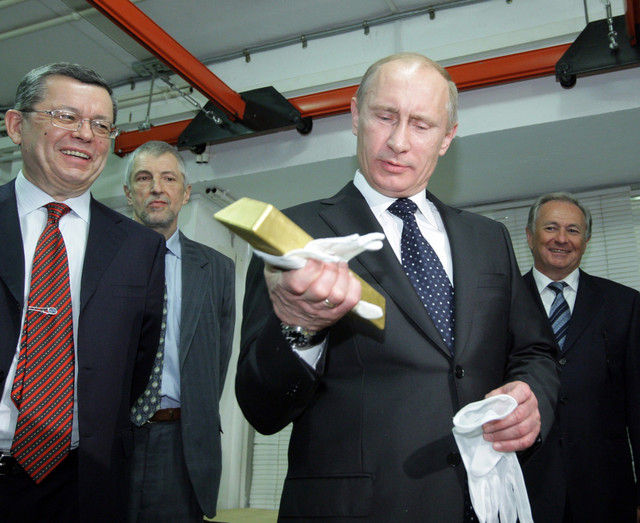
– Russia Is Hoarding Gold At The Fastest Pace In 12 Years:
…
Russia is adding gold to its reserves at the fastest pace in 12 years …and dumping US Treasuries at the fastest pace since 2011.
The Central Bank of Russia (CBR) has been increasing its holdings of gold every month since March 2015. The country is currently the sixth-largest gold owner after the United States, Germany, Italy, France and China.
According to the CBR, gold reserves spiked to $455.2 billion between March 2 and 9 hitting a historic high not seen since September 2014.
“Our international reserves increased by $2.9 billion or 0.6 percent in a single week, mainly on the strength of positive re-evaluation,” said the regulator.
…
According to World Gold Council data, last year the CBR became a world leader in stockpiling gold.
The bank has more than doubled the pace of its gold purchases, statistics showed. It has been increasing Russia’s gold reserves to meet the goal set by President Vladimir Putin to make it less vulnerable to geopolitical risks. The Russian gold cache has increased by more than 500 percent since 2000.
And while the Russian central bank is buying gold with both hands and feet, it is dumping US Treasuries at the fastest pace for a January since 2011…
…
* * *
PayPal: Donate in USD
PayPal: Donate in EUR
PayPal: Donate in GBP
A totally sustainable development and absolutely nothing to worry about…

– At $21 Trillion, The National Debt Is Growing 36% Faster Than The US Economy
* * *
PayPal: Donate in USD
PayPal: Donate in EUR
PayPal: Donate in GBP
– Centrelink debt scandal: report reveals multiple failures in welfare system:
Ombudman’s report says introduction of ‘robo-debt system’ put unreasonable burdens on welfare recipients and staff
An ombudsman’s report on the roll out of Centrelink’s automated debt recovery service has identified multiple failures that placed unreasonable burdens on welfare recipients and staff.
The self-initiated investigation was announced in January after months of complaints that the problem-riddled system was sending incorrect debt notices to people.
…
H/t reader kevin a.
* * *
PayPal: Donate in USD
PayPal: Donate in EUR
PayPal: Donate in GBP
– America: The Future Looks Broke:
H/t reader eric:
“It is not just immoral, but is illegal to issue Bonds you KNOW you can NEVER repay, but all western countries are now doing it, are broke, and must collapse soon.”
* * *
PayPal: Donate in USD
PayPal: Donate in EUR
PayPal: Donate in GBP
“If a tree fell in a forest and nobody heard it, did it really make a sound?” asks our favorite fiscal gadfly and Director of Research at Truth in Accounting, Bill Bergman, referring to the media coverage that the Treasury Department’s “Fiscal Year 2017 Financial Report of the U.S. Government” has received, which was, at the time he wrote it 24 hours after the February 15 release of the report: “Nothing. Zip. Scratch.”
…
That $1.156 trillion in Net Operating Cost occurred in fiscal 2017. But these are the good times, the boom years, if you will, when shortfalls should shrink into oblivion. So what will happen to the shortfall when the economy slows down or goes into a recession? That was a rhetorical question.
For fiscal 2018 and going forward, the tax cuts will lower revenues by about $150 billion per year on average over the next ten years. And for fiscal 2018 and 2019, Congress passed the two-year budget resolution that will add about $150 billion on average per year to the outlays. Both combined will drive up the deficit by about $300 billion a year on average.
“Where We Are Headed” a chapter heading (pages 9 and 14) says. I can supply my own chart, based US Treasury data, to show exactly “where we are headed” in terms of the US gross national debt:
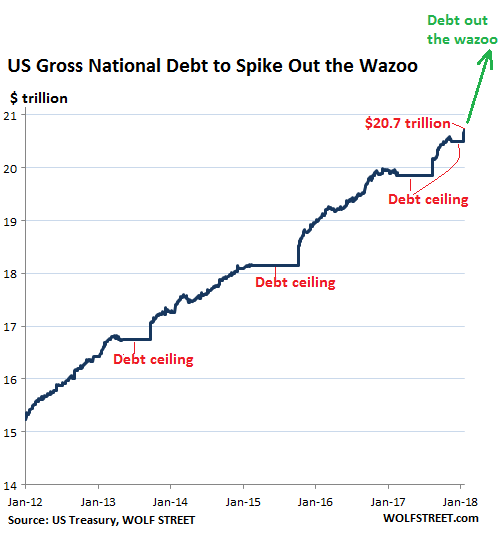
…
*****
Authored by MN Gordon via EconomicPrism.com,
United States Secretary of Treasury Steven Mnuchin has a sweet gig. He writes rubber checks to pay the nation’s bills. Yet, somehow, the rubber checks don’t bounce. Instead, like magic, they clear.
How this all works, considering the nation’s technically insolvent, we don’t quite understand. But Mnuchin gets it. He knows exactly how full faith and credit works – and he knows plenty more.

In fact, Mnuchin’s wife, Louise Linton, says she admires him because “he understands the economy.” And Mnuchin, no doubt, admires Linton, a Scottish actress 18 years younger, because “she loves SoulCycle Snapchat filters that make people look like puppies and piglets.” Naturally, Mnuchin gets the importance of puppy and piglet filters and how this bizarre fad fits into the big picture of the economy.

Unlike Mnuchin, we find the economy, and its infinite and dynamic relationships, to be beyond comprehension. But that doesn’t deter us from attempting to make some sense of it each week. When it comes to Snapchat filters we know nothing – and we could care less. Still, who are we to question Snap Inc.’s $24 billion market capitalization?
Prepare for total collapse.
https://youtu.be/2_kvyIqwXzo
* * *
PayPal: Donate in USD
PayPal: Donate in EUR
PayPal: Donate in GBP
#ITALY DEBT CRISIS: Borrowing soars to €2.2TRILLION sparking Eurozone fearshttps://t.co/pGAJ13rIav
— Infinite Unknown (@SecretNews) February 16, 2018
* * *
PayPal: Donate in USD
PayPal: Donate in EUR
PayPal: Donate in GBP
– Debt Bubble surpasses 300% of Global GDP:
Both developed and developing nations collaborated to achieve a new record of debt, but developed nations are the biggest offenders with 142 billion euros while developing nations added almost 51 billion euros.
The debt of households, companies, banks, and governments worldwide added up to a total of 193 billion euros at the end of 2017.
The figure represents a new record after increasing by 13.7 billion euros in the first nine months of last year, according to data compiled by the International Finance Institute (IIF).
The increase in global debt in absolute figures, in relation to world GDP reached 318% of global GDP, three percentage points below the historical maximum of 321% registered a year before.
…
H/t reader eric:
“Not long now I guess.”
* * *
PayPal: Donate in USD
PayPal: Donate in EUR
PayPal: Donate in GBP
– DANGER AHEAD FOR U.S. GOVT: Unable To Service Debt As Interest Rates Surge:
The U.S. Government is in serious trouble when interest rates rise. As interest rates rise, so will the amount of money the U.S. Government will have to pay out to service its rapidly rising debt. Unfortunately, interest rates don’t have to increase all that much for the government’s interest expense to double.
According to the TreasuryDirect.gov website, which came back online after being down for nearly a month, reported that the average interest rate paid on U.S. Treasury Securities increased from 2.2% in November 2016 to 2.3% in December 2017. While this does not seem like a significant change, every increase of 0.1% in the average interest rate, the U.S. Government has to pay an additional $20.5 billion in interest expense (based on the $20.5 trillion in total U.S. debt).
…
H/t reader squodgy:
“Somebody, somewhere knows the truth.
They will have prepared and have a bolthole.
Knowing when is essential.
We irrelevent serfs have no idea generally, but those who read I.U. have had enough pointers and warnings to know what’s going on.”
* * *
PayPal: Donate in USD
PayPal: Donate in EUR
PayPal: Donate in GBP
– Europe is sitting on a mountain of secret debt:
Data shows that in the third quarter of 2017 the EU’s debt-to-GDP ratio fell from 82.9 percent to 82.5 percent when compared with the same quarter of the previous year. Greece’s general government-debt-to-GDP ratio was the highest in the eurozone, at 177.4 percent. It was followed by Italy (134.1 percent) and Portugal (130.8 percent).
Oops! EU states are sitting on a huge mountain of secret debt. Contingent liabilities like govt guarantees, off-balance public-private partnerships, or public corporations debt may become actual govt liabilities if specific conditions prevail. https://t.co/9WwnjchlDN via @weltpic.twitter.com/5rADbrNQFt
— Holger Zschaepitz (@Schuldensuehner) February 1, 2018
Eurostat statistics are based on four broad categories of debt, which are guarantees issued by the state in relation to the liabilities of third parties. However, there are contingent liabilities which cannot be found in the official statistics. Those liabilities are not ‘hard’ debts but if even a small part of those guarantees was due to be repaid it would result in huge holes in the national budgets. This means there is accumulation of risks of which many are unaware.
– Debt Bubble surpasses 300% of Global GDP:
Both developed and developing nations collaborated to achieve a new record of debt, but developed nations are the biggest offenders with 142 billion euros while developing nations added almost 51 billion euros.
The debt of households, companies, banks, and governments worldwide added up to a total of 193 billion euros at the end of 2017.
The figure represents a new record after increasing by 13.7 billion euros in the first nine months of last year, according to data compiled by the International Finance Institute (IIF).
The increase in global debt in absolute figures, in relation to world GDP reached 318% of global GDP, three percentage points below the historical maximum of 321% registered a year before.
A totally sustainable development if you believe your politicians and central banksters.
– World Debt Is Rising Nearly Three Times As Fast As Total Global Wealth:
Some nasty dark clouds are forming on the financial horizon as total world debt is increasing nearly three times as fast as total global wealth. But, that’s okay because no one cares about the debt, only the assets matter nowadays. You see, as long as debts are someone else’s problem, we can add as much debt as we like… or so the market believes.
…
H/t reader squodgy:
“With NK now ‘chatting’ with SK, Syria cooling down, all EU buying gas from Russia, and hotspots generally diffused, the PTB are getting desperate to smokescreen the economic collapse of the massive debt based world, and therefore must be working very hard to create the very big event that now seems inevitable.
Will it be a dirty bomb, pandemic release, or military attack?
It’s strange but if the climate cooling materialises, over one third of the population will either starve or freeze anyway.”
In my opinion, TPTB know all about the timeline of global cooling and the coming massive earth changes (“The 3 Days of Darkness”), which will incl. a pole shift, and they have everything carefully planned.
Financial collapse & hyperinflation, followed by all-out civil war and then WW3.
And exactly during WW3 the massive earth changes will set in, causing maximum damage among the worldwide population.
Related info:
Read moreWorld Debt Is Rising Nearly Three Times As Fast As Total Global Wealth