Paul Craig Roberts was Assistant Secretary of the Treasury during President Reagan’s first term. He was Associate Editor of the Wall Street Journal. He has held numerous academic appointments, including the William E. Simon Chair, Center for Strategic and International Studies, Georgetown University, and Senior Research Fellow, Hoover Institution, Stanford University.
Dr. Paul Craig Roberts
By Paul Craig Roberts:
In 2010 the FBI invaded the homes of peace activists in several states and seized personal possessions in what the FBI—the lead orchestrator of fake “terrorist plots”—called an investigation of “activities concerning the material support of terrorism.”
Subpoenas were issued to compel antiwar protestors to testify before grand juries as prosecutors set about building their case that opposing Washington’s wars of aggression constitutes giving aid and comfort to terrorists. The purpose of the raids and grand jury subpoenas was to chill the anti-war movement into inaction.
Last week in one fell swoop the last two remaining critics of Washington/Tel Aviv imperialism were removed from the mainstream media. Judge Napolitano’s popular program, Freedom Watch, was cancelled by Fox TV, and Pat Buchanan was fired by MSNBC. Both pundits had wide followings and were appreciated for speaking frankly.
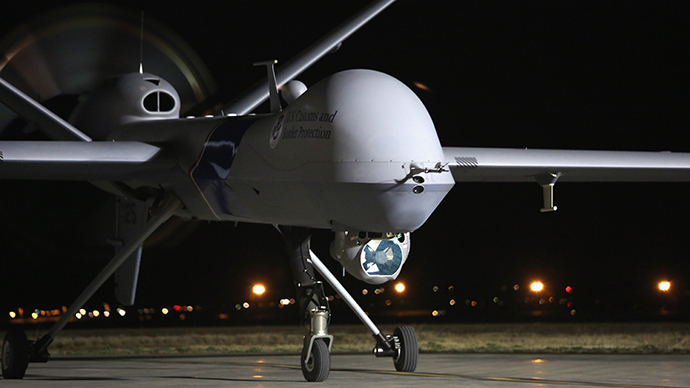
It’s the most benign thing in the world. In fact, it’s a concept whose time has come and it will only help protect us and keep us safe. Naturally, there’s nothing to worry about because there won’t be any abuse of the technology. After all, spy drones are already being used around the U.S.; what’s the problem with adding tens of thousands more?
In case you didn’t know it – and you probably didn’t – Congress, with little fanfare, passed an FAA reauthorization bill last week President Obama is expected to sign into law that will make it much easier for the government to put scores of unmanned spy drones into American skies.
Not only that the legislation authorizes the Federal Aviation Administration to develop regulations for the testing and licensing of commercial drones by 2015. If the law takes full effect, it is believed as many as 30,000 drones could be hovering over the U.S. by 2020.
The criminal tendencies of the U.S. Food and Drug Administration were on full display today when it was revealed the agency installed spy software and illegally hacked into the private Gmail accounts of at least half a dozen of its own top scientists. Those scientists, it turns out, were the very same whistleblowers who warned Congress about the FDA’s approval of dangerous medical devices that threatened the lives of patients. In response to them taking action to protect the lives of the innocent — something the FDA is supposed to do but has long since abandoned — they were instead subjected to illegal hacking and having their employment contracts with the FDA terminated.
Those six scientists and doctors have now filed a lawsuit in U.S. District Court which claims that they were subjected to FDA internal harassment and unjustified job termination. The lawsuit also describes how the FDA hacked into the private email accounts of these scientists, then intercepted their “whistleblower complaints” intended to be seen only by members of Congress.
The Food and Drug Administration secretly monitored the personal e-mail of a group of its own scientists and doctors after they warned Congress that the agency was approving medical devices that they believed posed unacceptable risks to patients, government documents show.
The surveillance — detailed in e-mails and memos unearthed by six of the scientists and doctors, who filed a lawsuit against the FDA in U.S. District Court in Washington last week — took place over two years as the plaintiffs accessed their personal Gmail accounts from government computers.
Information garnered this way eventually contributed to the harassment or dismissal of all six of the FDA employees, the suit alleges. All had worked in an office responsible for reviewing devices for cancer screening and other purposes.
Copies of the e-mails show that, starting in January 2009, the FDA intercepted communications with congressional staffers and draft versions of whistleblower complaints complete with editing notes in the margins. The agency also took electronic snapshots of the computer desktops of the FDA employees and reviewed documents they saved on the hard drives of their government computers.
Many of us breathed a sigh of relief when an overwhelming amount of Americans banned together and voiced their opposition to Congress over both the Stop Online Piracy Act, and Protect Intellectual Property Act.
Sites that dimmed the screen for a day or two have gone back to normal — Facebook users have swapped their anti-SOPA images for their previous profile pictures.
We may have even believed that the postponement of the vote originally scheduled for January 24th was some sort of white flag of capitulation. But that is certainly not the MO of most lawmakers.
While the outcry did get the attention of Congress, they are simply returning unflinchingly back to the drawing board to wait out our attention spans. Articles whirled that SOPA was dead and the bill was pulled when the bill’s sponsor Lamar Smith said in a statement that there would be no further action “until there is wider agreement on a solution.”
Federal Reserve Chairman Ben S. Bernanke said in a letter to four senior lawmakers yesterday that recent news articles about the central bank’s emergency lending programs contained “egregious errors.”
While Bernanke’s letter and an accompanying four-page staff memo posted on the Fed’s website didn’t mention any news organizations by name, Bloomberg News has published a series of articles this year examining the bailout. The latest, “Secret Fed Loans Gave Banks $13 Billion Undisclosed to Congress,” appeared Nov. 28.
“Bloomberg stands by its reporting,” said Matthew Winkler, editor-in-chief of Bloomberg News, who responded to the criticisms today on “Surveillance Midday” with Tom Keene.
Here is a point-by-point response by Bloomberg News to the Fed staff memo.
In the midst of allegations of police brutality and police aggression at the OWS protests, the U.S. Senate approved a bill that is said to “explicitly create a police state”: the National Defense Authorization Act. The NDAA, passed by a vote of 93 to 7, virtually stated that all of the United States may be considered a battlefield, and therefore the American military is permitted to indefinitely detain any American perceived to be a threat.
Several amendments were proposed by both Democrats and Republican Senators, which would have deleted the dangerous provisions that would allow the indefinite detention of American citizens. While most of those amendments were overwhelming voted down, a single compromise amendment was passed that was intended to quell fears that American citizens may be imprisoned indefinitely, though skeptics remain uncomfortable with the final outcome.
According to Firedoglake.com, sections 1031 and 1032 of the NDAA will: Continue reading »
Paul Craig Roberts was Assistant Secretary of the Treasury during President Reagan’s first term. He was Associate Editor of the Wall Street Journal. He has held numerous academic appointments, including the William E. Simon Chair, Center for Strategic and International Studies, Georgetown University, and Senior Research Fellow, Hoover Institution, Stanford University.