A controversial piece of facial recognition technology (and a PopSci “Best of What’s New 2010” alum) is rolling out in police stations across the country this fall, and naturally not everyone is happy about it. The Mobile Offender Recognition and Identification System (MORIS) uses an augmented iPhone to snap pictures of faces, scan fingerprints, and even to image irises, and then combs through police databases looking for matching identities. This, understandably, has privacy and civil liberties advocates crying foul.
The MORIS device attaches to the back of an iPhone, adding roughly 1.75 inches to the thickness of the smartphone. Police officers armed with the tool can take a photo of a person’s face from about five feet away, or scan his or her iris from about six inches, and wirelessly beam that data to law enforcement databases elsewhere to look for a match. It can also perform remote fingerprint matching.
Similar biometric technology has been deployed by the U.S. military in places like Iraq and Afghanistan to confirm the identities of civilians entering military safe zones and to search for known insurgents at checkpoints. But rolling it out in the streets of the U.S. has plenty of people concerned with privacy and Constitutional issues.
A SWAT team then descended on the 56-year-old woman’s house with a tank and automatic rifles after she was accused of firing a gun at police officers.
After a ten-hour stand-off, which resulted in the mother giving herself up, Ariana was taken into protective custody.
The girl had been home-schooled by her mother but wanted to start going to a regular school, which required her to take a number of immunisations, reports Prisonplanet.com.
The girl then suffered adverse reactions to these shots and her mother was told to put her on a prescribed pyschotropic drug.
‘She began acting out of character, being irritated, having facial grimaces that have been associated with immunisations,‘ the child’s aunt, Penny Godboldo, told the Detroit News.
(NaturalNews) The medical police state is alive and well in Detroit today, where Child Protective Services (CPS) called in the police to aid in their kidnapping of a 13-year-old daughter from an African American mother who refused to medicate her with dangerous psychiatric drugs. As this case is clearly showing, refusing to medicate your children with Big Pharma’s mind-altering drugs is now being treated as a felony crime.
• Child Protective Services (CPS) personnel attempted to kidnap Maryanne’s 13-year-old daughter. They accused her of not giving her child psychiatric medication prescribed by her doctor.
• Maryanne says the medication caused side effects in her daughter and made her condition worse, which is why she refused to give her daughter the medication.
• The medication was Risperdal, a neuroleptic antipsychotic medication known for causing serious side effects such as abdominal pain, vomiting, aggression, anxiety, dizziness and lack of coordination (http://www.risperdalsideeffects.com).
• When Maryanne refused to let CPS take her daughter away, CPS personnel then called the police, who then smashed down her front door and attempted to raid her home to kidnap her daughter by force.
• The police did NOT have a warrant or any court documents whatsoever granting them any right to enter Maryanne’s home, according to Godboldo’s attorneys.
• Police say that after they smashed in the front door, Maryanne opened fire on them. (Who wouldn’t open fire on a group of armed assailants trying to kidnap their daughter, by the way?)
• A SWAT team was then called in, carrying semiautomatic rifles and sniper gear. A 12-hour standoff ensued.
• Maryanne eventually surrendered to the SWAT team, and the state took her daughter to a psychiatric hospital where she is now being molested by the staff there, her mother says.
• Maryanne Godboldo now faces multiple felony charges: firing a weapon in a dwelling, felonious assault, resisting and obstructing an officer, and use of a firearm in the commission of a felony.
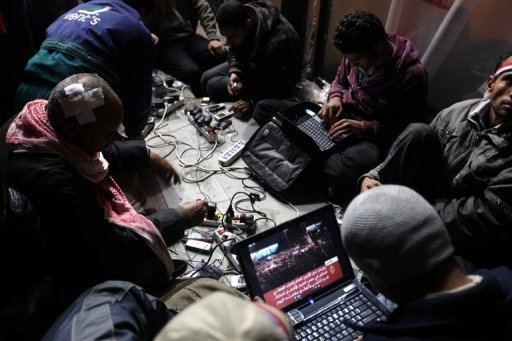
Egyptian anti-government bloggers work on their laptops from Cairo’s Tahrir Square
CAIRO (AFP) — A military court has jailed a blogger for three years for criticising the armed forces that have ruled Egypt since president Hosni Mubarak’s ouster in February, in a decision slammed by rights groups on Monday.
“Regrettably, the Nasr City military court sentenced Maikel Nabil to three years in prison,” the blogger’s lawyer Gamal Eid told AFP.
“The lawyers were not present, the verdict was handed out almost in secret.”
The decision had initially been set for Wednesday and was postponed to Sunday. The lawyers went on Sunday but were told to leave because there would be no verdict, Eid said.
“We were then very surprised to hear that he (Nabil) was sentenced to three years,” said Eid, who heads the Arabic Network for Human Rights Information (ANHRI).
On Friday, a Minnesota jury found that a blogger must pay $60,000 in damages because of statements he published in his blog about a public figure who was subsequently fired from his job. Internet publishers and free speech advocates should pay close attention to this case if it is appealed because the blogger was found liable even though the jury did not find that the blogger’s statements were false.
This decision is the latest example of the law’s apparent struggle to apply basic constitutional protections to internet publishers. If the Minnesota ruling holds up, it will mean that bloggers will have to worry they will be forced to pay for true statements that they publish that cause a person damages.
BEIJING — A human rights group says an Internet activist has been charged with subversion for spreading calls on the Internet for Middle Eastern-style anti-government protests in China.
The Hong Kong-based Information Center for Human Rights and Democracy says Guo Weidong was detained on Thursday night and his home in China’s eastern city of Haining searched. It says a document was delivered to his wife the next day stating that he was being charged with the vaguely defined charge of “incitement to subvert state power.”
Click here to find out more!
The lawmaker behind a bill Texas that would levy felony charges against overly-touchy security personnel may be staunchly Republican, but he truly believes his cause isn’t one tied to the political left or right.
“We’re talking about what would be a criminal act in any other place,” Rep. David Simpson (R) told Raw Story on Monday. “If you viewed someone naked without their permission or consent, or as a condition of travel, it would be sexual harassment or vouyerism. If you touched people’s privates, that would be sexual assault.
“This is not a left or right issue,” he added. “They are treating American citizens with great indignity, and we’ve got to make this right.”
Though unlikely to pass — even with a GOP supermajority in the Texas legislature — Simpson’s proposal has become a cause célèbre for civil libertarians, many of whom adamantly oppose the TSA’s screening procedures.
The bill would amend a Texas statute pertaining to “the offensive touching of persons,” extending it to security personnel who conduct a search “without probable cause.”
That’s actually the exact wording used in the Constitution in the section outlining prohibitions on unreasonable search and seizure. The legal standard for a lawful search is probable cause: a requirement that law enforcement must meet before most judges will issue search warrants.
MEPs led the campaign to stop the use of the scanners in the Parliament yet they are in use in 70 airports across Europe, including London Heathrow Photo: PA
The body scanners, bought in 2005 at a cost of £100,000 each, are “rotting” in the basement of the building in Brussels and have never been used.
When the scanners, which create an image of a person’s nude body, were eventually delivered to the Parliament in the autumn of 2005 MEPs objected to them being used in the building on privacy grounds.
Nikki Sinclair, a British independent MEP, said the Parliament tried to sell the machines but failed to do so.
Breaking: Newly Obtained Homeland Security Documents Reveal Radical Shift In Internet Policy
FIGHT BACK: Internet user arrested for linking to other websites.
Brian McCarthy ran a website, channelsurfing.net, that linked to various sites where you could watch online streams of TV shows and sports networks. A couple months ago, the government seized his domain name and on Friday they arrested him and charged him with criminal copyright infringement — punishable by five years in prison.
We just obtained a copy of the complaint (below) that the Department of Homeland Security (DHS) and Immigration and Customs Enforcement (ICE) made against him — and they don’t even allege that he made a copy of anything!Just that he ran what they call a “linking website” which linked to various sites with copyrighted material. Under that sort of thinking, everyone who’s sent around a link to a copyrighted YouTube video is a criminal.
Paul Craig Roberts was Assistant Secretary of the Treasury during President Reagan’s first term. He was Associate Editor of the Wall Street Journal. He has held numerous academic appointments, including the William E. Simon Chair, Center for Strategic and International Studies, Georgetown University, and Senior Research Fellow, Hoover Institution, Stanford University.
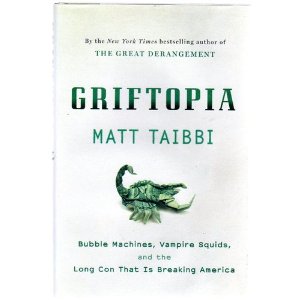
This essay is about three recent books that explain how we lost our economy, the Constitution and our civil liberties, and how peace lost out to war.
Matt Taibbi is the best–certainly the most entertaining–financial/political reporter in the country. There is no better book than Griftopia (2010) to which to turn to understand how stupidity, greed, and criminality, spread evenly among policymakers and Wall Street, created the financial crisis that has left Americans overburdened with both private and public debt. Taibbi walks the reader through the fraudulent financial instruments that littered the American, British, and European financial communities with toxic waste. He has figured it all out, and what in other hands might be an arcane account for MBAs is in Taibbi’s hands a highly readable and entertaining story.
For the first 65 pages Taibbi entertains the reader with the inability of the public and politicians to focus on any reality. The financial story begins on page 65 with Fed chairman Alan Greenspan undermining the Glass-Steagall Act leading to its repeal by three political stooges, Gramm-Leach-Bliley. This set the stage for the banksters to leverage debt upon debt until the house of cards collapsed. When Brooksley Born, head of the Commodity Futures Trading Commission, attempted to do her regulatory job and regulate derivatives, the Federal Reserve, Treasury, and Securities and Exchange Commission got her bounced out of office. To make certain that no other regulator could protect the financial system and its participants from what was coming, Congress deregulated the derivatives markets by passing the Commodity Futures Modernization Act.