– Is US Auto Sales Data Fabricated: FBI Investigating Chrysler For Falsifying Monthly Sales Reports
* * *
PayPal: Donate in USD
PayPal: Donate in EUR
PayPal: Donate in GBP
The man who trades freedom for security does not deserve nor will he ever receive either. – Benjamin Franklin
– “Rammed” – Fiat Chrysler Forced To Buy Back 500,000 Pickup Trucks From Customers In Historic Settlement (ZeroHedge, July 27, 2015):
In a stunning ruling, US safety regulators have mandated that Fiat Chrysler must offer to buy back from customers more than 500,000 Ram pickup trucks and other vehicles as part of a costly deal with safety regulators to settle legal problems in about two dozen recalls. As WTOP reports, this is the biggest such action in US history, and is in addition to a $105 million civil fine and owners of more than a million older Jeeps with vulnerable rear-mounted gas tanks will be able to trade them in or be paid by Chrysler to have the vehicles repaired. Think the punishment is harsh, consider that at least 75 people have died in crash-related fires, although Fiat Chrysler maintains they are as safe as comparable vehicles from the same era.
…
Flashback:
– Frontrunning: July 23 (ZeroHedge, July 23, 2014):
- Here come the gates which we predicted in 2010: SEC Is Set to Approve Money-Fund Rules (WSJ)
- Dick’s cuts 400 jobs as golf now less popular (MW)
- Kerry arrives in Israel, pushes for peace (Reuters) (Sure!)
- Pay Penalty Haunts Recession Grads as U.S. Economy Mends (BBG)
- Appeals Courts Issue Conflicting Rulings on Health-Law Subsidies (WSJ)
- Rebel Stronghold Donetsk Holds Breath as Shellfire Mounts (BBG)
- Business executive wins Georgia Republican runoff in U.S. Senate race (Reuters)
- Five held in China food scandal probe, including head of Shanghai Husi Food (Reuters)
- Jobs Hold Sway Over Yellen-Carney as Central Banks Splinter (BBG)
Overnight Media Digest
WSJ
* Two U.S. appeals courts issued conflicting rulings on subsidies for health coverage purchased on federal insurance exchanges, clouding a major part of Obama’s health law. (http://on.wsj.com/1pb81yo)
* The Federal Reserve Bank of New York found that Deutsche Bank AG’s U.S. operations suffer from a litany of serious financial reporting problems that the lender has known about for years but not fixed. (http://on.wsj.com/1jUoOXe)
The Car Coach Lauren Fix on why ‘E15’ gas could damage drivers’ vehicles older than 2012 models.
– U.S. loses $1.3 billion in exiting Chrysler (CNNMoney, July 21, 2011):
NEW YORK (CNNMoney) — U.S. taxpayers likely lost $1.3 billion in the government bailout of Chrysler, the Treasury Department announced Thursday.
The government recently sold its remaining 6% stake in the company to Italian automaker Fiat. It wrapped up the 2009 bailout that was part of the Troubled Asset Relief Program six years early.
Read moreUS Taxpayers Lost $1.3 Billion In Government Bailout Of Chrysler
See also:
– US: Record 1 in 6 Americans in Government Anti-Poverty Programs
Aug. 31 (Bloomberg) — U.S. auto sales in August probably were the slowest for the month in 28 years as model-year closeout deals failed to entice consumers concerned the economy is worsening and they may lose their jobs.
Industrywide deliveries, to be released tomorrow, may have reached an annualized rate of 11.6 million vehicles this month, the average of eight analysts’ estimates compiled by Bloomberg. That would be the slowest August since 1982, according to researcher Ward’s AutoInfoBank. The rate would be 18 percent below last year’s 14.2 million pace, when the U.S. government’s “cash for clunkers” incentive program boosted sales.
“Home sales are way down, the stock market is way down, the unemployment report is very disappointing and consumer confidence is sputtering,” Jesse Toprak, vice president of industry trends at TrueCar.com, said in an interview. “People just don’t want to make big-ticket purchases because they’re uncertain about their jobs and the value of their homes.”
While automakers increased discounts by 1 percent from July to an average of $2,864 per vehicle, sales to individuals probably fell 7 percent from last month, according to Santa Monica, California-based TrueCar.
Read moreUS Auto Sales May Hit 28-Year Low as Discounts Flop
Alex continues his discussion with pastor Lindsey Williams about the plans of the elite to crash the economy.
Added: 23rd Oct 09
1 of 4:
Read moreLindsey Williams on The Alex Jones Show: Economic Warfare Declared on the US
“Nobody in the senate today understands basic economics.”
Date: 17th Sep 09
Related information:
– US: Hyperinflation Nation
– Peter Schiff: The Case For Inflation (09/12/2009)
Hyperinflation Nation starring Peter Schiff, Ron Paul, Jim Rogers, Marc Faber, Tom Woods, Gerald Celente, and others.
Prepare now before the US dollar is worthless.
Part 1 :
May 14 (Bloomberg) — Chrysler LLC asked a bankruptcy judge to let it reject 789 automotive dealership agreements by June 9, many located in the suburbs of major U.S. cities.
The company wants to break contracts with about a quarter of its estimated 3,188 retail outlets, including seven dealers with AutoNation Inc., two with Lithia Motors Inc. and the Atlanta unit of Asbury Automotive Group Inc., according to a filing today in Manhattan with U.S. Bankruptcy Judge Arthur Gonzalez, who must approve the cuts.
Fiat SpA, not Chrysler, decided which dealers will be brought along to a new company to be formed with the company’s best assets and run by the Italian carmaker, according to people familiar with the matter. Trimming the bulk of dealers from urban areas will increase profitability at the remaining dealers, lawyers for Chrysler said.
Max Keiser:
“The Hedge Funds make more money with Chrysler dead than alive.”
“Capitalism is now eating itself in America, it’s swallowing itself, it’s destroying itself, because they are going after the last crumbs on the table as the American economy implodes.”
“They are going to fire millions of workers in the entire auto industry.”
“In France workers actually have representation. They can kidnap the boss in France and they can get away with that. In America if they try to kidnap the boss they would be gunned down by American Homeland Security. They have no ability to protest in America, the workers. They are just cogs in the wheel. They are treated like complete mud.”
“They want to eliminate the entire middle classes in America, because they are in the way of the bankers.”
Added: Mai 07, 2009
Source: YouTube
Chrysler, one of the three pillars of the American auto industry, will file for bankruptcy today after last-minute negotiations between the government and the automaker’s creditors broke down last night, an Obama administration official said.
U.S. officials had offered Chrysler’s secured lenders $2.25 billion in cash if they would agree to writedown the $6.9 billion in secured debt that the company owed. But a small group of hedge funds refused the 11th-hour deal, forcing an imminent bankruptcy.
Related articles:
– Daimler to Cede 19.9% Stake in Chrysler to Cerberus (Bloomberg)
– Chrysler Will File for Bankruptcy, Official Says (Bloomberg)
An administration official this morning expressed disappointment, saying the holdouts had failed to “do the right thing,” but that “their failure to act in either their own economic interest or the national interest does not diminish the accomplishments made by Chrysler, Fiat and its stakeholders, nor will it impede the new opportunity Chrysler now has to restructure and emerge stronger going forward.”
President Obama is scheduled to address the issue at noon today at the White House.
April 29 (Bloomberg) — President Barack Obama plans to announce tomorrow morning that Chrysler LLC will be placed into Chapter 11 bankruptcy leading to an alliance with Italian automaker Fiat SpA, people involved in the matter said.
Administration officials are still trying to resolve outstanding issues, and the plan is not finished yet, said one of the people, who declined to be named. If there’s a bankruptcy filing, it could come as soon as tomorrow, the people said.
Read moreObama Said to Ready Plan For Chrysler Bankruptcy, Fiat Alliance
Zombie banks, zombie carmakers, zombie debt and soon a zombie dollar……
Flags fly above a Chrysler sign outside their Detroit Axle facility in Detroit, Dec. 19, 2008. Photographer: Jeff Kowalsky/Bloomberg News
Feb. 17 (Bloomberg) — General Motors Corp. and Chrysler LLC, already relying on government aid to survive, take their case to the U.S. Treasury today that they can undo past mistakes and justify more U.S. aid to return to profit.
GM, with a pledge for $13.4 billion in loans, may seek support beyond an $18 billion request made Dec. 2 because of worsening economic conditions, people familiar with the automaker’s plan said. Chrysler has said it needs at least $3 billion in addition to $4 billion it received last month.
General Motors and Chrysler are to call upon the US government for billions more in extra funding as President-elect Barack Obama asks the US Congress to release the second half of the $700bn (£471bn) bail-out fund.

Chrysler, along with General Motors, has already received $17.4bn from the US government Photo: Getty
The two companies, who were granted $17.4bn from the US Treasury’s $700bn Troubled Assets Relief Programme (TARP) in December, are working to achieve further funds in order to carry out comprehensive restructurings of their ailing businesses.
GM chairman and chief executive Rick Wagoner said at the North American International Motor Show in Detroit that the $13.4bn his company should receive in full by mid-February will be enough to see it through to the end of March, but wouldn’t comment on what the next move might be.
But GM president Fritz Henderson stressed yesterday that the baseline plan submitted to Congress in December called for a total of $18bn under the worst-case scenario envisaged for the US auto industry.
“We’ll develop our plan … then we’ll present it. We’ll make judgments from there,” he said ahead of GM’s press conference at the motor show. “It was pretty clear that the requirements were beyond, at that point, $12bn for a continued downside scenario.”
Meanwhile Chrysler is already in talks with the Treasury over further funding, seeking $3bn in additional government aid for its finance arm, with sources suggesting a second cash infusion on top of the $4bn received in December could be complete by the end of this week. “We are making good progress to qualify for a total of $7bn, which puts us in a really good financial position,” Chrysler vice-chairman Jim Press said.
The cash calls from Detroit came as President-elect Obama asked President George W Bush to ask Congress to free-up the remaining $350bn of the TARP allocation.
Read moreGeneral Motors and Chrysler to ask US for more funds
Jan. 5 (Bloomberg) — General Motors Corp.’s U.S. sales plunged to a 49-year low in 2008, dragged down by a 31 percent slide in December as demand was ravaged by the recession and concern that the biggest domestic automaker might collapse.
Toyota Motor Corp.’s U.S. deliveries plummeted 37 percent last month, while Honda Motor Co. slipped 35 percent, Ford Motor Co. fell 32 percent and Nissan Motor Co. was down 31 percent, pointing toward the industry’s worst annual volume since 1992. Chrysler LLC dived 53 percent.
Related articles:
– Auto sales plunge again in December (CNN)
– Bleak US sales in December cap a grim year for automaker (IHT)
– US Auto Sales Plunge Whopping 36 Percent in Dec. (AP)
The federal rescue of GM and Chrysler couldn’t overcome buyer pessimism and tight credit in the world’s biggest auto market. Ford’s 2008 U.S. sales sagged to a 47-year low, while GM’s total of 2.95 million light vehicles was the least since 1959, according to trade publication Automotive News.
“It’s one of the worst years ever, and this year will be worse,” said Stephanie Brinley, an analyst at consulting firm AutoPacific Inc. in Southfield, Michigan. “It’s not a gas problem. It’s not a credit problem. It’s a consumer confidence problem, and it’s worldwide.”
GM and Chrysler received commitments last month for as much as $17.4 billion in U.S. loans, saying they would have run short of operating cash by this month.
GM’s results last month beat the average estimate of a 41 percent drop among six analysts surveyed by Bloomberg News. Tempering the decline was a 43 percent surge in deliveries of the Chevrolet Malibu sedan. Sales of GM’s Saab brand, which the Detroit-based automaker says it may sell, fell 57 percent.
U.S. Market Share
Thanks to bigger declines throughout 2008, the U.S. automakers will likely mark the first calendar year where their combined market share was less than 50 percent, based on results through November, when they held 47 percent.
The drop in full-year U.S. sales for Toyota and Honda were the first for the Japanese automakers since 1995 and 1993, respectively.
Toyota failed to get a boost from no-interest loans offered on most of its models since Oct. 2. Sales of its Prius hybrid, the best-selling gasoline-electric car in the U.S., declined 45 percent. The Tundra full-size pickup dropped 52 percent, while Toyota’s Lexus luxury brand finished the month down 32 percent.
Industrywide Decline
Industrywide U.S. sales extended a streak of declines of at least 25 percent dating to September. Vehicle sales for the year likely will total slightly more than 13 million, based on estimates from a Bloomberg News survey of 22 analysts and economists.
While that annual total would be the lowest in 16 years, it doesn’t reflect the steepening slide in U.S. auto demand.
Last month’s seasonally adjusted annual sales rate probably was 10 million, a 39 percent decline, based on the Bloomberg survey. The November rate was 10.2 million, and annual sales for all of 2007 were 16.1 million.
“We are at the bottom now,” said Tom Libby, an automotive analyst at consumer-research firm J.D. Power & Associates in Troy, Michigan. “People have just stopped buying and I don’t blame them. When you have such a decline in savings and net worth, it just doesn’t surprise me sales have fallen so much.”
Sales of Daimler AG’s Mercedes-Benz and Smart minicar fell 24 percent in December. Volkswagen AG was down 14 percent, while its Audi unit was off 9.3 percent. Bayerische Motoren Werke AG’s sales of BMW- and Mini-brand autos fell 36 percent.
Weak Economy
U.S. jobless rolls reached a 26-year high in the week ended Dec. 20, signaling a worsening labor market as the economy heads into the second year of a recession. That weakness adds to the strain on automakers after record fuel prices in 2008’s first half damped demand for full-size pickups and sport-utility vehicles.
President-elect Barack Obama has made an economic stimulus package his top priority, and he told reporters today in Washington that the nation faces an “extraordinary challenge” in reviving growth.
“The sooner stimulus efforts find their way to where they’ll do the most good — into the hands of consumers — the sooner we’ll see a turnaround in confidence levels and a return of buyers to the marketplace,” Jim Lentz, president of Toyota’s U.S. sales unit, said in a statement today.
December’s plunge may have been eased by the resumption of low-cost financing from GM last week, auto-research firm Edmunds.com said, citing a surge in vehicle inquiries on its site and dealer surveys.
Ford’s U.S. sales were “strong” in the last two weeks of December, Executive Vice President Mark Fields told reporters today in Dearborn, Michigan, where the automaker is based. Ford discounted its remaining F-150 pickups from the 2008 model year after a redesigned version debuted in October.
GM, Chrysler Rescue
Consumer concern that Detroit-based GM and Auburn Hills, Michigan-based Chrysler would fail to get government aid and be forced into bankruptcy may have contributed to December’s slump, Patrick Archambault, a Goldman, Sachs & Co. analyst based in New York, said in a Dec. 28 research note.
President George W. Bush announced Dec. 19 that GM and Chrysler would get the emergency loans in exchange for restructuring their businesses. GM had said it might run out of operating funds by the end of 2008, while Chrysler had said it might fall short by the middle of this month.
GM had resisted demands by some U.S. lawmakers that it file for bankruptcy instead of pursuing federal loans, saying buyers wouldn’t trust a car company under court protection.
To contact the reporters on this story: Mike Ramsey in Southfield, Michigan, at [email protected]; Alan Ohnsman in Los Angeles at [email protected]
Last Updated: January 5, 2009 15:22 EST
By Mike Ramsey and Alan Ohnsman
Source: Bloomberg
It seems that the US government and the Federal Reserve are looting taxpayers’ until there is nothing left.
If you take into account what Peter Schiff and Lindsey Williams are telling us….
– Peter Schiff: US Dollar is on the verge of collapse; This is hyperinflation; This is Zimbabwe (12/17/2008):
“I am a 100% convinced that anybody who has their wealth in US Dollars will be just as broke as the people who had their money with Madoff.”
– Peter Schiff on CNBC: The government is pouring gasoline on a fire that it set (12/29/08):
“We are in the process of creating another Great Depression.”
…with the odd timing that there is an ‘Army combat unit to deploy within the U.S.’ plus ‘Pentagon: 20,000 Troops to Bolster Domestic Security’ …
((Of course those troops need training: Northcom Combat Team Conducts “Humanitarian Support” Exercise in Maryland: “The Armed Forces Press Service has initiated a propaganda campaign designed to convince the American people that deploying the 3rd Infantry Division in the United States in violation of the Posse Comitatus Act is a good thing.”))
…then it does not sound like a crazy conspiracy theory anymore that the government will deploy more and more soldiers within the U.S. in preparation for civil unrest in case US citizens realize that they are betrayed by the government and the Fed, who ‘are’ destroying the future of the US by creating massive debt and hyperinflation, which will ultimately lead to the total collapse of the US.
Soon the government and the Fed will have turned the U.S. into a ‘Third World’ country.
Source: Bloomberg
Jan. 1 (Bloomberg) — The U.S. Treasury threw the door open to taxpayer financing for a widening array of companies and industries by drafting broad guidelines on aid to the auto industry.
The Treasury’s guidelines, published yesterday, would let officials provide funds to any company they deem important to making or financing cars. That leaves room for the government to provide money from the Troubled Asset Relief Program beyond loans already committed to General Motors Corp., GMAC LLC and Chrysler LLC.
“There are going to be other industries that are going to have just as good a case,” as the auto companies, former St. Louis Federal Reserve Bank President William Poole said in an interview on Bloomberg Television. “We don’t know what those other industries are going to be. Where does this process stop?”
Shares of auto suppliers including American Axle & Manufacturing Holdings Inc. and Lear Corp. jumped yesterday after Treasury announced the guidelines. The Motor & Equipment Manufacturers Association has been lobbying for the use of federal funds as a backstop in case parts makers can’t collect money the auto manufacturers owe them.
Read moreTreasury to continue bailing out firms, industries by looting taxpayers’
WASHINGTON – President Bush agreed to an emergency bailout of General Motors and Chrysler, giving them a few months to get their businesses in order, but left to President-elect Barack Obama the difficult political decision of ruling on their progress.

The president’s plan gives carmakers until March 31 to restructure.
Doug Mills/The New York Times
The plan pumps $13.4 billion by mid-January into the companies from the fund that Congress authorized to rescue the financial industry. But the two companies have until March 31 to produce a plan for long-term profitability, including concessions from unions, creditors, suppliers and dealers.
The bailout plan sets “targets” rather than concrete requirements about what those concessions may be, meaning that Mr. Obama and his advisers have enormous latitude to decide how to define long-term viability.
Read moreBush Gives Emergency Loans to Automakers: A $17.4 Billion, 3-Month Lifeline
A huge bailout for Detroit was barely able to budge Wall Street on Friday.
Stock markets surged in early trading after President Bush announced plans to extend $13.4 billion in emergency loans to the troubled automakers General Motors and Chrysler. But Wall Street’s reaction cooled, the morning’s early gains eroded, and markets ended mixed.
A future out of control, bankrupt financial institutions trying to hold on, limitation on credit severely limits ability of the economy to start up again, debt totally embraces our lives, handouts a state secret, soon cash infusions wont work for banks anymore, banks hold too much toxic garbage to even know if they are solvent. We are now 17 months into a credit crisis that continues to expose the corruption and incompetence of government, banking, Wall Street and transnational corporations. The situation has not stabilized and it won’t anytime soon. All we see are sweetheart deals for elitist corporations for which American taxpayers will pay for years to come. The future of our nation is totally out of control. For the last eight years our economy has been running on something for nothing, lies and deceit. The result will be hyperinflation and then the Second Great Depression.
Read moreHyperinflation and then The Second Great Depression
If you oppose those disastrous bailouts people then you should have better voted for Ron Paul and not for Mr. ‘Change is Protectionism’ or Mr. ‘Bomb Them All’. Ron Paul would have listened to the people. He always did. Those elite puppets won’t.
_________________________________________________________________________
NEW YORK (CNNMoney.com) — A majority of Americans oppose a bailout of the troubled U.S. auto industry, according to a poll released Wednesday.
The CNN/Opinion Research Corp. poll, conducted by telephone on Dec. 1-2 with nearly 1,100 people, showed that 61% of those surveyed oppose government assistance for the major U.S. automakers.
The poll comes at a critical time for the American auto industry. Ford Motor, General Motors and Chrysler LLC are requesting up to $34 billion dollars in emergency loans from the government to amid the weakest auto sales in 25 years and persistently tight credit.
General Motors and Chrysler, burning through billions of dollars in cash, are the most imperiled. All three companies submitted plans to Congress on Tuesday making their case for funding, and industry executives are set to testify on Capitol Hill as lawmakers debate whether to take emergency action.
But Wednesday’s poll suggests that Americans believe bailing out the Big Three is a bad idea.
A full 70% of respondents indicated that a bailout is unfair to taxpayers.
Read morePoll: 61% oppose auto bailout; 70% say bailout is unfair to taxpayers
The ‘USSA’ will bailout almost everything until the USS Titanic sinks.
__________________________________________________________________________

A U.S. flag flies outside the headquarters of General Motors Corp. in Detroit, Michigan, Oct. 17, 2008. Photographer: Gary Malerba/Bloomberg News
Dec. 3 (Bloomberg) — General Motors Corp. and Chrysler LLC told Congress they need $11 billion in government loans just to survive the year. Democrats pledged to keep them out of bankruptcy without saying how.
The aid requests delivered yesterday to U.S. lawmakers total $34 billion, more than a third larger than the plans they set aside last month, and heighten the pressure for action as a deepening auto slump quickens GM’s rush toward a default.
While President-elect Barack Obama has said he favors an industry rescue, GM and Chrysler said yesterday they won’t be operating through his January inauguration without the money stalled by a deadlock in Congress. Democrats want to use the $700 billion bank-bailout fund, and Republicans favor tapping an Energy Department loan program.
Read moreGM, Chrysler Seek $11 Billion Just to Avert 2008 Collapse

On Friday November 21, the world came within a hair’s breadth of the most colossal financial collapse in history according to bankers on the inside of events with whom we have contact. The trigger was the bank which only two years ago was America’s largest, Citigroup. The size of the US Government de facto nationalization of the $2 trillion banking institution is an indication of shocks yet to come in other major US and perhaps European banks thought to be ‘too big to fail.’
The clumsy way in which US Treasury Secretary Henry Paulson, himself not a banker but a Wall Street ‘investment banker’, whose experience has been in the quite different world of buying and selling stocks or bonds or underwriting and selling same, has handled the unfolding crisis has been worse than incompetent. It has made a grave situation into a globally alarming one.
‘Spitting into the wind’
A case in point is the secretive manner in which Paulson has used the $700 billion in taxpayer funds voted him by a labile Congress in September. Early on, Paulson put $125 billion in the nine largest banks, including $10 billion for his old firm, Goldman Sachs. However, if we compare the value of the equity share that $125 billion bought with the market price of those banks’ stock, US taxpayers have paid $125 billion for bank stock that a private investor could have bought for $62.5 billion, according to a detailed analysis from Ron W. Bloom, economist with the US United Steelworkers union, whose members as well as pension fund face devastating losses were GM to fail.
Read moreColossal Financial Collapse: The Truth behind the Citigroup Bank “Nationalization”
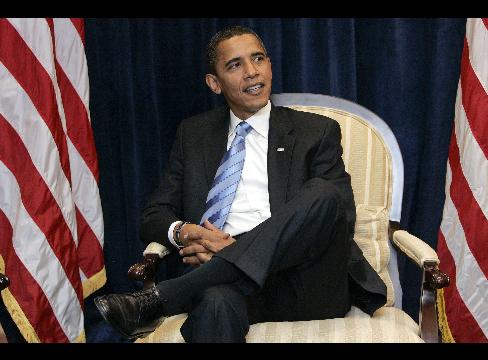
U.S. President-elect Barack Obama looks on before the start of a meeting with Senator John McCain of Arizona, former Republican presidential candidate, at Obama’s transition office in Chicago, Nov. 17, 2008. Photographer: Frank Polich/Bloomberg News
Nov. 21 (Bloomberg) — President-Elect Barack Obama‘s transition team is exploring a swift, prepackaged bankruptcy for automakers as a possible solution to the industry’s financial crisis, according to a person familiar with the matter.
A representative of Obama’s team has already contacted at least one bankruptcy-law firm to say that Daniel Tarullo, a professor at Georgetown University’s law school who heads Obama’s economic policy working group, would call to discuss the workings of a so-called prepack, according to this person.
U.S. lawmakers yesterday delayed until December a vote on whether to give General Motors Corp., Ford Motor Co. and Chrysler LLC a $25 billion bailout. GM today said it would idle production at four plants an extra week and return some corporate jets to conserve cash. Automakers could use a judge-supervised bankruptcy to reduce debt and reject expensive contracts.
“It creates the environment to deal with GM’s problems but limits government financial commitment,” said bankruptcy lawyer Mark Bane of Ropes & Gray in New York.
Bankruptcy is just one option being examined. Obama told CBS News’s “60 Minutes” on Nov. 16 that government aid to automakers might come in the form of a “bridge loan,” advanced if the industry could draw up plan to make itself “sustainable.” The president-elect earlier urged Congress to approve as much as $50 billion to save automakers, using the model of Chrysler’s bailout in 1979.
Read moreObama Team Said to Explore `Prepack’ Auto Bankruptcy

Chinese carmakers SAIC and Dongfeng have plans to acquire GM and Chrysler, China’s 21st Century Business Herald reports today. [A National Enquirer the paper is not. It is one of China’s leading business newspapers, with a daily readership over three million.]
The paper cites a senior official of China’s Ministry of Industry and Information Technology- the state regulator of China’s auto industry- who dropped the hint that “the auto manufacturing giants in China, such as Shanghai Automotive Industry Corporation (SAIC) and Dongfeng Motor Corporation, have the capability and intention to buy some assets of the two crisis-plagued American automakers.”
These hints are very often followed with quick action in the Middle Kingdom. The hints were dropped just a few days after the same Chinese government gave its auto makers the go-ahead to invest abroad. And why would they do that?