* * *
PayPal: Donate in USD
PayPal: Donate in EUR
PayPal: Donate in GBP
The man who trades freedom for security does not deserve nor will he ever receive either. – Benjamin Franklin
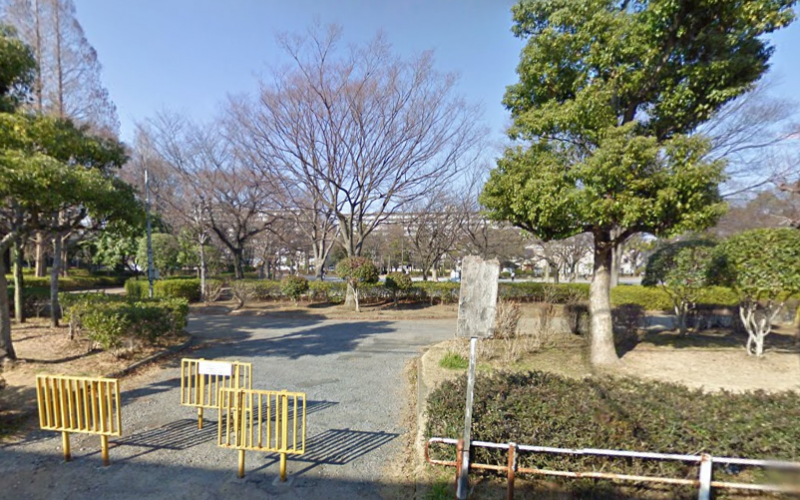
– Over 100,000 Bq/Kg of Cs-134/137 still detected in a park of Chiba (Fukushima Diary, Oct 13, 2014):
101,000 Bq/Kg of Cs-134/137 was measured from the soil of a park in Chiba. A citizen’s organization “PLANET ROCK” analyzed and reported this October.
The location is “Shin-Matsudo central park” in Matsudo city, Chiba. This area is known as one of the worst hot spots in Kanto area.
The specific sample was collected beside the toilet of the park. From the other side of the toilet, they also measured 93,400 Bq/Kg of Cs-134/137.
Read moreOver 100,000 Bq/kg Of Cs-134/137 Detected In Park (28 Km By Car From Tokyo Station)
– Indiana stored babies’ DNA, blood for research without parental consent (RT, July 13, 2014):
The Indiana State Department of Health has been collecting babies’ blood and DNA without their parents’ permission since 1991, according to an investigation by a local news station. Now the state wants to know what to do with the blood samples.
When a baby is born in Indiana, as with other states, the state conducts a newborn screening test. A nurse or midwife takes a few drops of blood from the heel of each infant. The blood is collected on a specialized filter paper, which is then sent to the state’s Newborn Screening Lab in downtown Indianapolis.
Read moreIndiana Stored Babies’ DNA, Blood For Research Without Parental Consent Since 1991
– High levels of cesium detected in fish off Chiba (NHK, Feb 18, 2013):
Fish caught in waters off Choshi City in Chiba Prefecture have been found to contain radioactive cesium above the government safety limit.
Choshi is nearly 200 kilometers south of the crippled Fukushima Daiichi nuclear power plant.
Chiba Prefecture says it found 130 becquerels of cesium per kilogram in Japanese sea bass caught about 10 kilometers off Choshi on Thursday of last week. The acceptable limit is 100 becquerels.
It is the first time that higher-than-permitted levels of radioactive substances have been found in fish landed at ports in the prefecture.
Goshi Hosono’s Ministry of the Environment is on the sudden offensive against citizens and residents of Kanto and Tohoku, again.
According to the Yomiuri Shinbun article, the Ministry of the Environment is already talking with the officials in the municipalities in three prefectures to built final disposal sites in their cities and towns.
As the wide-area disposal of disaster debris winds down as it is now widely revealed that there is simply not enough debris to widely distribute, Mr. Hosono looks desperate to do something so that he can claim he has made people “share the pain”.
From Yomiuri Shinbun (8/21/2012):
????????????????????
Final disposal sites for ashes from contaminated garbage to be built in the land owned by the national government in four prefectures
– 180,000 Bq/Kg from the yellow substance in Kashiwa Chiba (Fukushima Diary, Aug 19, 2012)
?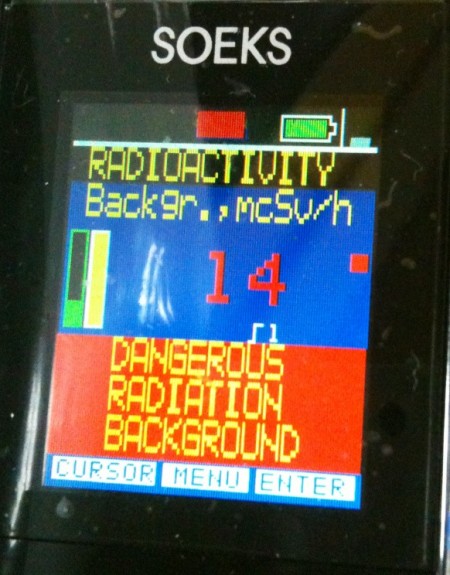
?- 14 ?Sv/h from the yellow substance on the roof in Kashiwa Chiba (Fukushima Diary, Aug 10, 2012):
…
Around the end of July, I had the professional cleaners wash the roof of our house.
The roof was covered with something like this yellow moss. It was 0.7 ?Sv/h on its surface.I took 20g of it by a kitchen knife. Radiation meter indicated it was red zone, 1.2 ?Sv/h.
I haven’t measured 1.2?Sv/h from merely 20g of sample even around here known to be hotspot.
It was totally washed off after cleaning, radiation level was decreased a little bit, 0.4 ?Sv/h on the surface, but the yellow substance was still with mud in the rain gutter.
I took 3.6 kg of it with the perfect protective clothing (tyvek, gas mask, goggles, plastic gloves).
I packed the clothing soon after taking off the sample, had shower to clean eyes, ears, nostrils carefully.
This is very dangerous, please don’t do it. I can’t take a responsibility if something happened to you.The radiation level was 14 ?Sv/h. I haven’t measured higher than 10 ?Sv/h before. It makes sense why the radiation level is high on the second floor.
Read moreRoofs Near Tokyo Covered With Yellow Radioactive Substance (14 MicroSieverts/Hour)
– 12,200 Bq/Kg from Teganuma lake Chiba (Fukushima Diary, July 4, 2012):
Chiba prefecture measured radiation at 19 points of Teganuma lake (195km from Fukushima) including 2 rivers to flow into Teganuma lake. The rivers run through hotspots, and they measured over 10,000 Bq/Kg from the ground soil of the bottom of rivers, where the rivers flow into the lake. The highest reading was 12,200 Bq/Kg. The measurement was done from 5/24 to 6/6/2012.
Read moreRadioactive Japan: Chiba, Lake Teganuma: 12,200 Bq/Kg
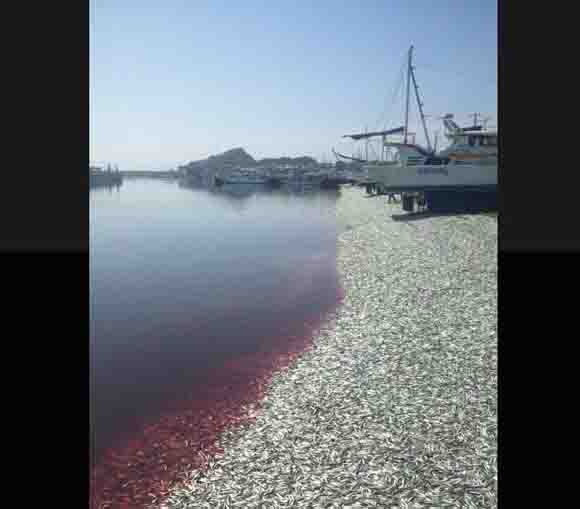
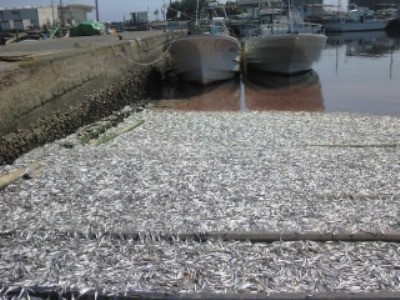
– Something fishy’s going on in a fishing port in Japan, literally – and tons and tons of it too! (Rocket News, June 5, 2012):
Something terribly fishy is going on at the fishing port of Ohara (pronounced Oh-hara) in Isumi City of Chiba Prefecture, and it has nothing to do with espionage or political corruption. There are tons and tons of dead sardines washing up on the shore, and not only is the sight disturbing, but the huge amount of dead fish is literally smelling up the entire surrounding area.
According to the news, the dead fish started washing up around noon of June 3rd, and as of early afternoon on June 4th, the situation still remained pretty much out of control. The amount of dead sardines that has washed up is thought to total several dozen metrics tons, so you can imagine how bad the smell of rotting fish must be.
We’ve seen the pictures uploaded onto Twitter, and the port looks completely filled with fish – it almost looks like a carpet of sardines. It doesn’t seem likely that any fishing boats will be setting sail from this port soon. There are also, of course, the usual posts and comments on the internet on how this could be an omen, a sign of a coming great natural disaster.
When we inquired with a local inn, we were told that the port was scheduled to be closed from June 1st to 5th, but given the emergency, local fishermen are currently out in full force trying to resolve the situation. Already more than 2 full days into the bizarre occurrence, the smell has to be almost unbearable, but the people of Ohara still have no idea when they will be able to get rid of all the sardines. We sincerely hope they will be able to solve the problem quickly.
Source: Twitter @yumihareyama (Japanese), Twitter @ryoshikobo (Japanese)
?You have to admit the sight is somewhat apocalyptic
[ Read in Japanese ]
– Iodine 131 measured in Tokyo (Fukushima Diary, May 3, 2012)
– Iodine 131 measured in Kawasaki, Yokohama, Chiba and Gunma (Fukushima Diary, May 3, 2012)
– Iodine 131 measured in Yamanashi (Fukushima Diary, May 3, 2012)
– 14,210 Bq/Kg of cesium beside school in Chiba (Fukushima Diary, April 25, 2012):
Noda city Chiba measured 14,210 Bq/Kg and 8,650 Bq/Kg of cesium from soil taken in street gutters beside schools, announced on 4/24/2012.
On 4/17/2012, Noda city took samples from street gutters beside 6 elementary schools and 2 junior high schools. They measured 14,210 Bq/Kg and 8,650 Bq/Kg of cesium at 2 of 8 locations but it is not announced where those 2 locations are.
Read moreRadioactive Japan: 14,210 Bq/Kg Of Cesium Next To Chiba Schools
– Professor Yukio Hayakawa Takes a “Radioactive Walk” In Abiko City and Kashiwa City in Chiba (EX-SKF, April 19, 2012):
The Gunma University professor took a walk in part of Abiko City and Kashiwa City, in the so-called “Tokatsu area” in the northwest corner of Chiba Prefecture with elevated radiation levels.
He says there is a statistically significant difference between the radiation levels on the ground levels and the levels at 1 meter off the ground, with the levels at 1 meter off the ground 20 to 30% less than at the ground levels.
The radiation levels of “black dust” he found along the way (in microsievert/hour):
2.676
3.767
2.489
1.556Professor Hayakawa’s walk from Abiko City to Kashiwa-no-ha in Kashiwa City on April 16, 2012:
???-???
EveryTrail – Find hiking trails in California and beyond
– 186 Bq/Kg from tap water in Kashiwa (Fukushima Diary, April 7, 2012):
A Japanese magazine reported they measured 186 Bq/kg from tap water in Kashiwa.
186 Bq/kg from tap water in Kashiwa Chiba (3/14/2012)
147 Bq/kg from tap water in Kashiwa Chiba (3/24/2012)
62 Bq/kg from tap water in Tokyo (3/14/2012)
31 Bq/kg from tap water after filtering in Tokyo (3/14/2012)
They used the dosemeter named JG22N. JG22N picks up beta ray and converted it into the energy of cesium 137.
It therefore might have picked up strontium, iodine, and tritium and converted it all to cesium 137.
Tritium has almost never been measured from tap water or rain though it acts exactly like water.
– 1.17?Sv/h in Kashiwa Chiba (Fukushima Diary, Mar 19, 2012):
Just for reader’s information, at the check point of off-limits area, where is 30km area from Chernobyl, it is 0.4?Sv/h.
EveryTrail – Find trail maps for California and beyond
– Prof. Yukio Hayakawa’s Walk with his Survey Meter in Nagareyama-Kashiwa in Chiba Prefecture (EX-SKF, Feb. 19, 2012):
Radiation levels remain elevated in Kashiwa City in Chiba Prefecture. It was in Kashiwa that 450,000 becquerels/kg of radioactive cesium was found from the soil near the drain in the public space in the middle of the city. There is a strange (to me anyway) collaboration between the city and the citizen volunteers to decontaminate the city.
Before the Fukushima I Nuke Plant accident, the background radiation level in Kashiwa City must have been no higher than the average in Chiba, which was 0.03 microsievert/hour (see this site). Now, as Professor Hayakawa’s walk shows, it is 10 times that in many locations. Contrary to a belief by some in Japan that there was no radioactive plume that went south from Fukushima through Ibaraki to Chiba, Tokyo and Kanagawa, these elevated radiation levels in Kashiwa City are the evidence that the plume did in fact come.
– #Radioactive Tomato in Kashiwa City, Chiba Prefecture (EX-SKF, Dec. 22, 2011):
18.5 becquerels/kg of radioactive cesium has been detected from tomatoes grown in Kashiwa City in Chiba Prefecture. The survey was done by one of the largest supermarket chain AEON.
From Savechild.net (12/23/2011):
? ??????????2011?11?8????????????????????????????????????????????????????? ??????????????????????????????????????????12?22????????????????????????? ????????18.5????/kg??????????????
The large supermarket chain AEON announced on November 8 that it would conduct a more thorough analysis of radioactive materials in food items, and it has been publishing the results on its homepage. There has been occasional detection of radioactive cesium in marine products, but never in vegetables. However, according to the result published on December 22, 18.5 becquerels/kg of radioactive cesium was detected from tomatoes grown in a contract farm in Chiba Prefecture.
The tomatoes in question were tested on December 15, according to the AEON’s webpage.
Read moreRadioactive Tomato in Kashiwa City, Chiba Prefecture
– High levels of radiation detected at 2 schools in Chiba Prefecture (Mainichi, Oct. 26, 2011):
ABIKO, Chiba — High levels of radiation have been detected on the premises of two elementary schools here, local education authorities have revealed.
According to the Abiko Municipal Board of Education, 11.3 microsieverts of radiation per hour was detected just above the surface of the ground near a ditch in the compounds of the Abiko Municipal Daiichi Elementary School on Sept. 15. The amount was 1.7 microsieverts in the air 50 centimeters above the ground.
Soil had piled up in the ditch, which had been damaged by growing tree roots, a situation similar to a residential area of the Chiba Prefecture city of Kashiwa where 57.5 microsieverts per hour was detected.
Radioactive cesium amounting to 60,768 becquerels per 1 kilogram of soil was found in the ditch.
Read moreExtremely High Levels Of Radiation Detected At 2 Schools In Chiba Prefecture
– Kashiwa City’s Radioactive Dirt: 276,000 Bq/Kg of Cesium (EX-SKF, Oct. 22, 2011):
The highly radioactive dirt in Kashiwa City in Chiba, which measured 57.5 microsieverts/hr 30 centimeters below the surface, was not from radium after all or any other nuclides that are used in industrial or medical use (some suggested cobalt-60, for example). It was from radioactive cesium.
On October 22 Kashiwa City announced the result of the analysis of three dirt samples from the location at different depth (one on the surface, two at 30 centimeter deep). The analysis was done on October 22. The unit is becquerels per kilogram:
Read moreKashiwa City’s Radioactive Dirt: 276,000 Bq/Kg of Cesium!!!!!
Tokyo is not safe:
– 300,000 Bq/m² of Radioactive Cesium at Okutama Region Where Tokyo’s Drinking Water Comes From
– Incinerator Near Tokyo Shut Down, High Levels Of Radioactive Cesium Detected In Ash
– Tokyo To Burn Massive Amounts Of Radioactive Debris From Tohoku
– Radioactive Train In Tokyo Metropolitan Area: Over 10 Microsievert/Hour Inside Train (Video)
– Geiger Counter Measures 0.378 Microsieverts In Tokyo Train Station 1 Meter Above Ground!!!
– ‘Severely Contaminated Hotspots’ Found In Tokyo
– High radiation dose readings marked in spots in Tokyo, Chiba (Mainichi/Kyodo News, Oct. 13, 2011):
TOKYO (Kyodo) — High radiation doses were reported Thursday in spots in Tokyo and neighboring Chiba Prefecture, both over 200 kilometers away from the crippled Fukushima Daiichi nuclear plant, with their readings found to exceed current dose levels in some evacuation zones around the plant.
Airborne radiation of up to 3.35 microsieverts per hour was recorded Thursday along a sidewalk in a residential area in Tokyo’s Setagaya Ward in an inspection commissioned by the ward, and a citizens’ group detected up to 5.82 microsieverts close to the ground at a children’s theme park in Funabashi, Chiba Prefecture, local officials said.
While officials are still investigating whether the radiation resulted from the nuclear accident, the levels detected were both higher than the 2.17 microsieverts per hour measured Wednesday at the village office in Iitate, Fukushima Prefecture. The village is 45 kilometers from the plant and designated as an evacuation zone due to the relatively high radiation.
Funabashi is about 210 km from the Fukushima plant, while Setagaya is about 230 km away.
Read moreHigh Radiation Dose Readings Marked In Spots In Tokyo, Chiba