– Chevron avoids paying Ecuador for Environmental Damage
*****
*****
H/t reader Squodgy.
* * *
PayPal: Donate in USD
PayPal: Donate in EUR
PayPal: Donate in GBP
The man who trades freedom for security does not deserve nor will he ever receive either. – Benjamin Franklin
– Chevron avoids paying Ecuador for Environmental Damage
*****
*****
H/t reader Squodgy.
* * *
PayPal: Donate in USD
PayPal: Donate in EUR
PayPal: Donate in GBP
– The Shale Massacre: Chevron Fires Another 7,000 After Laying Off 1,500 Three Months Ago:
Even though Chevron said in July that its cost-cutting initiatives would be “completed by mid-November of 2015” it decided to surprise everyone moments ago when on its earnings call it announced it would not only slash its capex by another 25%, but will shortly distribute another 7,000 pink slips. The reason: another terrible quarter in which the $2 billion in earnings were a 73% plunge from a year earlier.
…
– Chevron Slashes 23% Of PA Workforce As US Rig Count Collapses To June 2010 Lows (ZeroHedge, Jan 30, 2015):
For the 8th week in a row (something that hasn’t happened since June 2009), US total rig count plunged. This week’s 90 rig drop to 1543 is the largest so far (with oil rigs down 94 to 1223 – lowest since Jan 2013). The total rig count is now down 20% in the last 8 weeks to the lowest since June 2010 as it tracks the 4-month lagged oil price perfectly. This is the 2nd biggest 8-week drop in 22 years. This – rather unsurprisingly – has led Chevron to decide to cut 23% of its Pennsylvania workforce “due to activity levels.” Not ‘unambiguously positive’ as so many in the central planning bureaus would have everyone believe.
…
– It Begins: Energy Giant Chevron Suspends Stock Buyback, Blames “Cash Flow Squeeze” (ZeroHedge, Jan 30, 2015):
It was less than 24 hours after we posted that either oil will double from here allowing energy companies to grow into a normal P/E multiple, or energy stocks will have to crash by over 40% for the ridiculous 23x to return to its normal, long-term average of 13.6x. Moments ago energy giant Chevron admitted that not only does it not see oil doubling any time soon, but that energy prices are almost certain to go far lower from here, and as a result the company decided that after buying back $5 billion of its shares in 2014, i.e., buying high and higher before the stock crashes may not be the best use of dwindling cash flow, and as a result has just suspended its stock buyback program of the rest of 2015. Yes, energy giant Chevron just ended its buyback!
…
H/t reader squodgy:
“Anybody remember jewess Nuland bragging about investing $5Bn to de-stabilize the Ukraine to intimidate Russia?
Remember the big sponsorship cards all over the stage with CHEVRON plastered everywhere?
Now look….
What now? The ordinary Ukrainians must really love the EU & USA now.”
– Chevron Shale Exit Shreds Ukraine’s Hope of Energy Independence (Bloomberg, Dec 17, 2014):
Shale gas was supposed to be Ukraine’s ticket to greater energy independence from Russia. Chevron Corp. (CVX)’s decision to pull the plug has smashed those hopes.
The second-largest U.S. energy producer will pull out of an agreement for exploring the Oleska field in western Ukraine, a government official said this week. It was the final blow to the country’s dream of becoming a big shale-gas producer after Royal Dutch Shell Plc (RDSA) retreated earlier this year from a similar deal in eastern provinces riven by a bloody war with pro-Russian separatists.
While Chevron can walk away unscathed, for Ukraine it’s another blow to the prospects of reviving a chaotic economy that remains dependent on Russia, a country it claims to be in armed conflict with. Already weighed down by the war that’s killed more than 4,600 people and teetering on the verge of default, Ukraine was counting on foreign capital to develop its domestic gas resources.
Read moreChevron Shale Exit Shreds Ukraine’s Hope of Energy Independence
H/t Reader squodgy:
“As I recall the UN is funded by the Rockefeller Foundation, as is the CFR.
David Rockefeller presides with others at the annual gathering of elite at the Bilderburg coven.
David Rockefeller’s Texaco/Chevron destroyed the jungles of Ecuador…”
Donny Rico & Chevron make it a crime to defend the environment.
Jan 20, 2014 Amazon Watch teams up with Pulitzer Prize winner Mark Fiore once again!
Predominantly zionists,
Here is another zionist about to rape another pristine part of the home of the Mountain Gorilla.”
– Israeli billionaire finds 3 bln barrels of oil in Congo (Reuters, Aug 7, 2014):
* Find on similar scale to UK, South Sudan oil reserves
* Oil of DRCongo says oil can boost GDP by 25 pct
* Campaigners say Gertler has made huge profits in Congo (Adds industry comment, further explanation in paragraph 3)
KINSHASA – An oil company owned by Israeli billionaire Dan Gertler said on Thursday it had discovered around 3 billion barrels of oil in the Democratic Republic of Congo, an amount similar to the proven reserves of oil producers Britain and South Sudan.
– Big Oil’s Central Asian Mafia (Veterans Today, Aug 6, 2013)
(Excerpted from Big Oil & Their Bankers: Chapter 17: Caspian Sea Oil Grab)
According to Kurt Wulff of the oil investment firm McDep Associates, the Four Horsemen, romping in their new Far East pastures, saw asset increases from 1988-1994 as follows: Exxon Mobil- 54%, Chevron Texaco- 74%, Royal Dutch/Shell- 52% and BP Amoco- 54%. Big Oil had more than doubled its collective assets in six short years.
This quantum leap in global power had everything to do withthe takeover of the old Soviet oil patch and the subsequent impoverishment of its birthright owners.
While the Four Horsemen gorged on Russian and Central Asian oil, Wall Street investment bankers were facilitating the oil grab and ripping off the Russian Treasury.
Salomon Smith Barney’s Phibro Energy oil trading subsidiary set up shop in Moscow. Goldman Sachs was hired by Yeltsin to lure foreign capital to Russia. Heading the Russian Goldman Sachs team was Robert Rubin, later Clinton Secretary of Treasury & Citigroup CEO. CS First Boston took a 20% stake in Lukoil, in partnership with BP Amoco.
– “The Worm Turns” As Chevron ‘Infected’ By Stuxnet Collateral Damage (ZeroHedge, Nov 10, 2012):
“I don’t think the US government even realized how far it had spread” is how the collateral damage from the Iran-attacking Stuxnet computer virus is described by Chevron. The sleep San-Ramon-based oil giant admitted this week that from 2010 on “we’re finding it in our systems and so are other companies… so now we have to deal with it.” It would seem that little consideration for just how viral this cyber warfare tactic has become and this news (reported by Russia Today) is the first time a US company has come clean about the accidental infection. Discovered in 2010, the Stuxnet worm was reported with all but certainty to be the creation of the United States, perhaps with the assistance of Israel, to set back Iran’s nuclear enrichment program as a preemptive measure against an eventual war. In a June 2012 article published by The New York Times, government agents with direct knowledge of Stuxnet claimed that first President George W. Bush, then Barack Obama, oversaw the deployment of the worm as part of a well-crafted cyberassault on Iran. On the record, the federal government maintains ignorance on the subject of Stuxnet, but perhaps Chevron sums up the impact of Stuxnet best (given the escalating Iranian enrichment program): “I think the downside of what they did is going to be far worse than what they actually accomplished.”
Via Russia Today:
America’s cyberwar is already seeing collateral damage, and it’s hitting the country’s own billion-dollar companies. Oil giants Chevron say the Stuxnet computer virus made by the US to target Iran infected their systems as well.
Read more‘The Worm Turns’ As Chevron ‘Infected’ By Stuxnet Collateral Damage
– 10 Most Profitable U.S. Companies Paid 9% in Federal Income Taxes (AllGov, Aug 18, 2012):
The largest corporations in the U.S., consisting of oil, retail, banking and technology giants, paid an average of only 9% of their earnings in income taxes to the Internal Revenue Service last year.
According to the tax code, companies are supposed to pay 35% income tax. But NerdWallet determined that the top 10 came nowhere near that.
Exxon Mobil, the country’s biggest business, made more than $73 billion in 2011, but paid only $1.5 billion to the IRS.
The second largest company, Chevron, paid $1.9 billion in taxes after collecting $47.6 billion in revenue.
No. 3 on the list, Apple, made $34.2 billion. It paid $3.9 billion to the IRS.
These were followed by:
Read more10 Most Profitable U.S. Companies Paid 9% In Federal Income Taxes
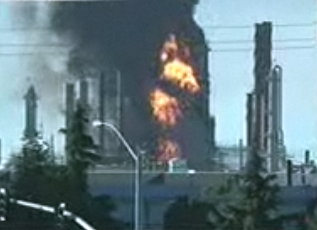
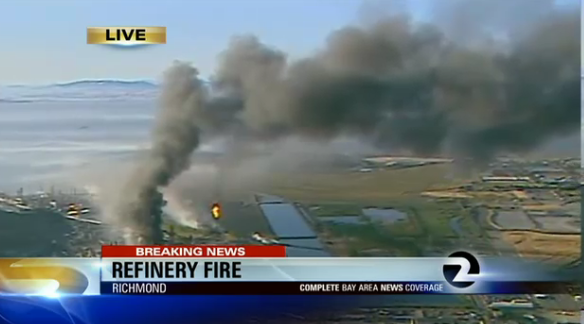
– Chevron’s Largest California Refinery “Immediate-Extreme-Health-Hazard” Fire Emergency (ZeroHedge, Aug 6, 2012):
UPDATE: *CHEVRON RICHMOND REFINERY HYDROCRACKER EXPLODED: KPIX-TV, REFINERY SHUTDOWN, CAN PROCESS 244,000 BBL/DAY
Chevron’s Richmond refinery, the largest refinery in California, is under a Level 3 Hazardous Material extreme immediate warning with local authorities advising local citizens to “to shelter in place, go inside, close all windows and doors, turn off all heaters, air conditioners and fans. If not using the fireplace, close fireplace dampers and vents, and cover cracks around doors and windows with tape or damped towels.” As KTVU2 comments, it appears massive and out of control currently. Live KRON4 stream embedded.
- *2 DISTINCT PLUMES OF SMOKES OBSERVED EMITTING FROM CVX REFINERY
- *CHEVRON SPOKESWOMAN SAYS NOT SURE WHAT CAUSE OF FIRE IS :CVX US
- *CHEVRON RICHMOND REFINERY HAS EVACUATION ON EMISSIONS: FILING
Live Stream from KRON4…
Broadcasting live with Ustream
and a broader perspective of the wind’s influence…
and across the bay…
– New Chapter’s new owner (P&G) steeped in animal testing and led by directors with ties to weapons contractors, Big Pharma, Monsanto, Chevron and more (Natural News, Mar 23, 2012):
NaturalNews has never really taken much of an interest in Procter & Gamble — until now. Having acquired New Chapter, a once-promising supplier of high-end herbal supplements such as Zyflamend, P&G now demands some honest scrutiny. Who are these people that New Chapter has decided to cozy up to? What are their business interests, and what are their ethics?
To answer this question, NaturalNews conducted an investigation of Procter & Gamble’s board of directors in order to determine what business interests those directors might represent. What we found was more than a bit disturbing, and as you will see below, P&Gs board of directors is made up of people with ties to weapons manufacturers, Homeland Security, the Federal Reserve, oil companies, the Fukushima nuclear power plant, global banks, pharmaceutical companies, biotechnology (GMOs), mining giants, black box voting machines, and predictably both Microsoft and the Bill & Melinda Gates Foundation.
It’s like a Who’s Who of some of the most destructive industries on the planet, all in one room.
The Price Of Oil: The historic swings in oil prices last year were the result of financial speculation from Wall Street and not supply and demand. Steve Kroft investigates.
(CBS) About the only economic break most Americans have gotten in the last six months has been the drastic drop in the price of oil, which has fallen even more precipitously than it rose. In a year’s time, a commodity that was theoretically priced according to supply and demand doubled from $69 a barrel to nearly $150, and then, in a period of just three months, crashed along with the stock market.
So what happened? It’s a complicated question, and there are lots of theories. But as correspondent Steve Kroft reports, many people believe it was a speculative bubble, not unlike the one that caused the housing crisis, and that it had more to do with traders and speculators on Wall Street than with oil company executives or sheiks in Saudi Arabia.
To understand what happened to the price of oil, you first have to understand the way it’s traded. For years it has been bought and sold on something called the commodities futures market. At the New York Mercantile Exchange, it’s traded alongside cotton and coffee, copper and steel by brokers who buy and sell contracts to deliver those goods at a certain price at some date in the future.
Read more60 Minutes: Speculation Affected Oil Price Swings More Than Supply And Demand
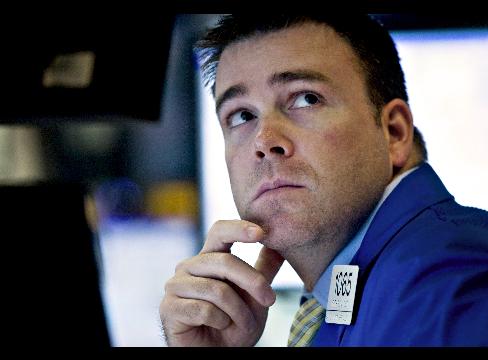
A trader looks up at monitor while working on the floor of the New York Stock Exchange in New York on Oct. 15, 2008. Photographer: Jin Lee/Bloomberg News
Oct. 15 (Bloomberg) — U.S. stocks plunged the most since the crash of 1987, hammered by the biggest drop in retail sales in three years and growing doubt that plans to bail out banks will keep the economic slump from deepening.
Exxon Mobil Corp. and Chevron Corp. tumbled more than 12 percent as commodity prices declined on concern the slowing economy will hurt demand. Wal-Mart Stores Inc. retreated 8 percent after the Commerce Department said purchases at chain stores decreased 1.2 percent last month. Morgan Stanley lost 16 percent after Oppenheimer & Co. analyst Meredith Whitney said the government’s bank rescue is not a “panacea” solution.
The Standard & Poor’s 500 Index sank 90.17 points, or 9 percent, to 907.84, with nine companies declining more than 20 percent. The Dow Jones Industrial Average retreated 733.08, or 7.9 percent, to 8,577.91, its second-biggest point drop ever. The Nasdaq Composite Index lost 150.68, or 8.5 percent, to 1,628.33. About 37 stocks fell for each that rose on the New York Stock Exchange.
Read moreU.S. Stocks Drop Most Since Crash of 1987 on Recession Concerns
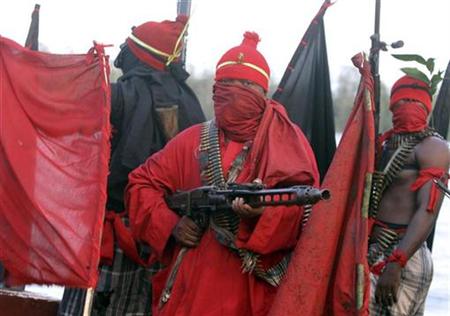
PORT HARCOURT, Nigeria (Reuters) – Nigerian militants threatened on Wednesday to broaden their “oil war” to offshore oilfields and announced attacks on a crude oil pipeline in the Niger Delta and another Shell-operated facility.
The Movement for the Emancipation of the Niger Delta (MEND), responsible for attacks that have cut a fifth of OPEC member Nigeria’s oil output, said it would launch attacks outside Rivers state for the first time since clashes began on Saturday.
Government officials in charge of collecting billions of dollars worth of royalties from oil and gas companies accepted gifts, steered contracts to favored clients and engaged in drug use and illicit sex with employees of the energy firms, federal investigators reported yesterday.
Investigators from the Interior Department’s inspector general’s office said more than a dozen employees, including the former director of the oil royalty program, took meals, ski trips, sports tickets and golf outings from industry representatives. The report alleges that the former director, Gregory W. Smith, also netted more than $30,000 from improper outside work.
Read moreReport: Oil Agency Ran Amok, Interior Dept. Inquiry Finds Sex, Drugs, Corruption
Think U.S. health authorities have never conducted outrageous medical experiments on children, women, minorities, homosexuals and inmates? Think again: This timeline, originally put together by Dani Veracity (a NaturalNews reporter), has been edited and updated with recent vaccination experimentation programs in Maryland and New Jersey. Here’s what’s really happening in the United States when it comes to exploiting the public for medical experimentation:
(1845 – 1849) J. Marion Sims, later hailed as the “father of gynecology,” performs medical experiments on enslaved African women without anesthesia. These women would usually die of infection soon after surgery. Based on his belief that the movement of newborns’ skull bones during protracted births causes trismus, he also uses a shoemaker’s awl, a pointed tool shoemakers use to make holes in leather, to practice moving the skull bones of babies born to enslaved mothers (Brinker).
(1895)
New York pediatrician Henry Heiman infects a 4-year-old boy whom he calls “an idiot with chronic epilepsy” with gonorrhea as part of a medical experiment (“Human Experimentation: Before the Nazi Era and After”).
(1896)
Dr. Arthur Wentworth turns 29 children at Boston’s Children’s Hospital into human guinea pigs when he performs spinal taps on them, just to test whether the procedure is harmful (Sharav).
(1906)
Harvard professor Dr. Richard Strong infects prisoners in the Philippines with cholera to study the disease; 13 of them die. He compensates survivors with cigars and cigarettes. During the Nuremberg Trials, Nazi doctors cite this study to justify their own medical experiments (Greger, Sharav).
(1911)
Dr. Hideyo Noguchi of the Rockefeller Institute for Medical Research publishes data on injecting an inactive syphilis preparation into the skin of 146 hospital patients and normal children in an attempt to develop a skin test for syphilis. Later, in 1913, several of these children’s parents sue Dr. Noguchi for allegedly infecting their children with syphilis (“Reviews and Notes: History of Medicine: Subjected to Science: Human Experimentation in America before the Second World War”).
(1913)
Medical experimenters “test” 15 children at the children’s home St. Vincent’s House in Philadelphia with tuberculin, resulting in permanent blindness in some of the children. Though the Pennsylvania House of Representatives records the incident, the researchers are not punished for the experiments (“Human Experimentation: Before the Nazi Era and After”).
(1915)
Dr. Joseph Goldberger, under order of the U.S. Public Health Office, produces Pellagra, a debilitating disease that affects the central nervous system, in 12 Mississippi inmates to try to find a cure for the disease. One test subject later says that he had been through “a thousand hells.” In 1935, after millions die from the disease, the director of the U.S Public Health Office would finally admit that officials had known that it was caused by a niacin deficiency for some time, but did nothing about it because it mostly affected poor African-Americans. During the Nuremberg Trials, Nazi doctors used this study to try to justify their medical experiments on concentration camp inmates (Greger; Cockburn and St. Clair, eds.).
Read moreVaccines and Medical Experiments on Children, Minorities, Woman and Inmates (1845 – 2007)