Nov 29

- Lead-proton collisions yield surprising results (MIT News, Nov 27, 2012):

Unexpected data from the Large Hadron Collider suggest the collisions may be producing a new type of matter.

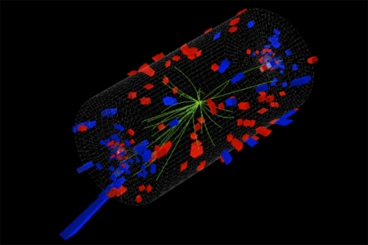
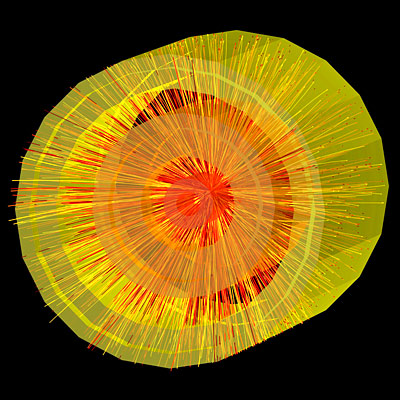
A proton collides with a lead nucleus, sending a shower of particles through the CMS detector.
Image: CERN

Collisions between protons and lead ions at the Large Hadron Collider (LHC) have produced surprising behavior in some of the particles created by the collisions. The new observation suggests the collisions may have produced a new type of matter known as color-glass condensate.

When beams of particles crash into each other at high speeds, the collisions yield hundreds of new particles, most of which fly away from the collision point at close to the speed of light. However, the Compact Muon Solenoid (CMS) team at the LHC found that in a sample of 2 million lead-proton collisions, some pairs of particles flew away from each other with their respective directions correlated. Continue reading »

Tags: , , , , , ,

Jul 04

- Particle’s Discovery Points to a Firmer Grasp of Physics (The New York Times, July 4, 2012):

ASPEN, Colo. — Physicists working at CERN’s Large Hadron Collider said Wednesday that they had discovered a new subatomic particle that looks for all the world like the Higgs boson, a potential key to an understanding of why elementary particles have mass and indeed to the existence of diversity and life in the universe.

“I think we have it,” Rolf-Dieter Heuer, the director general of CERN, said in an interview from his office outside Geneva, calling the discovery “a historic milestone.” His words signaled what is probably the beginning of the end for one of the longest, most expensive searches in the history of science. If scientists are lucky, the discovery could lead to a new understanding of how the universe began.

Continue reading »

Tags: , , , , , , ,

Jul 04

- Higgs Boson VIDEO: A Metaphor To Explain The Particle, Or Further Confuse You (Huffington Post, July 4, 2012)

Tags: , , , , , , ,

Jul 04

- God particle is ‘found’: Scientists at Cern expected to announce on Wednesday Higgs boson particle has been discovered (Daily Mail, July 1, 2012):

  • Scientists ‘will say they are 99.99% certain’ the particle has been found
  • Leading physicists have been invited to event – sparking speculation that Higgs boson particle has been found
  • ‘God Particle’ gives particles that make up atoms their mass
  • Fermi Lab in Chicago also ‘closing in’ on proof of Higgs boson

Scientists at Cern will announce that the elusive Higgs boson ‘God Particle’ has been found at a press conference next week, it is believed.

Five leading theoretical physicists have been invited to the event on Wednesday – sparking speculation that the particle has been discovered.

Scientists at the Large Hadron Collider are expected to say they are 99.99 per cent certain it has been found – which is known as ‘four sigma’ level.

Continue reading »

Tags: , , , , , , ,

Nov 19

Well, Nikola Tesla said over 100 years ago that Einstein was wrong.


- CERN Experiment Excludes 1 Error In Faster-Than-Light Finding (Huffington Post, Nov. 18, 2011):

GENEVA — The chances have risen that Einstein was wrong about a fundamental law of the universe.

Scientists at the world’s biggest physics lab said Friday they have ruled out one possible error that could have distorted their startling measurements that appeared to show particles traveling faster than light.

Many physicists reacted with skepticism in September when measurements by French and Italian researchers seemed to show subatomic neutrino particles breaking what Nobel Prize-winning physicist Albert Einstein considered the ultimate speed barrier.

The European Organization for Nuclear Research said more precise testing has now confirmed the accuracy of at least one part of the experiment.

“One key test was to repeat the measurement with very short beam pulses,” the Geneva-based organization, known by its French acronym CERN, said in a statement.r

The test allowed scientists to check if the starting time for the neutrinos was being measured correctly before they were fired 454 miles (730 kilometers) underground from Geneva to a lab in Italy.

The results matched those from the previous test, “ruling out one potential source of systematic error,” said CERN.

Continue reading »

Tags: , , , , , , ,

Sep 24


Neutrinos travelling faster than light have been found, say particle physicists in Italy. Photograph: Dan Mccoy /Corbis

- Speed of light discovery: would you go back in time? (Guardian, Sep. 23, 2011):

Physicists’ discovery of neutrinos that may travel faster than the speed of light raises the prospect of time-travelling particles. You’re not a tachyon, granted. But if you had the opportunity, would you go back in time?

- Speed of light broken – an expert’s view (Telegraph, Sep. 23, 2011):

If CERN scientists are correct in claiming they have observed particles travelling faster than the speed of light it would fundamentally change our understanding of the laws of physics, experts say.

Prof Jenny Thomas, of University College London, says the claims, if proven true, would call into question our very understanding of physics and the universe.

She said: “It would turn everything on its head. It is too awful to think about.

“The basic thing it that would be questioned is that there is an absolute speed limit which is the basis of special relativity and that is a huge building block of modern physics.

“It permeates everything to do with how we have modelled the universe and everything. It would be very hard to predict what the effects would be.”

Special relativity is integral to the understanding of particle accelerators and the creation of particle beams, which are of crucial importance in fields like medicine and engineering, she said.

It could even be that the most famous equation of all time, E=mc2, turns out to be incorrect because it is based on the law of special relativity, Prof Thomas said.

- Faster Than The Speed Of Light… OPERA Update (Universe Today, Sep. 24, 2011):

A few days ago, the physics world was turned upside down at the announcement of “faster than the speed of light”. The mighty neutrino has struck again by breaking the cosmic speed limit and traveling at a velocity 20 parts per million above light speed. To absolutely verify this occurrence, collaboration is needed from different sources and we’re here to give you the latest update.

“This result comes as a complete surprise,” said OPERA spokesperson, Antonio Ereditato of the University of Bern. “After many months of studies and cross checks we have not found any instrumental effect that could explain the result of the measurement. While OPERA researchers will continue their studies, we are also looking forward to independent measurements to fully assess the nature of this observation.”

Continue reading »

Tags: , , , , , ,

Sep 23

- UPDATE 1-Particles found to break speed of light (Reuters, Sept 22, 2011):

GENEVA – An international team of scientists said on Thursday they had recorded sub-atomic particles travelling faster than light — a finding that could overturn one of Einstein’s long-accepted fundamental laws of the universe.

Antonio Ereditato, spokesman for the researchers, told Reuters that measurements taken over three years showed neutrinos pumped from CERN near Geneva to Gran Sasso in Italy had arrived 60 nanoseconds quicker than light would have done.

“We have high confidence in our results. We have checked and rechecked for anything that could have distorted our measurements but we found nothing,” he said. “We now want colleagues to check them independently.”

Continue reading »

Tags: , , , ,

Nov 19

HOW DID THEY DO IT?
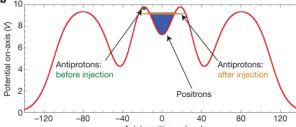
The physicists combined positrons and antiprotons in beginning with 30,000 antiprotons cooled to 200˚ above absolute zero, or 200 kelvin, and 2 million positrons cooled to about 40 kelvin.

The experiment took place inside a magnetic trap known as an Ioffe-Pritchard trap.report online today in Nature.

That trap was only ‘deep’ enough to capture the slowest-moving antiatoms.

After mixing the protons and positrons, the trap was turned off and electric fields used to sweep any remaining charged particles out the device.

They then turned off the magnetic trap and looked for any lingering antiatoms drifting into the material and annihilating to produce detectable particles.

In 335 trials, the physicists saw a total of 38 trapped atoms—about one every 10 trials.

Physics breakthrough as scientists at CERN capture atoms of elusive ‘antimatter’ for first time


Starship Enterprise takes on a Klingon warship in Star Trek. The spacecraft used antimatter to power its ‘warp drive’

Now scientists say they have captured a sample of real-life antimatter for the first time.

In an astonishing breakthrough, a team of British and international physicists were able to ‘trap’ 38 atoms of anti-hydrogen in a laboratory for a fraction of a second.

While the experiment is unlikely to lead to the warp engines, anti-matter drives or the faster than light travel of Star Trek, it could shed light on the nature and origins of the Universe.

Antimatter is the mirror of ordinary matter. Normal atoms are made up of positively-charged nuclei orbited by negatively-charged electrons.

However, their antimatter counterparts are the wrong way round. They have negative nuclei and positively-charged electrons.

When matter and antimatter meet they instantly annihilate each other, releasing a burst of energy.

Since it was first proposed by the British physicist Paul Dirac in 1931, antimatter has been a staple of science fiction.

Continue reading »

Tags: , , , , , ,

Nov 11

British scientists are celebrating after creating mini-versions of the “Big Bang” thought to have given birth to the universe 14 billion years ago.


(Click on images to enlarge.)
The collisions created the highest temperatures and densities ever achieved

The achievement was produced by the Large Hadron Collider (LHC) which is a giant machine probing the nature of matter at the European Organisation for Nuclear Research (CERN) in Geneva.

The “Mini Bangs” were created during the Alice experiment where lead ions were smashed together at enormous energies.

Dr David Evans, a member of the UK team from the University of Birmingham, said: “We are thrilled with the achievement.

“The collisions generated mini Big Bangs and the highest temperatures and densities ever achieved in an experiment.

“This process took place in a safe, controlled environment generating incredibly hot and dense sub-atomic fireballs with temperatures of over 10 trillion degrees, a million times hotter than the centre of the Sun.

One of the lead collisions in the Alice ‘detector’

“At these temperatures even protons and neutrons – which make up the nuclei of atoms – melt, resulting in a hot dense soup of quarks and gluons known as a quark-gluon plasma.”

Powerful magnets spun the lead ions round miles of underground tunnels at velocities approaching the speed of light.

Continue reading »

Tags: , , , ,

Sep 20

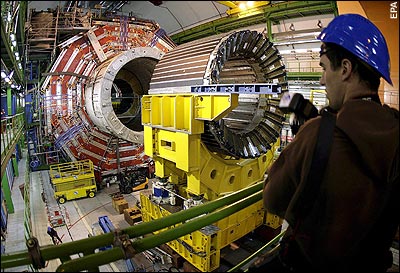
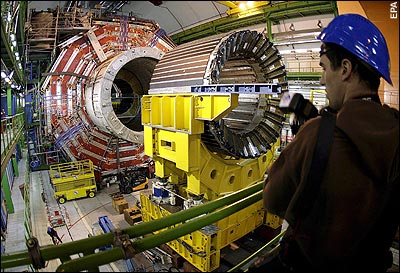
The giant Large Hadron Collider, the world’s largest and most expensive scientific experiment, will be shut down for at least two months, scientists at the European Center for Nuclear Research, or CERN, in Geneva said today.

The shutdown casts into doubt the hopes of CERN physicists to achieve high-energy collisions of protons in the machine before the end of the year. “It’s too early to say whether we’ll still be having collisions this year,” James Gillies, head of communications for CERN, said in an e-mail message. The laboratory shuts down to save money on electricity during the winter.

A gala inauguration party scheduled for Oct. 21 will still take place, Dr. Gillies said.

The collider is designed to accelerate the subatomic particles known as protons to energies of 7 trillion electron volts, far surpassing any other accelerator on Earth, and bang them together in search of new particles and forces.

Continue reading »

Tags: , , , , , ,