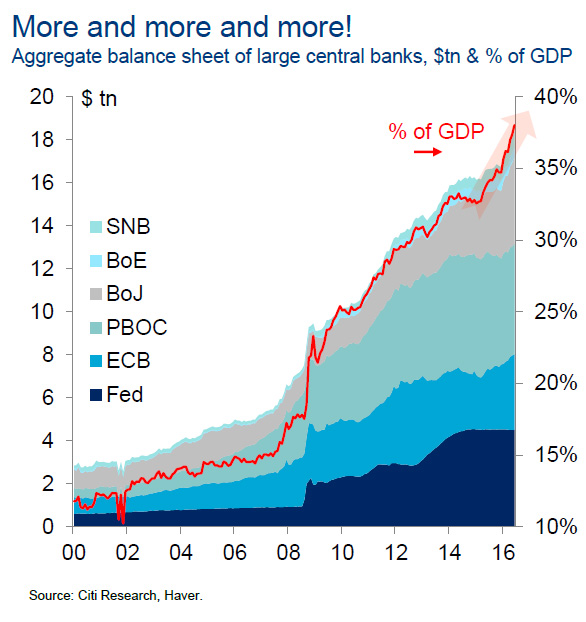
– Central Banks Are Now Cornered:
Central Banks are in VERY serious trouble
…
* * *
PayPal: Donate in USD
PayPal: Donate in EUR
PayPal: Donate in GBP
The man who trades freedom for security does not deserve nor will he ever receive either. – Benjamin Franklin
– Central Banks Are Now Cornered:
Central Banks are in VERY serious trouble
…
* * *
PayPal: Donate in USD
PayPal: Donate in EUR
PayPal: Donate in GBP
FYI.
https://youtu.be/T__NtmAw8AE
H/t reader Squodgy:
“And they live in England & Switzerland.”
* * *
PayPal: Donate in USD
PayPal: Donate in EUR
PayPal: Donate in GBP
– Central Banks Have Purchased $2 Trillion In Assets In 2017:
In his latest “flow report”, BofA’s Michael Hartnett looks at the “Disconnect Myth” between rising stocks and bonds and summarizes succinctly that there is “no disconnect between stocks & bonds.”
Why? The best, and simplest, explanation for low yields & high stocks is simple: so far in 2017 there has been $1.96 trillion of central bank purchases of financial assets in 2017 alone, as central bank balance sheets have grown by $11.26 trillion since Lehman to $15.6 trillion. Hartnett concedes that the second best explanation is bonds pricing in low CPI (increasingly a new structurally low level of inflation due to tech disruption of labor force) while equities price in high EPS (with little on horizon to meaningfully reverse trend), although there is no reason why the second can’t flow from the first.
Read moreCentral Banks Have Purchased $2 Trillion In Assets In 2017
– “Nothing Else Matters”: Central Banks Have Bought A Record $1.5 Trillion In Assets In 2017:
Central banks have bought a record $1.5 trillion of financial assets in just the first five months of 2017, which amounts to $3.6 trillion annualized, “the largest CB buying on record.”
…
* * *
PayPal: Donate in USD
PayPal: Donate in EUR
PayPal: Donate in GBP
Remember when bashing central banks and predicting financial collapse as a result of monetary manipulation and intervention was considered “fake news” within the “serious” financial community, disseminated by fringe blogs?
Good times.
In an interview with Swiss Sonntags Blick titled appropriately enough “A Recession Is Sometimes Necessary“, the former CEO of UBS and Credit Suisse, Oswald Grübel, lashed out by criticizing the growing strength of central banks and their ‘supremacy over the markets and other banks’. The former chief executive officer claimed that the use of negative interest rates and huge positive balance sheets represent ‘weapons of mass destruction’. He calls for an end to the use of negative interest rates.
“Central bankers have fostered a casino like atmosphere where savers/investors are presented with a Hobson’s Choice, or perhaps a more damaging Sophie’s Choice of participating (or not) in markets previously beyond prior imagination. Investors/savers are now scrappin’ like mongrel dogs for tidbits of return at the zero bound. This cannot end well.”
– “This Cannot End Well” Bill Gross Warns:
In one of his starkest warnings about the endgame of existing unorthodox, monetary policy, in his latest letter titled “Doubling Down”, Bill Gross repeats a familiar tune, warning that “our financial markets have become a Vegas/Macau/Monte Carlo casino, wagering that an unlimited supply of credit generated by central banks can successfully reflate global economies and reinvigorate nominal GDP growth to lower but acceptable norms in today’s highly levered world.”
FYI.
– Hungary Becomes First European Nation To Ban Rothschild Banks:
The name Rothschild is literally associated with wealth. This is because for over 200 years, the family has remained the most powerful and wealthy family in the world. Most of the Rothschild fortune has been made in the world of banking, but investments in other industries, such as coal, estates, and construction, have helped secure the family’s wealth and immense power.
One of the banks owned by the Rothschild group (the biggest banking group in the world) is the International Monetary Fund (IMF), AKA ’Imposing Misery and Famine’. Not only does the group make money off usurious interest rates at the misfortune of crumbling economies, it literally owns governments and people of power. Because it’s nearly impossible to escape the clutches of the banking group, news of IMF being booted from Hungary is being heralded as a victorious happening.
Read moreHungary Becomes First European Nation To Ban Rothschild Banks
– ‘Father Of Modern Finance’ Warns “Central Banking Is Like Pornography – Not The Real Thing”:
“Everyday we read headlines on what the central banks are doing. But their policies don’t have any effect. They are just like treading water. All the central banks are doing is substituting one form of debt with another form of debt… I think it means the business of central banks is like pornography: It’s not the real thing.”
…
* * *
PayPal: Donate in USD
PayPal: Donate in EUR
PayPal: Donate in GBP
– Mutiny Among The “Magic People” – India Central Banker Admits “The Ammo Is Almost Gone”:
The self-described “magic people” who “give to the markets” are facing a mutiny this morning as Raghuram Rajan, the head of the Indian central bank, admits central banks and governments of rich countries are running out of ammunition for stimulating their economies… but they can never admit as much. Crushing the dreams of “extreme monetary policy”-setters, Rajan goes on to discuss the sanity of ‘helicopter money’ warning that people will not be ‘stimulated’ to spend but will question: “What kind of world are we in when the central bank prints money and throws it out of the window?”
…
* * *
PayPal: Donate in USD
PayPal: Donate in EUR
PayPal: Donate in GBP
– Lost Faith In Central Banks And The Economic End Game:
We live in strange economic times, stranger perhaps than at any other point in history. Since 2007-2008, the globally intertwined and dependent fiscal system has suffered considerable declines in every conceivable area. Manufacturing around the world is in a slump, from Japan to China to Europe, with the minimal manufacturing accomplished in the U.S. also fading. Consumption is falling, most notably in petroleum and raw materials. Employment is truly dismal, with the U.S. posting over 94 million people as “non-participants” in the national work force.
Read moreLost Faith In Central Banks And The Economic End Game
https://www.youtube.com/watch?v=fpkPon9A1Vo&ebc=ANyPxKo8kXzmJUW3ewBmJFylyE3yOi2ROqoRK1xJJDv6EhZ9mL6-M68Q4sbk_JEWUKMIjnw2aoNLBe4Dgqv3CrDfPPiIeEjddQ
* * *
PayPal: Donate in USD
PayPal: Donate in EUR
PayPal: Donate in GBP
– Global Central Banks Continue Longest Gold-Buying-Spree Since Vietnam War:
While “greed was good” in the ’80s, it appears “gold is good” in the new normal. As much as the barbarous relic is despised by all the mainstream money-peddlers in public (aside from those who have left the familia like Alan Greenspan), it seems to be loved in private. Central banks have been net buyers of gold for eight straight years, according to IMF estimates, the longest streak since the first troops were deployed in The Vietnam War.

Chart: Bloomberg
As Bloomberg notes, Russia, China and Kazakhstan among the biggest hoarders, International Monetary Fund data show.
Read moreGlobal Central Banks Continue Longest Gold-Buying-Spree Since Vietnam War
– Central Banks Are Trojan Horses, Looting Their Host Nations:
A Nobel prize winning economist, former chief economist and senior vice president of the World Bank, and chairman of the President’s council of economic advisers (Joseph Stiglitz) says that the International Monetary Fund and World Bank loan money to third world countries as a way to force them to open up their markets and resources for looting by the West.
Do central banks do something similar?
Economics professor Richard Werner – who created the concept of quantitative easing – has documented that central banks intentionally impoverish their host countries to justify economic and legal changes which allow looting by foreign interests.
Read moreCentral Banks Are Trojan Horses, Looting Their Host Nations
As the world places its ‘life’ in the hands of a few unelected members of ivory tower trusting them to centrally plan the global utopia, that faith may be shattered by Bank of Italy Governor Ignazio Visco. As Bloomberg reports, Visco and seven other people were place under investigation according to chief prosecutor. While the statement does not list allegations, court documents reveal alleged corruption, fraud, and abuse of office.
As Bloomberg details,
Bank of Italy Governor Ignazio Visco is under investigation in a probe regarding the 2013 placement of Banca Popolare di Spoleto SpA in special administration, according to a court document obtained by Bloomberg News.

Hitler was financed by Rothschild agents.
The Rothschilds were behind the Russian Revolution and financed Stalin.
The Rothschilds were behind the French Revolution, WWI and WWII.
They are behind the financial crisis, the coming greatest financial collapse in world history and they have WW3 planned for us.
Will Putin move against the Rothschild owned Russian central bank, or not? Will he nationalize it?
04.02.2013

– Guess How Many Nations In The World Do Not Have A Central Bank? (Economic Collapse, June 8, 2015):
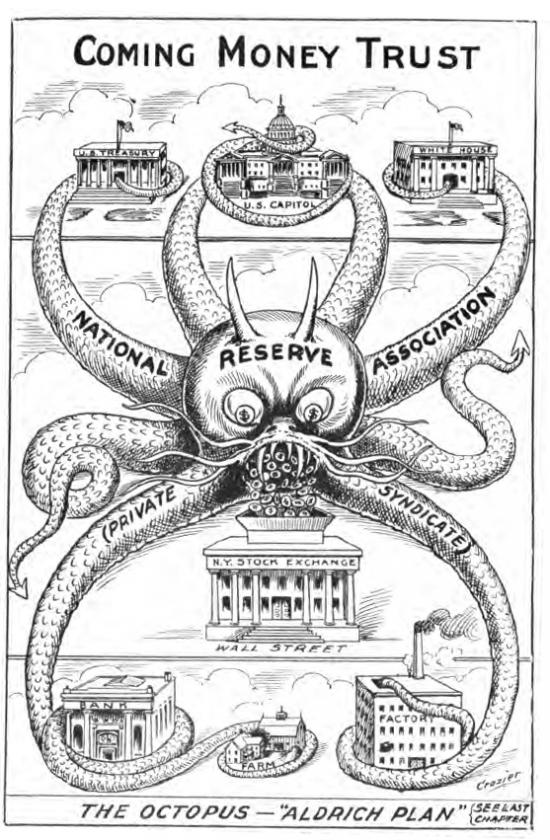
Central banking has truly taken over the entire planet. At this point, the only major nation on the globe that does not have a central bank is North Korea. Yes, there are some small island countries such as the Federated States of Micronesia that do not have a central bank, but even if you count them, more than 99.9% of the population of the world still lives in a country that has a central bank. So how has this happened? How have we gotten the entire planet to agree that central banking is the best system? Did the people of the world willingly choose this? Of course not. To my knowledge, there has never been a single vote where the people of a nation have willingly chosen to establish a central bank. Instead, what has happened is that central banks have been imposed on all of us. All over the world, people have been told that monetary issues are “too important” to be subject to politics, and that the only solution is to have a group of unelected, unaccountable bankers control those things for us.
So precisely what does a central bank do?
Read moreGuess How Many Nations In The World Do Not Have A Central Bank?
– “It’s A Coup D’Etat,” David Stockman Warns “Central Banks Are Out Of Control” (ZeroHedge, May 24, 2015):
We’re all about to be taken to the woodshed, warns David Stockman in this excellent interview. The huge wealth disparity is “not because of some flaw in capitalism, or Reagan tax cuts, or even the greed of Wall Street; the problem is central banks that are out of control.” Simply put, they have “syphoned financial resources into pure gambling” and the people that own the stocks and bonds get the huge financial windfall. “The 10% at the top own 85% of the financial assets,” and thus, thanks to the unleashing of almost limitless money-printing, which has created a massive worldwide financial inflation, “the central banks have created and exaggerated the wealth gap.” Stockman concludes, rather ominously, “it’s a coup d’etat, the central banks have taken over – unconstitutional domination of the entire economy.”
…
– Weak Dong Forces Vietnam Central Bank To Devalue Currency (Again) (ZeroHedge, May 6, 2015):
Having put off the decision to devalue the Vietnamese currency in March, the Dong has pressured the weaker limit (1% trading band) of the reference rate ever since. This has led to Vietnam’s central bank devaluing the dong reference rate to 21,673 (from 21,458) for the 2nd time this year. This is the softest the dong has ever been relative to king dollar, pushing them deeper into the currency wars.
…