Sep 05

Scientists working on the world’s biggest machine are being besieged by phone calls and emails from people who fear the world will end next Wednesday, when the gigantic atom smasher starts up.

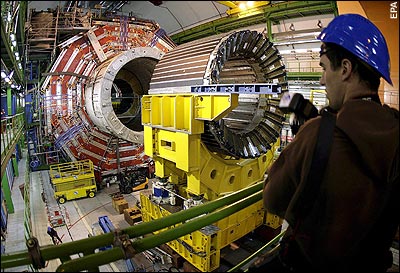
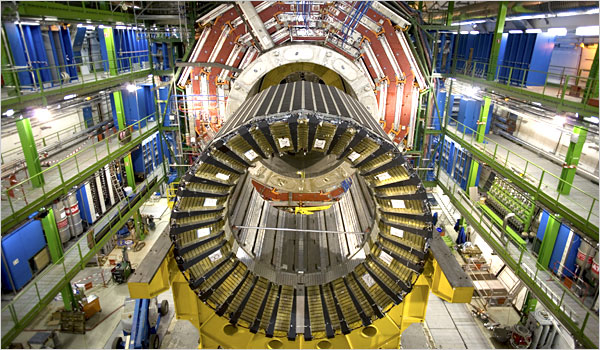
The Large Hadron Collider near Geneva, where particles will begin to circulate around its 17 mile circumference tunnel next week, will recreate energies not seen since the universe was very young, when particles smash together at near the speed of light.


Hadron Collider: The final pieces slot into place

Such is the angst that the American Nobel prize winning physicist Frank Wilczek of the Massachusetts Institute of Technology has even had death threats, said Prof Brian Cox of Manchester University, adding: “Anyone who thinks the LHC will destroy the world is a t—.”

The head of public relations, James Gillies, says he gets tearful phone calls, pleading for the £4.5 billion machine to stop.

Continue reading »

Tags: , , , , , , , , ,

Jun 02


10-year-old takes college by storm

Sophomore holds an A-plus average in subjects like algebra, astronomy

DOWNEY, Calif. - With the end of another school year approaching, college sophomore Moshe Kai Cavalin is cramming for final exams in classes such as advanced mathematics, foreign languages and music.

But Cavalin is only 10 years old. And at 4-foot-7, his shoes don’t quite touch the floor as he puts down a schoolbook and swivels around in his chair to greet a visitor.

“I’m studying statistics,” says the alternately precocious and shy Cavalin, his textbook lying open on the living room desk of his parents’ apartment in this quiet suburb east of Los Angeles.

Within a year, if he keeps up his grades and completes the rest of his requirements, he hopes to transfer from his two-year program at East Los Angeles College to a prestigious four-year school and study astrophysics.

‘Wormholes’ a primary interest
One of his primary interests is “wormholes,” a hypothetical scientific phenomenon connected to Albert Einstein’s theory of relativity. It has been theorized that if such holes do exist in space, they could — in tandem with black holes — allow for the kind of space-age time travel seen in science fiction.

“Just like black holes, they suck in particulate objects, and also like black holes, they also travel at escape velocity, which is, the speed to get out of there is faster than the speed of light,” Cavalin says. “I’d like to prove that wormholes are really there and prove all the theories are correct.”

First, he has statistics homework to finish. Later, he’ll work with his mother, Shu Chen Chien, to brush up on his Mandarin for his Chinese class. Then it’s over to the piano to prepare for his recital in music class.

His father, Yosef Cavalin, frets about the piano-playing, noting that his only child recently broke his arm pursuing another passion, martial arts. He has won several trophies for his age group. Continue reading »

Tags: , , , ,

Mar 31

More fighting in Iraq. Somalia in chaos. People in this country can’t afford their mortgages and in some places now they can’t even afford rice.None of this nor the rest of the grimness on the front page today will matter a bit, though, if two men pursuing a lawsuit in federal court in Hawaii turn out to be right. They think a giant particle accelerator that will begin smashing protons together outside Geneva this summer might produce a black hole or something else that will spell the end of the Earth - and maybe the universe.

Scientists say that is very unlikely - though they have done some checking just to make sure.

The world’s physicists have spent 14 years and $8 billion building the Large Hadron Collider, in which the colliding protons will recreate energies and conditions last seen a trillionth of a second after the Big Bang. Researchers will sift the debris from these primordial recreations for clues to the nature of mass and new forces and symmetries of nature.

But Walter L. Wagner and Luis Sancho contend that scientists at the European Center for Nuclear Research, or CERN, have played down the chances that the collider could produce, among other horrors, a tiny black hole, which, they say, could eat the Earth. Or it could spit out something called a “strangelet” that would convert our planet to a shrunken dense dead lump of something called “strange matter.” Their suit also says CERN has failed to provide an environmental impact statement as required under the National Environmental Policy Act.

collider.jpg Continue reading »

Tags: , , , , , , ,