Dec 04

NEW YORK: The U.S. phone giant AT&T said Thursday that it would eliminate 12,000 jobs, about 4 percent of its work force, as it joins a raft of corporations trying to slash costs in the face of the economic downturn.

AT&T will cut the jobs over the remainder of 2008 and 2009, and take a charge of about $600 million in this year’s fourth quarter for severance.

Continue reading »

Tags: , , , , ,

Jun 28

(What a courageous man! - The Infinite Unknown)

Mark Klein, the retired AT&T engineer who stepped forward with the technical documents at the heart of the anti-wiretapping case against AT&T, is furious at the Senate’s vote on Wednesday night to hold a vote on a bill intended to put an end to that lawsuit and more than 30 others.

[Wednesday]’s vote by Congress effectively gives retroactive immunity to the telecom companies and endorses an all-powerful president. It’s a Congressional coup against the Constitution.

The Democratic leadership is touting the deal as a “compromise,” but in fact they have endorsed the infamous Nuremberg defense: “Just following orders.” The judge can only check their paperwork. This cynical deal is a Democratic exercise in deceit and cowardice.

Klein saw a network monitoring room being built in AT&T’s internet switching center that only NSA-approved techs had access to. He squirreled away documents and then presented them to the press and the Electronic Frontier Foundation after news of the government’s warrantless wiretapping program broke.

Wired.com independently acquired a copy of the documents (.pdf) — which were under court seal — and published the wiring documents in May 2006 so that they could be evaluated.

The lawsuit that resulted from his documents is now waiting on the 9th U.S. Appeals Court to rule on whether it can proceed despite the government saying the whole matter is a state secret. A lower court judge ruled that it could, because the government admitted the program existed and that the courts could handle evidence safely and in secret.

But the appeals court ruling will likely never see the light of day, since the Senate is set to vote on July 8 on the FISA Amendments Act of 2008, which also largely legalizes Bush’s warrantless wiretapping program by expanding how the government can wiretap from inside the United States without getting individualized court orders.

Klein continues:

Congress has made the FISA law a dead letter–such a law is useless if the president can break it with impunity. Thus the Democrats have surreptitiously repudiated the main reform of the post-Watergate era and adopted Nixon’s line: “When the president does it that means that it is not illegal.” This is the judicial logic of a dictatorship.

The surveillance system now approved by Congress provides the physical apparatus for the government to collect and store a huge database on virtually the entire population, available for data mining whenever the government wants to target its political opponents at any given moment-all in the hands of an unrestrained executive power. It is the infrastructure for a police state.

Continue reading »

Tags: , , , , , , , , , , , , , , ,

Jun 28

If you’re a CEO of one of America’s largest corporations and have enjoyed the Presidency of George W. Bush, a contribution to the McCain campaign is looking like a pretty good investment.

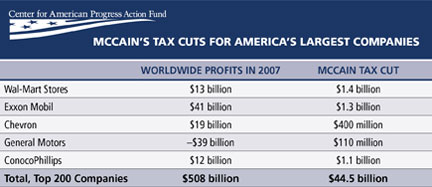
A new report from the Center For American Progress Action Fund finds that a key piece of John McCain’s tax plan — cutting the corporate tax rate from 35% to 25% — would cut taxes by almost $45 billion every year for America’s 200 largest corporations as identified by Fortune Magazine.

Eight companies — Wal-Mart Stores Inc., Exxon Mobil Corp., ConocoPhillips Co., Bank ƒƒof America Corp., AT&T, Berkshire Hathaway Inc., JPMorgan Chase & Co., and Microsoft Corp. — would each receive over $1 billion a year.

The following table shows the tax savings to America’s five largest firms. See a full list of all 200 companies and their savings under McCain here:

These giveaways are just one part of McCain’s doubling of the Bush tax cuts for corporations and the wealthy which would create the largest deficits in 25 years and drive the United States into the deepest deficits since World War II.

A recent analysis by the Public Campaign Action Fund found that John McCain’s campaign has received $5.6 million from the PACs and executives of the Fortune 200.

Over the past eight years, under George W. Bush, American workers have seen their wages stagnate as corporate profits have skyrocketed. John McCain’s misguided priorities show he’s more of the same: the same $45 billion in tax cuts for America’s 200 largest companies could be used to lift over 9 million Americans out of poverty. Continue reading »

Tags: , , , , , , , ,

Apr 15

Fine print reveals that you have fewer rights than you might realize


The Comcast case is a rare example of the government getting into the ISP contract nitty-gritty. “There really should be an onus on the regulators to see this kind of thing is done correctly,” said Bob Williams, who deals with telecom and media issues at Consumers Union.

NEW YORK - What’s scary, funny and boring at the same time? It could be a bad horror movie. Or it could be the fine print on your Internet service provider’s contract.

Those documents you agree to — usually without reading — ostensibly allow your ISP to watch how you use the Internet, read your e-mail or keep you from visiting sites it deems inappropriate. Some reserve the right to block traffic and, for any reason, cut off a service that many users now find essential.

The Associated Press reviewed the “Acceptable Use Policies” and “Terms of Service” of the nation’s 10 largest ISPs — in all, 117 pages of contracts that leave few rights for subscribers.

“The network is asserting almost complete control of the users’ ability to use their network as a gateway to the Internet,” said Marvin Ammori, general counsel of Free Press, a Washington-based consumer advocacy group. “They become gatekeepers rather than gateways.”

Continue reading »

Tags: , , , , , , , , , ,

Apr 13

Would you want other people to know, all day long, exactly where you are, right down to the street corner or restaurant?

Unsettling as that may sound to some, wireless carriers are betting that many of their customers do, and they’re rolling out services to make it possible.

Sprint Nextel Corp. has signed up hundreds of thousands of customers for a feature that shows them where their friends are with colored marks on a map viewable on their cellphone screens. Now, Verizon Wireless is gearing up to offer such a service in the next several weeks to its 65 million customers, people familiar with it say.
WSJ’s Jessica Vascellaro tests out Loopt’s new buddy-tracking device to see whether it’s helpful for hooking up with friends or just another invasion of privacy.

Making this people-tracking possible is that cellphones today come embedded with Global Positioning System technology. With it, carriers have already offered mapping features such as turn-by-turn driving instructions. But they long hesitated to offer another breakthrough made possible by GPS — tracking of cellphone users’ whereabouts in real time — because of privacy and liability concerns. Continue reading »

Tags: , , , , , , , , , , , ,

Mar 14

The National Security Agency was once known for its skill in eavesdropping on the world’s telephone calls through radio dishes in out-of-the-way places like England’s Menwith Hill, Australia’s Pine Gap, and Washington state’s Yakima Training Center.

Today those massive installations, which listened in on phone conversations beamed over microwave links, are becoming something akin to relics of the Cold War. As more communications traffic travels through fiber links, and as e-mail and text messaging supplant phone calls, the spy agency that once intercepted telegrams is adapting yet again. Continue reading »

Tags: , , , , , , , , , , , , , ,

Mar 14

wwwreuterscom.jpeg

WASHINGTON (Reuters) - The House of Representatives abruptly postponed a vote on a spy bill on Thursday after Democrats agreed to a Republican request to hold a rare secret session to discuss classified security matters.

The vote was reset for Friday.

The bill would revamp a 1978 surveillance law and reject President George W. Bush’s demand that phone companies that participated in his warrantless domestic spy program begun after the September 11 attacks be immunized from lawsuits. Continue reading »

Tags: , , , , , , ,