* * *
PayPal: Donate in USD
PayPal: Donate in EUR
PayPal: Donate in GBP
The man who trades freedom for security does not deserve nor will he ever receive either. – Benjamin Franklin
And here comes another BOOM!!!
Got food?
* * *
PayPal: Donate in USD
PayPal: Donate in EUR
PayPal: Donate in GBP
– Inconvenient? Record Arctic Sea Ice Growth In September:
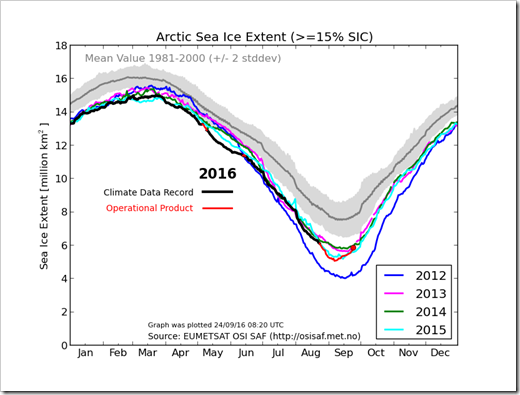
According to data from The Danish Meteorological Institute, since hitting its earliest minimum extent since 1997, Arctic sea ice has been expanding at a phenomenal rate.
http://ocean.dmi.dk/arctic/icecover.uk.php
As notalotofpeopleknowthat blog details, it is already greater than at the same date in 2007, 2008, 2010, 2011, 2012 and 2015.
Put another way, it is the fourth highest extent in the last ten years.

ftp://sidads.colorado.edu/DATASETS/NOAA/G02135/north/daily/data/
Even more remarkably, ice growth since the start of the month is actually the greatest on record, since daily figures started to be kept in 1987.
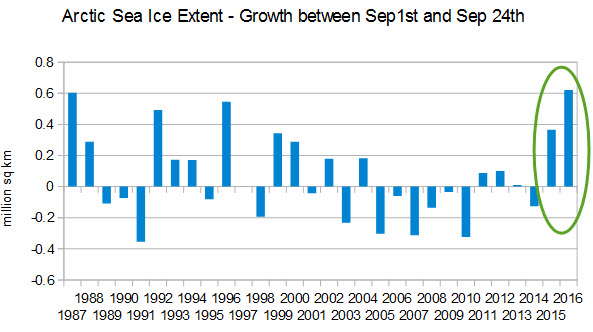
Read moreRecord Arctic Sea Ice Growth In September – #Global Cooling, #ClimateChange, #GlobalWarming
– New Paper Indicates There Is More Arctic Sea Ice Now Than For Nearly All Of The Last 10,000 Years:
Solar Forcing Of Modern, Historic Arctic Sea Ice
Only Slightly Less Sea Ice Now Than Little Ice Age
In a new paper (Stein et al., 2017), scientists find that Arctic sea ice retreat and advance is modulated by variations in solar activity.
In addition, the sea ice cover during the last century has only slightly retreated from the extent reached during coldest centuries of the Little Ice Age (1600s to 1800s AD), which had the highest sea ice cover of the last 10,000 years and flirted with excursions into year-round sea ice.
The Medieval Warm Period sea ice record (~900 to 1200 AD) had the lowest coverage since the Roman era ~2,000 years ago.
<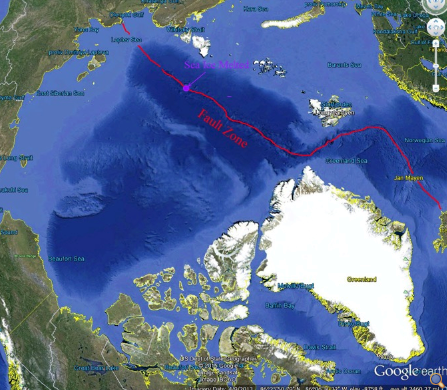
October 2015 sea-ice-melt location above Gakkel Ridge
– Underwater volcanoes melting Arctic Ice, says geologist:
Powerful deep Arctic Ocean geological heat flow forces are melting the ice, says geologist James Edward Kamis.In an article entitled “Heat From Deep Ocean Fault Punches Hole in Arctic Ice Sheet,” Kamis punches his own holes in the “humans-are-melting-the-ice”chorus.
“A very interesting high temperature and low salinity hole has just been punched in the sea ice … directly above the deep ocean Gakkel Ridge Rift / Fault System,” wrote Kamis in early November. (The event Kamis is referring to took place on October 12, 2015.)
Massive amounts of heat pulsing from the earth
The Gakkel ridge is a gigantic chain of underwater volcanoes snaking 1,800 kilometers (1,100 miles) beneath the Arctic Ocean from the northern tip of Greenland to Siberia.
Read moreUnderwater Volcanoes Melting Arctic Ice, Says Geologist

– Arctic ice pack grew by 41 percent in 2013 (Ice Age Now, July 23, 2015):
Al Gore said it would be clear water by now … Video
The Arctic ice pack has expanded dramatically despite years of doom-laden predictions that it was melting away for good.
British scientists discovered that it grew by more than 40 percent in 2013 thanks to cooler than expected temperatures, and say they were shocked at the speed of recovery in such a short time.
Three years ago Professor Peter Wadhams of Cambridge University forecast that the Arctic would be ice free by 2015 – or 2016 at the latest. And Al Gore made strong claims that the caps would disappear by 2014.
In 2007, 2008 and 2009, Gore publicly and very hysterically warned that the North Pole would be “ice-free” by around 2013 because of alleged ‘man-made global warming.
The government-funded BBC ran an article under the headline: ‘Arctic summers ice-free ‘by 2013’.’ Other establishment media outlets did the same.
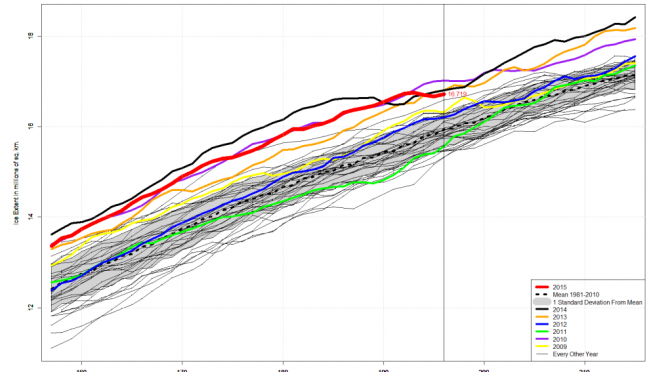
– Arctic sea ice at highest extent for the date in last five years (Ice Age Now, July 18, 2015):
Meanwhile, Antarctic sea ice is at the 4th highest ever measured.
The Denmark meteorological institute is showing Arctic sea ice at its highest extent for the date in the last five years, and it falls within the norm, one standard deviation.
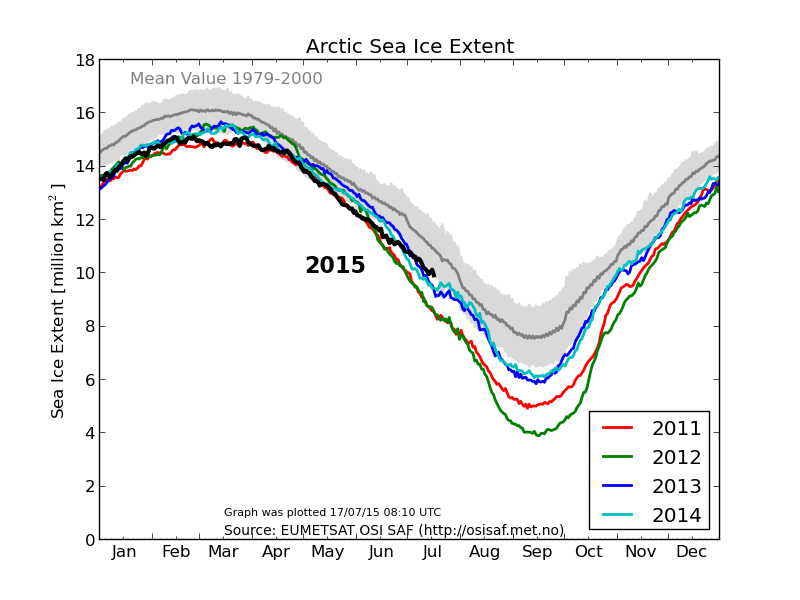
Read moreArctic sea ice at highest extent for the date in last five years
– Arctic Sea Ice Extent At Its Highest Level In Over A Decade (Real Science, November 15, 2014):

http://ocean.dmi.dk/arctic/old_icecover.uk.php
With Antarctic sea ice at a record high, northern hemisphere snow cover near a record high, and Arctic sea ice at a decadal high, government climate experts say that it is the hottest year ever.

– Martini Meltdown (Ice Age Now, Sep 29, 2014):
Sea-ice in the Arctic. That ice ain’t melting and the polar bears are thriving.
Martini Meltdown
By Dr. Klaus L.E. Kaiser
The Sunday Times has reached a new height of incoherence with its science editor’s, (Jonathan Leake) column on Arctic ice cap in ‘death spiral.’
Nothing could be further from the truth. The ice cover in the Antarctic has recently reached a new all-(recorded)-time extent and the ice cover in the Arctic appears to be on a similar path. No wonder as the frost-free days in the Arctic, above 80 N have been fewer in the last two summers and the last winter in North America was brutally cold and long.
– August 15 Global Sea Ice Area Highest Since 1996 (Real Science, Aug 17, 2014)
– Arctic Sea Ice Area Highest Since 2004 (Real Science, Aug 17, 2014)

Second only to the melting of the Arctic ice and those “drowning” polar bears, there is no scare with which the global warmists, led by Al Gore, more like to chill our blood than the fast-vanishing glaciers of the Himalayas, which help to provide water for a sixth of mankind.
Read moreStubborn glaciers fail to retreat, awkward polar bears continue to multiply

WASHINGTON (Reuters) – The thickest, oldest and toughest sea ice around the North Pole is melting, a bad sign for the future of the Arctic ice cap, NASA satellite data showed on Tuesday.
“Thickness is an indicator of long-term health of sea ice, and that’s not looking good at the moment,” Walt Meier of the National Snow and Ice Data Center told reporters in a telephone briefing.
This adds to the litany of disturbing news about Arctic sea ice, which has been retreating over the last three decades, especially last year, when it ebbed to its lowest level.
Read moreNASA data shows thickest and oldest Arctic ice is melting