“Retaliate”? “Calibrate a target retaliation list”?
Retaliate because Europeans don’t want American GMO junk and GMO garbage in general?
Now everybody knows who the REAL TERRORISTS are. Thank you.
This is the New World Order attacking the people on all levels of life and don’t believe for one moment that the elite puppet governments of Europe will defend its citizens against GMO.
The people in Europe are much more aware about GMOs and their detrimental health effects and the people are the resistance, not the European puppet governments.
Terrorist Craig Stapleton, the US ambassador to France
(NaturalNews) Wikileaks continues to rock the political world by shedding light on conspiracies, corruption and cover-ups. The latest batch of diplomatic cables released by Wikileaks reveals what can only be characterized as a U.S.-led conspiracy to force GMOs onto European countries by making those countries pay a steep price if they resist.
The cable reveals the words of Craig Stapleton, the US ambassador to France, who was pushing the commercial interests of the biotech industry by attempting to force GMOs into France. In his own words (below), he expresses his frustration with the idea that France might pass environmental laws that would hamper the expansion of GMOs:
“Europe is moving backwards not forwards on this issue with France playing a leading role, along with Austria, Italy and even the [European] Commission… Moving to retaliation will make clear that the current path has real costs to EU interests and could help strengthen European pro-biotech voice.”
Got that so far? His own words: “Retaliation” as a way to “make [it] clear” that resisting GMOs will have a price.
Stapleton goes on to say something rather incredible:
“Country team Paris recommends that we calibrate a target retaliation list that causes some pain across the EU since this is a collective responsibility, but that also focuses in part on the worst culprits. The list should be measured rather than vicious and must be sustainable over the long term, since we should not expect an early victory…”
As you read these words again, remember that these are the words of the U.S. ambassador to France who is suggesting the US “calibrate a target retaliation list” in order to “cause some pain across the EU” that must be “sustainable over the long term.”
The global GMO conspiracy is no longer a theory
Need we say anything more? This cable proves, once and for all, that there is a global GMO conspiracy where government operatives work in secret to push Monsanto’s GMO agenda while punishing opponents of GMOs and adding them to a “target retaliation list.”
This cable also proves that NaturalNews has been right all along about the GMO conspiracy, and that GMO opponents such as Jeffrey Smith are battling what can only be called an evil conspiracy to control the world’s food supply. It also proves that when Alex Jones talks about the global conspiracy to control the world food supply, he’s not just ranting. He’s warning about the reality of the world in which we now live.
As Jeffery Smith said today in a Democracy Now interview:
“We’ve been saying for years that the United States government is joined at the hip with Monsanto and pushing GMOs as part of Monsanto’s agenda on the rest of the world. This lays bare the mechanics of that effort. We have Craig Stapleton, the former ambassador to France, specifically asking the U.S. government to retaliate and cause some harm throughout the European Union.” (http://www.democracynow.org/seo/201…)
Military terms
Do you notice something about these words used by the US ambassador to France? “Calibrate a target retaliation list” sounds eerily familiar, doesn’t it? It’s the kind of language you might find tossed around in a military bombing war exercise.
That’s no coincidence: These government operatives quite literally consider themselves to be at war with the world, and they intend to conquer the world with their genetically modified poisons. They will do anything, it seems, to force-feed their deadly crops to the public.
In what researchers call a novel ‘mind-body’ therapy, most patients in a study suffering from irritable bowel syndrome reported relief after receiving pills they were told contained no real medicine.
In a study involving 80 people suffering from irritable bowel syndrome, 59% of the patients taking a placebo said their symptoms had been adequately relieved, compared to 35% in the non-treatment group. (Jim Craigmyle / Corbis)
A simple sugar pill may help treat a disease — even if patients know they’re getting fake medicine.
The finding, reported online Wednesday in the journal PloS One, may point the way to wider — and more ethical — applications of the well-known “placebo effect.”
“The conventional wisdom is you need to make a patient think they’re taking a drug; you have to use deception and lies,” said lead author Ted Kaptchuk, an associate professor of medicine at Harvard Medical School. And, Kaptchuk added, it seems many doctors do this: In one report, as many as half of rheumatologists and internists surveyed said they had intentionally given patients ineffective medication in the hopes it would have a positive result.
Kaptchuk, however, wondered whether the deception was needed. When he first tried to persuade fellow researchers to explore a sort of “honest” placebo, “they said it was nuts,” he said. After all, didn’t the whole effect hinge on people believing they were getting real treatment?
Patients were easier to enlist. “People said, ‘Wow, that’s weird,’ and we said, ‘Yeah, we think it might work.’ ”
The researchers enrolled 80 people suffering from irritable bowel syndrome, explaining the experiment while framing it positively — they called it a novel “mind-body” therapy.
Half the patients were given a bottle with the word “placebo” printed on it. The pills it held, they were told, were like sugar pills. The patients were told they didn’t even need to believe in the placebo effect, but had to take the pills twice daily.
The other half were given no treatment at all.
At the end of the three-week trial, 59% of the patients taking the placebo said their symptoms had been adequately relieved, far outstripping the 35% in the non-treatment group.
“We were all taken aback,” Kaptchuk said. “We triple-checked the data before we decided it was real.”
Plan to require fingerprinting to pick up certain prescriptions targets fraud
Peoria could become the first Arizona city to require fingerprinting at pharmacies when picking up prescriptions for commonly abused drugs in an effort to curb an escalating number of fraud cases.
Peoria law-enforcement officials this month proposed an ordinance that would require anyone filling prescriptions for drugs such as OxyContin and Percocet to show ID and be fingerprinted at the pharmacy counter, including anyone picking up a prescription for a family member or friend.
Peoria City Attorney Steve Kemp said the proposal could provide better evidence to prosecute cases.
Dan Pochoda, legal director for the American Civil Liberties Union of Arizona, called it an “overreaction.”
“This raises serious concerns about intrusion of privacy,” Pochoda said.
SHANGHAI – Communities in central and northern China are facing power cuts and rationing as winter coal supplies fall short of surging demand.
Cold weather and transport disruptions typically cause shortages most years, but the problem has been complicated by coal producers’ unhappiness over price controls that are crimping their profits.
China’s State Grid, the government power provider, said in reports seen Monday on its websites that recent winter storms had pushed demand higher while worsening traffic bottlenecks, hindering coal deliveries.
Phone calls to the State Grid’s branches in central China’s Henan, Shanxi, Shaanxi, Chongqing and Hubei provinces — the areas reportedly worst affected — rang unanswered Monday.
China depends on coal for more than three-quarters of its electricity and also to fuel centralized winter heating systems in northern cities. Spates of unusually cold weather often strain supplies, with power rationing not uncommon.
About 620,000 households were left without power due to bad weather in Zhejiang, a province west of Shanghai, a report on the State Grid website said. It said power was being restored.
US spy agency forms taskforce to assess fallout from 250,000 leaked US cables
The CIA has formed a WTF unit to deal with any fallout from the WikiLeaks disclosures. Photograph: Jason Reed/Reuters/Corbis
The CIA has launched a taskforce to assess the impact of 250,000 leaked US diplomatic cables. Its name? WikiLeaks Task Force, or WTF for short.
The group will scour the released documents to survey damage caused by the disclosures. One of the most embarrassing revelations was that the US state department had drawn up a list of information it would like on key UN figures – it later emerged the CIA had asked for the information.
“Officially, the panel is called the WikiLeaks Task Force. But at CIA headquarters, it’s mainly known by its all-too-apt acronym: WTF,” the Washington Post reported.
Victims of clerical sex abuse have reacted furiously to Pope Benedict’s claim yesterday that paedophilia wasn’t considered an “absolute evil” as recently as the 1970s.
In his traditional Christmas address yesterday to cardinals and officials working in Rome, Pope Benedict XVI also claimed that child pornography was increasingly considered “normal” by society.
“In the 1970s, paedophilia was theorised as something fully in conformity with man and even with children,” the Pope said.
“It was maintained — even within the realm of Catholic theology — that there is no such thing as evil in itself or good in itself. There is only a ‘better than’ and a ‘worse than’. Nothing is good or bad in itself.”
The Pope said abuse revelations in 2010 reached “an unimaginable dimension” which brought “humiliation” on the Church.
Asking how abuse exploded within the Church, the Pontiff called on senior clerics “to repair as much as possible the injustices that occurred” and to help victims heal through a better presentation of the Christian message.
“We cannot remain silent about the context of these times in which these events have come to light,” he said, citing the growth of child pornography “that seems in some way to be considered more and more normal by society” he said.
But outraged Dublin victim Andrew Madden last night insisted that child abuse was not considered normal in the company he kept.
Mr Madden accused the Pope of not knowing that child pornography was the viewing of images of children being sexually abused, and should be named as such.
He said: “That is not normal. I don’t know what company the Pope has been keeping for the past 50 years.”
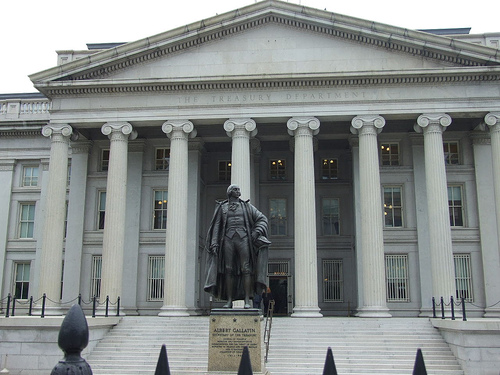
WASHINGTON (Reuters) – The U.S. government fell deeper into the red in fiscal 2010 with net liabilities swelling more than $2 trillion as commitments on government debt and federal benefits rose, a U.S. Treasury report showed on Tuesday.
The Financial Report of the United States, which applies corporate-style accrual accounting methods to Washington, showed the government’s liabilities exceeded assets by $13.473 trillion. That compared with a $11.456 trillion gap a year earlier.
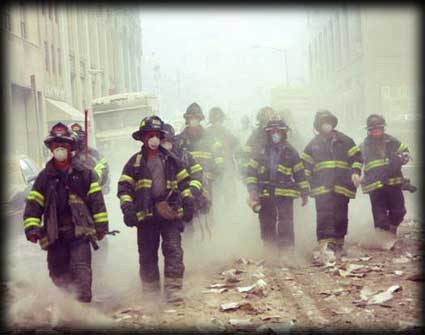
Mayor Bloomberg wants to bar sick Ground Zero workers from suing the city – but Reps. Jerry Nadler and Carolyn Maloney say they will push bills to allow people the choice to either sue or take money from a new victims’ compensation fund.
Bloomberg has cooked up a plan to withhold any of the $1 billion in insurance it received from the feds unless the city and its contractors in the Ground Zero cleanup get blanket immunity from lawsuits, officials told The Post.
“We don’t believe the city is liable for the acts of 19 terrorists,” said Deputy Mayor Ed Skyler.
Without immunity, he said, the city could be socked with suits seeking far more than $1 billion for years to come.
But the city’s demand has angered lawyers who want to start settling suits by more than 7,000 workers seeking compensation for respiratory illness, cancer and other diseases from toxic exposure.
“Bloomberg is holding these ill workers hostage – like human shields,” said attorney Paul Napoli.
NEW YORK (AP) — It was called a “Christmas miracle,” but a last-minute compromise by Congress will provide a smaller aid package than originally envisioned to help victims of the Sept. 11 attack on the World Trade Center and the responders sickened as they worked in its smoldering ruins.
The measure passed by Congress and sent to President Barack Obama on Wednesday would provide up to $4.2 billion in new aid to survivors and responders, $2 billion less than originally proposed. Obama said he is eager to sign it.
The package provides $1.5 billion to monitor the health of rescue and cleanup workers and treat illnesses related to ground zero. It also reopens a victims’ compensation fund with $2.7 billion.
MIAMI (AP) — Nearly one-fourth of the students who try to join the U.S. Army fail its entrance exam, painting a grim picture of an education system that produces graduates who can’t answer basic math, science and reading questions, according to a new study released Tuesday.
The report by The Education Trust bolsters a growing worry among military and education leaders that the pool of young people qualified for military service will grow too small.
“Too many of our high school students are not graduating ready to begin college or a career — and many are not eligible to serve in our armed forces,” U.S. Education Secretary Arne Duncan told the AP. “I am deeply troubled by the national security burden created by America’s underperforming education system.”
The effect of the low eligibility rate might not be noticeable now — the Department of Defense says it is meeting its recruitment goals — but that could change as the economy improves, said retired Navy Rear Admiral Jamie Barnett.
“If you can’t get the people that you need, there’s a potential for a decline in your readiness,” said Barnett, who is part of the group Mission: Readiness, a coalition of retired military leaders working to bring awareness to the high ineligibility rates.
The report by The Education Trust found that 23 percent of recent high school graduates don’t get the minimum score needed on the enlistment test to join any branch of the military. Questions are often basic, such as: “If 2 plus x equals 4, what is the value of x?”
The military exam results are also worrisome because the test is given to a limited pool of people: Pentagon data shows that 75 percent of those aged 17 to 24 don’t even qualify to take the test because they are physically unfit, have a criminal record or didn’t graduate high school.
Educators expressed dismay that so many high school graduates are unable to pass a test of basic skills.
NEW YORK, Dec. 21, 2010 /PRNewswire-USNewswire/ — Exposure to fluoride may lower children’s intelligence says a study pre-published in Environmental Health Perspectives, a publication of the National Institute of Environmental Health Sciences (online December 17, 2010).
Fluoride is added to 70% of U.S. public drinking water supplies.
According to Paul Connett, Ph.D., director of the Fluoride Action Network, “This is the 24th study that has found this association, but this study is stronger than the rest because the authors have controlled for key confounding variables and in addition to correlating lowered IQ with levels of fluoride in the water, the authors found a correlation between lowered IQ and fluoride levels in children’s blood. This brings us closer to a cause and effect relationship between fluoride exposure and brain damage in children.”
“What is also striking is that the levels of the fluoride in the community where the lowered IQs were recorded were lower than the EPA’s so-called ‘safe’ drinking water standard for fluoride of 4 ppm and far too close for comfort to the levels used in artificial fluoridation programs (0.7 – 1.2 ppm),” says Connett.
In this study, 512 children aged 8-13 years in two Chinese villages were studied and tested – Wamaio with an average of 2.47 mg/L water fluoride (range 0.57-4.50 mg/L) and Xinhuai averaging 0.36 mg/L (range 0.18-0.76 mg/L).
More than 1,400 of the department’s 5,000 phones were not used by employees, yet were activated and incurred $330,000 in service charges. One worker racked up $2,000 in personal international calls.
A quarter of the money spent last year on cellphones by Los Angeles County’s child welfare department was wasted on “unnecessary or inappropriate” charges, according to an audit released Tuesday.
The audit found that $514,000 of the $2.2 million spent in 2009 on the department’s 5,000 cellphones went to devices that were never used, personal calls to foreign countries and other questionable ends.
“It is likely that the department paid for inappropriate charges in the prior and current years” as well, Los Angeles County Auditor-Controller Wendy Watanabe wrote in her report.
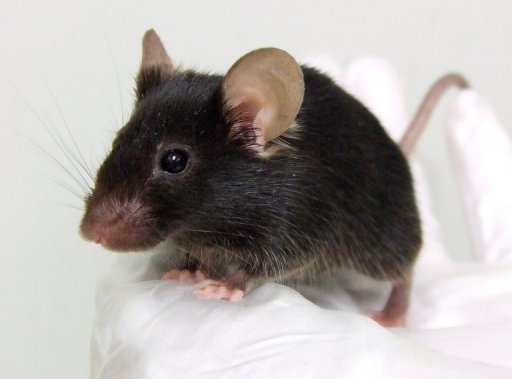
TOKYO — Japanese scientists said Tuesday they had produced a mouse that tweets like a bird in a genetically engineered “evolution” which they hope will shed light on the origins of human language.
A team of researchers at the University of Osaka created the animal in their “Evolved Mouse Project”, in which they use genetically modified mice that are prone to miscopying DNA and thus to mutations.
“Mutations are the driving force of evolution. We have cross-bred the genetically modified mice for generations to see what would happen,” lead researcher Arikuni Uchimura told AFP.
“We checked the newly born mice one by one… One day we found a mouse that was singing like a bird,” he said, noting that the “singing mouse” was born by chance but that the trait will be passed on to future generations.
“I was surprised because I had been expecting mice that are different in physical shape,” he said by telephone, adding that in fact the project had also produced “a mouse with short limbs and a tail like a dachshund”.
Glenn Beck spent the past week denouncing the liberal billionaire and philanthropist George Soros as a “puppet master” who is orchestrating a coup “to bring America to her knees.”
Given Soros’ alleged role plotting to destroy the United States, Beck and his Fox viewership might be surprised to learn that one of Sarah Palin’s top aides has been on Soros’ payroll for years.
That would be Republican lobbyist Randy Scheunemann, Palin’s foreign policy adviser and a member of her small inner circle. He runs a Washington, D.C., consulting firm called Orion Strategies. Scheunemann and a partner have since 2003 been paid over $150,000 by one of Soros’ organizations for lobbying work, according to federal disclosure forms reviewed by Salon. The lobbying, which has continued to the present, centers on legislation involving sanctions and democracy promotion in Burma.
“All tyranny needs to gain a foothold is for people of good conscience to remain silent.”
– Thomas Jefferson
Americans are now officially doomed, because I am sure that President Obama will sign the Food Safety Modernization Act into law.
Your government has taken away YOUR right to grow YOUR own food on YOUR own land, to save YOUR own seeds and to exchange YOUR produce with YOUR friends and neighbors!
Soon you will be treated like marijuana growers, if you grow tomatoes or salad on your own land.
Dr. Rima Laibow:
“This bill is the triumph of agri-bills”
“It is the industrialization tool for the entire US food supply”
“It brings all of Codex standards and guidelines into implementation”
“This bill means that no farmer can safe seed”
“If it does pass, you and I, our children, our loved ones will suffer and we will die”
Is there a solution?
1. Every American should start RIGHT NOW to plant an organic garden…
2. … and practice civil disobedience the way Gandhi did.
3. If the government raids your property, then you should be prepared for that by forming groups, that will sue the government for violating your constitutional rights.
4. If all legal options fail, then we need to remind the US government of the second amendment.
“The strongest reason for the people to retain the right to keep and bear arms is, as a last resort, to protect themselves against tyranny in government.” – Thomas Jefferson
Former Governor of Minnesota Jesse Ventura:
5. If the US government will refuse to give us our constitutional rights back, turning itself into a fascist dictatorship, then we the people have the right to shoot the bastards.
(And you and I know that I’ve never used such strong words.)
“God forbid we should ever be twenty years without such a rebellion…. And what country can preserve its liberties, if its rulers are not warned from time to time, that this people preserve the spirit of resistance? Let them take arms…. The tree of liberty must be refreshed from time to time with the blood of patriots and tyrants.”
– Thomas Jefferson, in a letter to William S. Smith (1787)
“All those who voted for S.510 — which includes the entire U.S. Senate, Republicans and Democrats alike — are traitors to the freedoms upon which America was founded.”
– Mike Adams
More information at the end of this important article…
(NaturalNews) The U.S. House of Representatives passed H.R. 2751 yesterday with a 216 to 144 vote (yes, many members of the House did not even vote). The so-called Food Safety Modernization Act now heads to the President to be signed into law.
When witnessing such a moment in history when the federal government greatly expands its power over an entire industry, it’s important to understand the Law of Unintended Consequences. Virtually everything bad that happens after a bill gets passed is due to this Law of Unintended Consequences.
On the surface, the intention behind the food safety bill seems innocent enough: Let’s all protect the food supply and prevent people from getting sick due to e.coli and salmonella exposure. But the reality of the result that emerges from the law is quite different.
Get ready for more dangerous, pesticide-ridden food from south of the border
Because the S.510 / HR 2751 food safety bill places an enormous new burden on U.S. farmers — yes, even small farms that are supposedly “exempt” — it’s going to drive many farmers out of business.
It will also erect new barriers to farmers entering the food production business, and this is especially true for the small local farmers who grow food for local co-ops, farmers’ markets and CSA organizations (Community Supported Agriculture). What we’re going to see from all this, then, is the following:
• A reduction in the available SUPPLY of fresh local produce.
• A loss of local farming know-how and food sustainability.
• The financial failure of CSAs, food co-ops and small local markets.
• The loss of countless jobs that were related to local food production.
• An INCREASE in the price of local food, especially organic food.
Food safety bill does nothing to address food imports
At the same time these huge regulatory burdens are thrust upon U.S. farmers, there are no new regulations required for food grown outside the United States.
This means that food coming into the USA from Mexico, Chile, Peru or anywhere else does not have to meet S.510 food safety regulations at all. The FDA, after all, doesn’t inspect greenhouses in Mexico or grape farms in Chile which export their products to the United States.
Furthermore, many dangerous chemical pesticides that have been banned in the USA are legal to use elsewhere, and foods treated with those pesticides are perfectly legal to import into the United States. So instead of buying food grown in the United States on small, organic farms, more U.S. consumers are going to be buying food grown elsewhere that’s treated with extremely toxic pesticides.
Here are some of the unintended consequences of all this:
• An INCREASE in the importation of fresh produce from other countries.
• A worsening of the agricultural trade imbalance between the U.S. and other nations.
• An INCREASE in the pesticide contamination of fresh produce sold at U.S. grocery stores.
• An INCREASE in agriculture jobs in Mexico, Chile, Peru and elsewhere, even while agriculture jobs are lost in the USA.
• A DECREASE in the overall safety of the food supply because now the proportion of foods imported from foreign countries with little or no regulatory oversight will greatly expand compared to U.S. grown foods.
In effect, then, what Congress has done is impaired the competitiveness of U.S. farms, shifted farming jobs out of the country, increased the pesticide residues in fresh produce sold in U.S. grocery stores and harmed local food security and sustainability by driving small, local farmers out of business.
Such is the nature of the Law of Unintended Consequences. And such is the nature of just about everything that Big Government tries to do when it threatens to “solve problems” by expanding its regulatory control over almost any industry.
We need food security in America
What Congress fails to understand is that we need food security far more than we need more FDA regulations. The knowledge base of local farmers who know how to grow, harvest and distribute food is far more valuable to the security of our nation than preventing a relatively small number of people from getting sick from e.coli each year (even if such a trade-off were a simplistic equation, which it isn’t). Because if we lose food security, then we become slaves to the big corporate food producers who are attempting to centralize food production and place food, seeds and crops under their absolute control.
A cynic might even suggest that was the whole purpose of the food safety bill in the first place: To destroy small farmers and centralize food production power in the hands of a few wealthy corporations. Whether that was the intent or not, it is certainly going to be the effect.
What Congress has done with this food safety bill, in effect, is to cripple America’s food production know-how and poison the population with far more dangerous pesticide-ridden produce that will now be imported from other countries instead. This bill should have been called the “Mexico Farming Jobs Act” because it’s going to shift countless jobs south of the border as farms in the USA realize they simply can’t operate under the immense burden of FDA regulatory tyranny.
What’s the definition of insanity?
It all makes you wonder what the members of Congress are really thinking. Don’t they ever step back and attempt to consider the real-world ramifications of their actions?
Time and time again, the U.S. government seems to do the opposite of what would reasonably be required to solve problems. Think about it: When the U.S. government wanted to stop Wall Street bankers and investment firms from wasting money, it simply handed them a few trillion dollars in new money so they could waste more.
When the government wanted to end debt spending, it spent more debt money out of the foolish belief that you can somehow end your debt by going deeper into it.
When the government claimed it would reduce your health care costs and cover everyone with health insurance, it passed a sick-care law that has only seen health care costs spiraling out of control while insurers cancel policies and end coverage for many children.
And now, the government claims to be making your food safer even though the real impact of the new law will be to make your food far more dangerous while destroying U.S. farming jobs.
This is why those who really know government also know that they who govern best govern the least. Instead of trying to “fix” all the nation’s problems by meddling with the actions of hard-working people trying to make a living (such as organic farmers), the government needs to simply get out of the way and let farmers produce their food without the heavy regulatory burden of the FDA — an agency that we know is frequently engaged in actions that can only be called criminal in nature (http://www.naturalnews.com/030461_S…).
Get ready for skyrocketing food prices in 2011 – 2013
With the passage of this food safety bill, I am now publicly predicting skyrocketing food prices over the next two years. We will see fresh, local produce become increasingly more expensive and more difficult to acquire. Many local farmers will shutter their businesses, and farming know-how will be lost for perhaps a generation. The damage that will be done to America’s food security and agricultural base is incalculable.
Such is the price we shall all pay for allowing our representatives in Washington to once again violate our Natural Right to grow food and exchange it for goods or cash with our neighbors. The reason this Natural Right was never even mentioned in the US Constitution, by the way, is because the right to grow your own food without government interference is such an obvious “Natural Right” (a God-given right, or a right that is self-evident) that our forefathers never imagined such a right would be infringed by the federal government.
Or if a right were ever infringed by the federal government, our forefathers were certain that the citizens of the United States of America would exercise their other Constitutional rights to nullify the attempted overreaching authority of the federal government and thereby restore their freedoms. Sadly, such a solution does not work when the majority of the population is lulled into a false sense of freedom by a government that deliberately lies to them on a daily basis. Freedom does not exist with the vast majority of the population has no interest in defending it.
Vegetable gardeners can learn something from marijuana growers
Better buy yourself some heirloom seeds while you have the chance. Plant your stealth garden and cover it with camouflage so the government can’t see it and order you to destroy it. Soon, backyard vegetable gardeners will need to operate like marijuana growers and start hiding their food from government’s prying eyes.
No doubt the U.S. federal government will start using spy satellites to identify “unregistered gardens” that will be targeted for termination. Soon, small farmers may even be raided by armed FDA agents who terrorize their operations and seize cabbages. Seriously.
It sounds crazy today, I know. But a decade ago, no one thought the government would ever outlaw raw cow’s milk and arrest ranchers for selling milk to their neighbors, and that’s now happening on a regular basis.
In five years, FDA farm raids may be routine. That is, if there’s anything left of the federal government (as we know it) in five years.(Actually the only good news is that the US will collapse as planned by the elite before those traitors can take away your own food. – Infinite) I’m not sure how long they can keep up the financial house of cards, frankly. Always remember this enlightening fact: The entire federal government is just one paycheck away from collapse. I wonder how long FDA inspectors will keep harassing farmers if their paychecks stop? Remember, FDA employees have no loyalty to anything other than their paychecks. Once the money from Washington stops, the army of FDA mercenaries collapses virtually overnight.
And the resilient farmers of America will win in the end, I have no doubt. If I had to choose to live on a deserted island with either ten North Carolina farmers or ten FDA bureaucrats, the choice would be a no-brainer. Farmers can keep you alive. FDA bureaucrats will only stab you in the back, steal your coconuts, and refuse to do any actual work on their own.
They are, after all, parasites who feed on taxpayer dollars and lend nothing of value to society. If the FDA actually did anything useful at all, it would have banned mercury fillings to protect the public from mercury toxicity (http://www.naturalnews.com/030741_m…).
All those who voted for S.510 — which includes the entire U.S. Senate, Republicans and Democrats alike — are traitors to the freedoms upon which America was founded.
(NaturalNews) In arguing for S.501, the “Food Safety Modernization Act,” there are all sorts of attorneys, legislators and internet commentators who keep claiming, “The government won’t try to control the food production of small farms.” They say, “Your backyard garden is safe” and that the feds won’t come knocking on your door to control your seeds or foods.
As usual, these pushers of Big Government are utterly ignorant of the history in their own country. Because as you’ll learn right here, not only CAN the U.S. government control and dictate to single-family farms what they can grow in their own backyards; the government has already blatantly done so!
In this article, I’ll share with you the full and true story of how Big Government has already run rampant over the rights of individuals to grow their own food — I’ll even cite the US Supreme Court decision that “legalized” this tyranny.
How the tyrants came after a farmer named Roscoe Filburn
It all starts with a farmer named Roscoe Filburn, a modest farmer who grew wheat in his own back yard in order to feed his chickens.
One day, a U.S. government official showed up at his farm. Noting that Filburn was growing a lot of wheat, this government official determined that Filburn was growing too much wheat and ordered Filburn to destroy his wheat crops and pay a large fine to the federal government.
The year was 1940, you see. And through a highly protectionist policy, the federal government had decided to artificially drive up the prices of wheat by limiting the amount of wheat that could be grown on any given acre. This is all part of Big Government’s “infinite wisdom” of trying to somehow improve prosperity by destroying food and impairing economic productivity. (Be wary any time the government says it’s going to “solve problems” for you.)
The federal government, of course, claims authority over all commerce (even when such claims are blatantly in violation of the limitations placed upon government by the Constitution). But Roscoe Filburn wasn’t selling his wheat to anyone. Thus, he was not engaged in interstate commerce. He wasn’t growing wheat as something to use for commerce at all, in fact. He was simply growing wheat in his back yard and feeding it to his chickens. That’s not commerce. That’s just growing your own food.
But get this: The government insisted he pay a fine and destroy his wheat, so Filburn took the government to court, arguing that the federal government had no right to tell a man to destroy his food crops just because they wanted to protect some sort of artificially high prices in the wheat market.
This case eventually went to the US Supreme Court. It’s now known as Wickard v. Filburn, and it is one of the most famous US Supreme Court decisions ever rendered because it represents a gross expansion of the tyranny of the federal government.
The US Supreme Court sided with government tyranny
The US Supreme Court, you see, ruled that Roscoe Filburn’s wheat could be regulated and destroyed by the federal government simply because Roscoe’s wheat production might reduce the amount of wheat he bought from other wheat producers and therefore could impact interstate trade.
Now stay with me on this, because this is a really, really important point to understand.
The federal government claimed authority under the Commerce Clause of the US Constitution (Article 1, Section 8), even though the Commerce Clause was originally written primarily to prevent states from erecting tariffs, not to allow the federal government to control interstate trade. But thanks to the twisted interpretation of the government — and believe me, the government will twist every interpretation it can in an effort to assert more power over the population — the feds claimed that Filburn’s growing of his own wheat effectively reduced interstate commerce in wheat. Therefore, they reasoned, they could regulate his backyard wheat production (and order him to destroy his wheat).
Because of this US Supreme Court decision in 1942, it now means the federal government can order you to halt food production in your own back yard by arguing that when you grow your own food, the amount of food you purchase from other food providers is reduced, meaning that your food production impacts interstate trade and therefore can be fully controlled by the federal government.
In other words, the federal government claims the authority right now — even without the Food Safety Modernization Act — to knock on your door and order you at gunpoint to destroy all the food in your garden, your greenhouse or your farm. They can order you to destroy all seeds in your possession and all food harvested from your own garden. And they can do all this with the full protection of U.S. law by simply citing the precedent set in Wickard v. Filburn in 1942 as ruled by the US Supreme Court.
Drawback? Most programmes for smartphones, such as this iPhone, send data back to companies that sold them
Dozens of popular iPhone apps are secretly monitoring users and sending information back to companies – who then use it to target them with adverts.
More than half of the programmes and games for smartphones sent data back to the private companies once they had been downloaded, a study found.
The apps include the wildly popular Angry Birds game and music identifying software Shazam, which comes pre-installed on every iPhone.
Armed with this information firms including Google track the individuals’ movements and sell personalised adverts for which they can make more money than regular ones.
The study found that of 101 apps tested, 56 transmitted the phone’s individual number to a private company in some way, known as the Unique Device Identifier or UDID.
Some 47 sent the phone’s location and five sent age, gender and other personal information.
More data was sent back about a user’s location on the Apple’s iPhone than Google’s Android smartphone, the research discovered, even though both companies have promised not to let such practices take place.
The research was carried out in the U.S. but it would apply to users downloading apps from anywhere in the world.
Iran has hanged 11 men it says were members of a terrorist group responsible for a suicide bombing which claimed the lives of 39 people.
An image grab taken from footage broadcast by Al-Alam TV on December 15, 2010, shows the site where a suicide bomber blew himself up during a Shiite religious procession in the Iranian city of Chabahar Photo: AFP/GETTY
The executions were seen as retribution against Jundullah, a feared terrorist group which had claimed responsibility last week’s attack in the south-eastern port city of Chabahar. Jundullah said the bombing, which targeted worshippers observing a solemn day of mourning, was carried to avenge the hanging of its leader, Abdulmalik Rigi, earlier this year.
“Eleven members of the terrorist group and mercenaries who had a role in terrorist activities, fighting police and killing innocent people were hanged,” said Ebrahim Hamidi, head of the Justice Department of the southeastern province of Sistan-Baluchistan. The executions took place at dawn in Zahedan, the provincial capital of Sistan-Baluchistan.
IRNA, an official news agency, identified all 11 men, which indicated that they were members of the Sunni ethnic Baluchi minority.
Jundullah says it is fighting for the rights of the Baluchi minority in the remote Sistan-Baluchistan, which it says suffers discrimination at the hands of Iran’s leadership.
Iran has accused the group of links to al-Qaida, and claims its members are being trained in Pakistan.
The United States designated Jundullah a terrorist organisation earlier this year.
Just exchange the Fed with the BoE and ‘THE BEN BERNANK’ with ‘THEMERVY KING’.
Quantitative easing = printing money = creating money out of thin air = increasing the money supply = inflation = hidden tax on monetary assets = theft!
Interest rates will have to rise almost sixfold over the next two years to cope with rising inflation, business leaders have warned.
Interest rates will rise six fold in two years
It will bring financial pain to seven million home owners with floating interest rates who will see a jump of almost £200 on a typical monthly mortgage payment.
Charities have already warned that repossessions are likely to rise next year and the threat of a succession of quick interest rate rises will exacerbate their fears.
The Confederation of British Industry predicts that higher than anticipated rises in the cost of living will push the Bank of England (BoE) to begin increasing interest rates in the spring.
It predicted that the Bank base rate – the interest rate at which the BoE lends to other banks – will rise more than two percentage points by the end of 2012. Mortgage rates are expected to follow closely behind.
“Many households have been benefiting (from the low interest rates) in terms of mortgage payments, but that will start to turn over the next couple of years,” said Lai Wah Co, the CBI’s head of economic analysis.
The organisation predicts that the Consumer Prices Index, the Government’s preferred measure of inflation, will reach 3.8 per cent within the first three months of next year and that it will still be well above the Bank’s 2 per cent target two years from now. It currently stands at 3.3 per cent.
France’s AAA Grade at Risk as Rating Cuts Spread: Euro Credit
Dec. 20 (Bloomberg) — France risks losing its top AAA grade as Europe’s debt crisis prompts a wave of downgrades that threatens to engulf the region’s highest-rated borrowers, with Belgium also facing a possible cut.
Moody’s Investors Service said Dec. 15 it may lower Spain’s rating, citing “substantial funding requirements,” and slashed Ireland’s rating by five levels on Dec. 17. Standard & Poor’s is reviewing its assessments of Ireland, Portugal and Greece. Costs to insure French government debt rose to a record today with the country’s credit default swaps more expensive than lower-rated securities from the Czech Republic and Chile.
“Every sovereign may get penalized in the year ahead,” said Toby Nangle, who helps oversee $46 billion as director of asset allocation at Baring Asset Management in London. “It would be a big deal if France was to have its AAA rating stripped. I don’t think the likelihood of a downgrade is reflected in the market.”
European Union leaders agreed last week to amend the bloc’s treaties to create a permanent debt-crisis mechanism in 2013 in an effort to stem contagion that started more than a year ago in Greece. Government bond yields climbed across the region even after Greece and Ireland were rescued and a backstop facility worth about $1 trillion was created.
“If problems in the euro zone aren’t solved quickly, then the conditions of refinancing will be expensive for these countries and the ratings agencies will do more downgrades,” said Ralf Ahrens, who helps manage about $20 billion as head of fixed income at Frankfurt Trust. “We already see these dynamics in the market. I see France as a risk.”
Overdrawn American cities could face financial collapse in 2011, defaulting on hundreds of billions of dollars of borrowings and derailing the US economic recovery. Nor are European cities safe – Florence, Barcelona, Madrid, Venice: all are in trouble
Shuttered homes and businesses in downtown Detroit, Michigan. American cities and states have debts that could be as high as $2tn. Photograph: Spencer Platt/Getty ImagesMore than 100 American cities could go bust next year as the debt crisis that has taken down banks and countries threatens next to spark a municipal meltdown, a leading analyst has warned.
Meredith Whitney, the US research analyst who correctly predicted the global credit crunch, described local and state debt as the biggest problem facing the US economy, and one that could derail its recovery.
“Next to housing this is the single most important issue in the US and certainly the biggest threat to the US economy,” Whitney told the CBS 60 Minutes programme on Sunday night.
“There’s not a doubt on my mind that you will see a spate of municipal bond defaults. You can see fifty to a hundred sizeable defaults – more. This will amount to hundreds of billions of dollars’ worth of defaults.”
New Jersey governor Chris Christie summarised the problem succinctly: “We spent too much on everything. We spent money we didn’t have. We borrowed money just crazily. The credit card’s maxed out, and it’s over. We now have to get to the business of climbing out of the hole. We’ve been digging it for a decade or more. We’ve got to climb now, and a climb is harder.”
American cities and states have debts in total of as much as $2tn. In Europe, local and regional government borrowing is expected to reach a historical peak of nearly €1.3tn (£1.1tn) this year.
Cities from Detroit to Madrid are struggling to pay creditors, including providers of basic services such as street cleaning. Last week, Moody’s ratings agency warned about a possible downgrade for the cities of Florence and Barcelona and cut the rating of the Basque country in northern Spain. Lisbon was downgraded by rival agency Standard & Poor’s earlier this year, while the borrowings of Naples and Budapest are on the brink of junk status. Istanbul’s debt has already been downgraded to junk.
And everybody seems to find snow in midsummer wonderful???
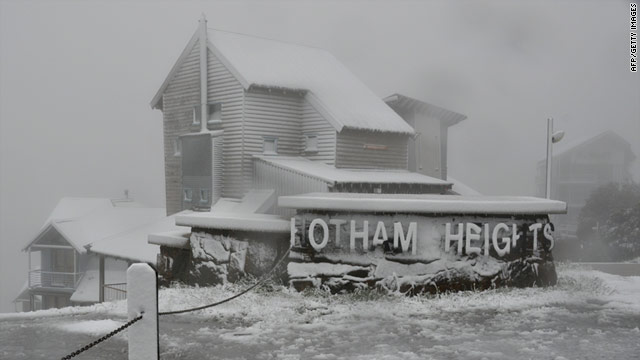
Australia normally experiences temperatures of 86F (30C) at this time of year, but the chances of a rare white Christmas have increased after plunging temperatures and snow swept across the east of the country.
Snow and ice covering building at Mount Hotham as snow fell in Australia Photo: AFP/GETTY
Freezing winds from Antarctica, blown up to Australia by a low-pressure system in the Southern Ocean, gave the country a taste of the conditions that are causing havoc across Europe.
Some 11 inches of snow fell at the ski fields in New South Wales, raising the prospect that parts of the country could experience a white Christmas.
“It’s white, everything is white,” Michelle Lovius, the general manager of the Kosciuszko Chalet Hotel at Charlotte Pass, said.
“First thing this morning everything was just very still, very peaceful and every single thing was just blanketed in a thick cover of white.”
At the ski fields, children in Father Christmas hats, who would usually be sunning themselves on the grassy slopes, made snowballs and rode on sleds.
Miss Lovius said such a large amount of snow was unusual for early December, normally the peak of the wild flower season in the mountainous region.
“We’re hoping that it (the cold) stays in for five days and we get a white Christmas,” she said.
In one part of the state temperatures dropped as low 39.2F (4C), the coldest December morning in 54 years, according to the Weather Channel.
Further south in the state of Victoria, Mt Hotham had four inches of snow and Mt Buller up to two inches.
“It is a blanket of white, which is beautiful at this time of year.
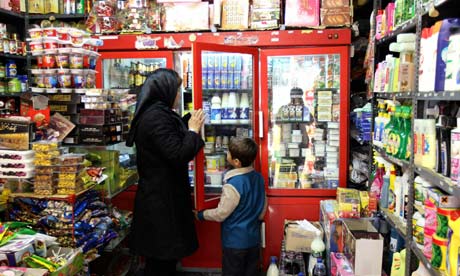
Tehran predicts unrest as ILNA news agency reports price of petrol rising fourfold and electricity almost threefold
An Iranian woman and a boy shop at a grocery store in Tehran. Photograph: Atta Kenare/AFP/Getty Images
Iranians are facing huge increases in fuel and food prices after Tehran began implementing a long-delayed plan to slash subsidies amid political controversy and fears of a fresh wave of popular unrest.
Riot police were deployed on main squares and at petrol stations in the capital and in other big cities as the new price regime came into force today.
Opposition websites reported drivers rushing to fill petrol tanks and long queues at cash machines as Iranians withdrew money paid to poor families to compensate for the subsidy cuts. Ferries at Bandar-Abbas on the Persian Gulf were not operating in protest against the steep rise in petrol prices.
The ILNA news agency said the price of petrol had risen fourfold; gas more than fivefold; and electricity almost threefold. Flour and bread prices are also to go up.
President Mahmoud Ahmadinejad called the reform the “biggest surgery” Iran’s economy had experienced in half a century.
Last month he warned protesters not to exploit the situation, saying they would “regret it for ever”, as the Green opposition movement sought to capitalise on discontent with an economy worsened by the impact of UN sanctions.
The economic plan was due for a September launch but repeated delays were seen as evidence of profound anxiety among the government about the effect.
Subsidies kept the price of flatbread to 1,000 rials (6p) before it rose sharply in recent months. Inflation is officially around 10%, though economists suggest far higher for food and other staples.
By Marian R. Williams, Ph.D.
Jefferson E. Holcomb, Ph.D.
Tomislav V. Kovandzic, Ph.D.
Scott Bullock
Civil forfeiture laws represent one of the most serious assaults on private property rights in the nation today. With civil forfeiture, police and prosecutors can seize your property and use it to fund their budgets—all without charging you with a crime. Americans are supposed to be innocent until proven guilty, but with civil forfeiture, your property is guilty until you prove it innocent—and law enforcement has a huge incentive to police for profit, not justice.
If police suspect that you committed a crime, they can arrest you and put you on trial. At that trial, prosecutors must prove you are guilty beyond a reasonable doubt.
But if police suspect your car was involved in a crime, they can take it, sell it and, in most places, pocket the proceeds to pad their budgets. They need not prove you committed any crime—or even arrest you—to take your property away.
Welcome to the upside-down world of civil asset forfeiture.
With civil forfeiture, your property is guilty until you prove it innocent to get it back.
This website uses cookies to improve your experience. We'll assume you're ok with this, but you can opt-out if you wish.AcceptRejectRead More https://infiniteunknown.net/dsgvo/
Privacy & Cookies Policy
Privacy Overview
This website uses cookies to improve your experience while you navigate through the website. Out of these, the cookies that are categorized as necessary are stored on your browser as they are essential for the working of basic functionalities of the website. We also use third-party cookies that help us analyze and understand how you use this website. These cookies will be stored in your browser only with your consent. You also have the option to opt-out of these cookies. But opting out of some of these cookies may affect your browsing experience.
Necessary cookies are absolutely essential for the website to function properly. This category only includes cookies that ensures basic functionalities and security features of the website. These cookies do not store any personal information.
Any cookies that may not be particularly necessary for the website to function and is used specifically to collect user personal data via analytics, ads, other embedded contents are termed as non-necessary cookies. It is mandatory to procure user consent prior to running these cookies on your website.